Friday, April 1, 2011

Jack of Fables 46-50 "The end"


FROM THE OUTSIDE LOOKING IN

After prolonged delays, this Wednesday brought the last issue of "Jack of Fables", which doubles not only as the finale of the "Fables"' spin-off, but the ending of it's last story arc as well. Writers Willingham and Sturges have spent five years working on solo adventures of Jack of stories, foreshadowing both the long time in planning "Great Fables crossover", as well as laying the seeds for this final storyline, which sees the ending on their satirical take on the character, at least for the moment.

The majority of the run has been illustrated by Tony Akins, a capable cartoonist who gave the title a distinctively manic look, that much better to differentiate it from the main "Fables" esthetic. Where in Marc Buckingham's hands the parent book sports a urban fantasy look, "Jack of Fables" was made to give off a more lurid atmosphere, mirroring the constant pattern of a never ending dirty joke that the writers strived for. Essentially, for all intents and purposes Jack of Fables had it's own tone, which is paramount for a successful spin-off. Even then, it was always a part of the broader Fables setting, even if purposely working in opposition to the more successful title.

A lot of the main Willingham/Sturges themes were resolved during the crossover, which was the first time the book close to matching the sales of the main title, but the writers were determined to continue for one more year of Jack's adventures. The sales swiftly returned to their previous levels, with the usual trend of continual decline, coming to roughly the half of monthly number of "Fables" copies sold in the Direct market (at least judging from the ICV2's estimates, which can be used to somewhat accurately describe the trends in American comic book publishing). At the time of cancellation, this was still a much higher average than that of a lot of Vertigo's ongoing series, but the creators are reportedly content with the decision, having already told all of the stories they wanted to tell with the character.

THE ULTIMATE JACK OF FABLES STORY

In any event, their last story arc serves as the finale to their work on the book, tying up all of the plot threads that weren't directly resolved during the "Great Fables crossover". Willingham and Sturges slyly start off with the spotlight on the three page sisters, and setting up their current agenda. Basically, the feisty librarians are trying to rebuild the Great library by tracking down the specific books they need to reinstate their Literal status. This is more or less typical Jack of Fables storytelling, serving to slowly reintroduce the reader to the status quo. The first sign of something unorthodox comes with the reintroduction of Jack and Gary, whose current predicament is illustrated in the manner of a Sunday page retro comic strip. And while the jokes told using this rigid layout are refreshingly straight forward, the context behind the change in Tony Akins' style is much more interesting.

Namely, there is a sense of a long time having passed between the story arcs which is finally made apparent by switching to Jack Frost's current whereabouts. Namely, that the de facto usurper of the book's previous two arcs is now relegated to a mere subplot should by itself be notable. Furthermore, seeing Akins' redesign of the character, who has transformed from the slender well-meaning fantasy protagonist to a full blown universe wide hero, further cements his companion, talking owl MacDuff's, 's endless prattling of their noble exploits. To put it bluntly, Jack Frost now looks like "Escape from New York"'s Snake Plissken, and his writers finally have him reconnect with the title's previous continuity. By giving the eye patch wearing, hyper muscled veteran one last mission in which he is to confront his father, now a caricature of a fairy tale dragon, Willingham and Struges are at first glance transparent about their motivations.

But it's only when the story continues, by shifting back to (present day?) Earth, and the rest of the supporting cast stuck working in a diner, that the full scope of their plans become revealed. That is, not only are Raven and his troop of runaway Fables also coming to the foot of Jack the dragon's cave, which is predictably where the Page sisters also find themselves going to, but that almost a decade has passed while the writers stubbornly kept the focus on his heroic son. This is no doubt the effect the creative team was going for, as the number of people finding their path leads them to Canadian countryside starts increasing, from every which way they are coming, all unaware of the company of the others.

Willingham and Struges seem to be saying that all of the characters previously encountered by Jack cannot move forward even after all these years of him going into retirement, and are seeking some kind of a resolution by confronting the reclusive anti-hero. The clever twist is that some of the foretold intruders upon Jack's soil never actually show up, but the sheer number of the ones that do more than dwarf them. Most importantly, Jack Frost, himself on the verge of retirement, rushes to meet the hideous dragon, one last act he needs to prove himself a true hero, even though MacDuff serves to remind the reader that his owner has done just this time after time, and across the whole galaxy. This is important on a metafictional level, as following the "Great Fables crossover", the book has basically jettisoned it's original, heavily flawed protagonist, in order to spotlight his estranged son, who as proven himself a hero without peer in the two story arcs preceding this last one.


Willingham and Struges went purposely so over the top with depicting a scenario that was the anti-thesis of their heavily post-modern parody of typical male, that they predict that the original "Jack of Fables" reader has by now found himself missing the original Jack. Horner's sexist power play and selfishness turned him into no less then a literal dragon, lying on the heap of the riches accumulated by tricking the other characters and thinking only of himself, but seeing his perfect son get all the glory since, it makes sense that two would go head to head for the book to return to it's meandering metafictional exploits.

THE WIDER POINT

Only, this confrontation is designed for the precise purpose of ending the book. The controversial choice actually makes sense on some level. "Fables" was always the more optimistic book, designed to find a place for fairy tale characters in the modern day and validate the struggles of fantasy authors trying to marry the two in literature. On the other hand, "Jack of Fables" from the start took to the negative of just this approach, singling out the various twist and turns the original fairy tales have taken in lesser hands, and trying to breathe some life in seemingly empty husks of Alice of Wonderland and Paul Bunyan, driven bland and lifeless after numerous revisions and adaptations. It was the book written by two people who admit that they have read a lot of bad writing in their decades long love of the genre, and are not afraid to call upon it.

By using this basic principle, Willingham and Sturges have created a very strange and obtuse storyline that kept hinting at it's most interesting parts, before being derailed by one or the other of Jack's completely unsympathetic schemes. Still, where it breaks off from "Fables" and establishes it's own take is that the role of characters in fiction still managed to be a central theme. The parent book launched from this premise and proceeded in world building, with the idea of contrasting the comparative fairy tales and making a coherent setting to place the fantasy adventures of lovable characters in. To it's credit, "Jack of Fables" never had such aspirations. It delighted in contradictions, and while being tangentially related to the overall Fables universe, the creative team insisted in telling a very particular story.

It was an exercise in using the least likable Fables character, and turning him into something even more monstrous, a horrible parody of manhood, while leisurely making their wider point. Meanwhile, the plots that were to further all these ideas were increasingly offbeat and manic, a far cry from the tongue in cheek romanticism of the parent book. Yet, that they were serious about their intentions, and that all of these ideas fed into the overall direction of the brand was clear during the "Great Fables crossover", that drew heavily on "Jack of Fables" plot lines.

Still, it's clear that, as imagined, the solo Jack book was never going to find the praise of the broader audience, and frankly, it's mainly on the strength of the franchise's overall popularity that it managed to survive as long as it did in the market notorious for it's resistance to new and experimental work. Willingham and Sturges actually make all of this a story point, stipulating that it was Jack Horner's sheer notoriety that kept the title from winning over new fans.

THE END

Still, by devoting two whole arcs to little more than a standard genre storytelling in order to subvert the expectations found little echo in industry. The joke seemingly fell flat, and thus a regular reader had every right to look forward to bringing back the rest of the supporting cast (along with the former protagonist), in what seemed the return to tackling the more nuanced stories a little more directly. Yet, the elegiac tone emanating from the surprised looks on the familiar faces, now supposedly several years older, preceded the official confirmation of the #50 being the book's conclusion.

Even then, the final storyline was plagued by delays and art assists (by Russ Braun), as well as the ink assists, that resulted in some of the pages sporting a hurried look, but did little to hinder the excitement of the fandom. Namely, the major comic book websites and it's devoted blogosphere took little note of the title's existence, and where likewise neutral to it's passing. Which is not to say that Jack of Fables#50 isn't an extra sized final issue precisely targeting a certain type of comic book fan.

A fantasy story featuring a battle to the death featuring the mythic hero and his dragon counterpart, told (mostly) using splash pages is certainly a call back to Thor #380, the high point of Walt Simonson's famous run on the character. Willingham being a creator debuting his own fantasy inspired superhero series at roughly the same time, "the Elementals" creator was surely aware of his colleague's work, that is still remembered favorably to this day. In lieu of the Simonson constructed poem that served to caption that 1987 Marvel comic, the "Jack of Fables" creative team reply by substituting it with color commentary, as if the final battle between their two competing leads was a football game. Likewise, without any kind of explanation one of the journalists is Jack Horner, as originally designed, who does not shy away from gives his own particular take on the proceedings.

What transpires certainly is certainly interesting, as the creative team envelops to tie up all of the multiple going concerns of their rich supporting cast in a huge one sided fight. The results are certainly amusing, and actually line up with the title's underpinnings. With the cancellation of "Jack of Fables", Willingham and Sturges are aware that all of their many problematic side Fables have no place to reside in, and once again directly refer to it in the story. This is done by having Raven, Jack Horner's Indian guide and protector, bring the assortment of escapees from the first story arc's Golden Boughs retirement village to Canada, on pretense of leading them to Fabletown. That none of these many quirky characters with impossibly complicated back story (particularly in relation to the their "Jack of Fables" adventures) seem destined to rejoin the main title seems an afterthought.

Thus the writers happily give them all, for their fate to be sealed, as much as any of the Fables can be effectively written off, at the hands of Tony Akins' wonderfully inventive full page showdowns. That the reader is meant to be caught in the unfairness of all of this is par for the course, but as always with this title, the initial shock is quickly replaced by the sense of elation, as Willingham and Sturges continually insist that these are all fictional characters designed to first and foremost to entertain. And considering "Jack of Fables"' trade record, that usually comes out as a deeply ironic black comedy, best illustrated by the revelation of the fate of tortoise that tried to escape Golden Boughs.

The final scenes show the eventual fate of Jack Horner. This is done by brining up a loose end from early on in the series, that nevertheless echoes a popular "Hellblazer" storyline, which might come at the expense of punchline, considering the potential overlap of the Vertigo imprint's audience. In any event, as the cover promises, the long time misadventures of Jack of stories come full circle, only with the character undergoing an obvious change in the process. Whether this means that following his solo outing Jack will still somehow be reintegrated back into the "Fables" main cast is still to be seen. Story wise, what is promised by creators (albeit in the back matter following the story, and not in any kind of formal epilogue) is that the baby introduced in the beginning of "The end", as well as presumably it's father, were slated to reappear in the Fables universe sometime down the line.

FABLES FUTURE FORETOLD
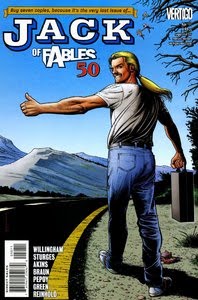
Once again, this ties into the speculation regarding the upcoming "Fables" plot lines. As for the overall strength of the brand, it is important to note that Vertigo is currently publishing the second "Cinderella" mini-series, written by Chris Roberson who penned the canceled title's solo fill-in issue in "Jack of Fables"#35. This not only indicates that DC's imprint is content in producing the material outside of the Fables' creator Bill Willingham's direct involvement, but more importantly, that they might as yet delay in authorizing another ongoing spin-off. This seems to mirror the decision to capitalize on the imprint's other current success, "American vampire", by likewise producing only a related mini-series.

In many ways, such caution is warranted, as the Direct market certainly doesn't seem to be receptive of the new ongoing commitments, even when tied to a more successful existing franchise, which mirrored Willingham and Sturges' experiences in writing the "JSA" and it's "JSA: All stars" spin-off respectively in the main DC Universe. And while the February cancellation of "JSA: All stars" seemingly has little to do with the Sturges co-written "Jack of Fables", it speaks to the same argument - whatever new projects the company plans around it's popular franchises should follow only after a serious rethinking at the company's part. That "Jack of Fables" was as ambitious as it was, and as long lasting, still doesn't guarantee that the potential "Cinderella" ongoing series would have a better chance of winning over the typical "Fables" reader.

At a time when existing comic book readers are already overtaxed with buying too many titles due to sheer loyalty or overblown hype, perhaps the best approach would be to continue with the mini-series until the company is sure exactly what kind of spin-off the majority of their readers are interested in,

Tuesday, February 15, 2011

John Byrne's Iron Man (#257-277)


In 1990, while still at the peak of his greatest commercial success, John ("X-Men", "Superman: Man of steel") Byrne decided to revamp Iron Man with John ("Uncanny X-Men", "Daredevil") Romita Jr. Positioned in a very particular moment of their careers, the "Invincible Iron Man" collaboration resulted in the publication of the ambitiously titled "Armor wars 2" nine-part storyline, following which Byrne continued on as a writer for nearly a year, with the bulk of his scripts illustrated by Paul ("Squadron Supreme") Ryan.

Historically, these Byrne written issues follow on the heels of the highly regarded David Micheline and Bob Layton character defining collaboration. As such, and as was the editorial mandate of the day, the new creative team tried their best to frame their take around the soap operatic effects that preceded them. And while the unnecessary complicated plot line of the public believing original Iron Man dead and replaced with a new, also unknown pilot gets formally acknowledged, Byrne successfully managed to tie his creative overhaul to a part then current status quo.

ARMOR WARS 2

This meant directly referencing Iron Man's recent spinal injury, as a way of setting up his current predicament. All the while, the "Armor wars 2" subtitle worked only as a cheap gimmick - nothing in the story had to do with any kind of follow up to the Micheline/Layton epic about Tony Stark getting back at the villains who appropriated his technology in their weapons. Byrne's broader idea was simply to get Iron Man into the state where the writer he could be at his most archetypal, while still telling a typical Iron Man story in the process.

In effect, the long set up for the forthcoming Mandarin story feels a bit arbitrary at first, given how disconnected the two plots are. Still, it definitely works when the run is taken as a whole, and the parallels to both Stark and his opponent's predicament, heavy handed though they are, speak of a larger plan that was there from the outset.

Design-wise, Romita jr.'s second run on "Invincible Iron Man" succeeds to once again, set up the entirety of Byrne's vision. James Rhodes sports a convincing African American physiognomy (if burdened by the then-current fashions), which is something that some of the previous artists have at times struggled with, the result of which made Rhodey appear as a "blackface" character. Moreover, Romita jr.'s Mandarin sports a very noble look and dignified outfit that is miles away from the misleading, racial caricature look he debuted with, and much more practical than seemingly any of the many clunky armors he was presented wearing previously.

That said, Byrne really opts to utilize most of the artist's abilities as a penciller of action based comics, with panel after panel of Iron Man tearing up bulky equipment and hurling it into his opponents, seemingly slowing down only to focus on the conversations between Stark and his best friend and employee. As such, "Armor wars 2" starts of as a seemingly typical Iron Man tale, teasing at the mystery of the reason behind Titanium man's return, while hinting at the identity of the true villain behind it (a little game that extends to the title of the issue itself). Still, the larger plot is quickly to intrude, as Byrne quickly reveals that his intention isn't in revitalizing the assortment of Iron Man's rogues gallery. As is apparent in the scenes constantly intercutting "Armor wars 2", the writer is very clear as to his decision to first and foremost restructure Stark's nemesis Mandarin into the threat he is supposed to be.

Similarly, the corporate takeover angle that comes to dominate the opening arc's plot line doesn't extend beyond Romita jr.'s departure. It seems like Byrne purposely decided to start his run of with the familiar elements of an Iron Man story, while slowly preparing the reader for the more ambitious Mandarin story. To achieve this slight of hand, John Byrne uses the Marss corporation, the antagonist in "Namor, the Sub-Mariner", his other Marvel ongoing series at the time. The sprawling, nine part saga interestingly features a clear antagonist in the guise of scientist Kearson DeWitt, who continually references a grudge with Iron Man that is never really revealed in the pages of Byrne's run. Suffice it to say, that despite this dangling plot line, Byrne and Romita jr. manage to bring "Armor wars 2" to a satisfying, action packed conclusion.

Simply put, there feels like there's a lot at stake for the title character's industrialist complex, that experiences even a worker's strike during the proceedings. This is done not only in the complicated ways Tony Stark engineers to avoid the Marss company's hostile influence over his life, but in the very scale of the fighting. The creators achieve a palpable level of danger to Iron Man's health and sanity without resorting to the familiar scenes of his armor slowly shutting off due to the energy discharged during the fight.

Unfortunately, despite Byrne's lofty plans for reshaping the character and the core of his mythos, the kind of consistent and entertaining storytelling evidenced in "Armor wars 2" is not really achieved later on in his run, except for late in the "Dragon seed" saga. With Romita jr. leaving to work on the "Cable" mini-series, honing his style to it's current look, a lot of energy seemingly leaves the pages of "Invincible Iron Man". Of course, Byrne continues his stated mission, to rehabilitate Stan Lee and Don Heck's early Marvel character for the 1990s, but for a while the focus seems squarely on the internal side of the development. Leaving the corporate angle for his Namor work, with precisely one scene showing Stark discussing the future prospects of the company ravaged by the assaults and crippled by the protest of the employees. And even then, it's to stave off the problem while focusing on his own personal problems.

This is not to say that John Byrne's version of the character is the typical scoundrel he is sometimes presented as, far from it. Stark is simply shown to be in mortal peril, with a continuing dire threat against his personal health, and even while attempting to survive, he proceeds to provide help on a truly heroic scale. From the opening issue in which he dismantles a nuclear reactor, to the closing ones in which he helps prevent the WW3 salvo of missiles, he is squarely a heroic figure. There is next to nothing of his playboy nature on display, which presents the character in a truly mature light. He repeatedly renounces his previous lifestyle, openly declaring himself as a former alcoholic, but one that has put behind him his dandy-like ways, to focus on the more pressing problems. And truthfully, despite the short assistance of West Coast Avengers at one point in "Armor wars 2", most of the threats that he combats seem far beyond his league.

Particularly, what becomes the main thrust of the book's run, Mandarin's rise to power in China, and the consequences of his alliance with the mentor-like figure of Chen Hsu results in a conflict that seems at least on the level of threats the Avengers try to put a stop to, if not possibly even a basis of a crossover encompassing all of Marvel universe. But Byrne knew better then to dilute his vision of the character in such ways.

As designed by Lee and Heck, Iron Man is a superhero, first and foremost, and as such should be capable of dealing with any threat with the help of his supporting cast. In this iteration, Iron Man chiefly interacts with Rhodey, who is somewhat surprisingly left without any real goals beyond helping Tony as best as he can. But this should come as no surprise, considering how focused Byrne gets, once past "Armor wars 2".

ORIGIN RETOLD

Namely, the writer promptly retells Iron Man's origin in a two-part story framed by the continuing plot involving his health problems. The familiar events are depicted without a direct reference to the Vietnam war, instead taking place in the South-East Asia, where a Stark compound is having trouble in the politically unstable part of the country. Without overt reference to any kind of war, Iron Man's subsequent captivity is handled as a part of an attack by the local crime lord. Wong-Chu's actions are retold as petty and short-sighted, with Byrne revealing that the real megalomaniac behind the capture of professor Yinsen and Tony Stark is the Mandarin, who has kept to the shadows the whole time.

And while certainly nothing in Iron Man's debut contradicts what Paul Ryan is given to pencil, the retcon seems forceful and makes for somewhat of a stilted story. Likewise, Ryan's clear layouts, and competent superhero art seems somewhat perfunctory after Romita jr's pages, that bursted with dynamicism and stylized figures. It is certainly clear that the editorial believes in Byrne's vision enough that they deemed to provide him with a capable artist, but it still makes for a somewhat drab mid section of the run. And while Wong-Chu certainly isn't a villain remembered for anything beyond being the catalyst of Stark's creation of the Iron Man armor, there was no reason to burden the relatively simple coming of age story by additional Mandarin scenes, just to drive home the point that the two were adversaries from the start (especially considering that Mandarin himself is a very early Iron Man villain).

But, nevertheless, Byrne continues on with his story by sending Stark and Rhodey to China, basically beginning the "Dragon seed" saga at least two issues before the official designation. Interestingly, dealing with Iron Man's beginnings has brought the writer to revisiting the character's stance against communism. And while coming to China, Stark certainly displays a paranoid and superior attitude to the conflicting ideology, Byrne doesn't go completely overboard in his attack at the communist state. Certainly his opinion is negative, and he has Stark being fairly open about the government's policies as it pertains to the common men, but he avoids the one sided paranoia of the Marvel Silver age.


To the contrary, Stark strikes a deal with the Chinese government, one that would help him solve his medical problems, if he decided to help with the threat Mandarin poses. As part of the continuing soap opera, Byrne has opted to have "Armor wars 2"'s effects on the protagonists cause him severe complications. It would be easy to point out to the change of editors mid-run as the writer's soon departure from the title as the reason for leaving behind a major story thread unresolved. But, considering the guiding principle that seemingly inspired him, it would probably be a mistake to blame him leaving Tony in such a dire predicament a genre tradition, with the writer openly inviting the new creative team to resolve plot line as they bet see fit, in the continuing saga of the lead character's adventures.

But on a closer examination, there is every reason to believe that Byrne wanted to restore Tony's fragile health and dependency on the armor from his earliest Silver age days. Conversantly, once the writer's did away with his alcohol dependency, it seemed the wisest to restore the grounded aspect of the character by returning to the original set-up. Thus, Stark, a man depending on increasingly complicated ways of using his technology to save his life and protect thousands of others, once again returns to his status as a conflicted Silver Age Marvel character. But Byrne certainly acknowledges the passage of time in his run, by giving Tony a love interest in dr Su Yin, a Chinese scientist, working on his recovery.

Unfortunately, due to the plot-heavy nature of the main four parts of the "Dragon seed" saga, Stark's attempt to seduce her, and his following emotional outbursts seem contrived. The whole ordeal seems slightly out of character for Marvel's womanizing hero, who despite his stated maturity seems slightly out of touch in these scenes. Perhaps Byrne was simply realistic, knowing how hard it is to depict a relationship that feels true in a superhero comic, that is inherently tied into it's protagonist being continually driven away from everything else to continually risk his life against the endless barrage of super villains.

THE DRAGON SEED SAGA

In any event, when approaching the title, the writer was aware how hard it would be to implant any kind of major change in the protagonist, given the popularity of the runs that came before him, as well as the nearly three decades of publishing that has pretty accurately defined the characters for whole generations of readers. Thus, he focused most of his energy on Mandarin, whose character arc is much clearer and precise. Byrne correctly poises that the over the top villain has been somewhat overshadowed by the corporate opponents his predecessors have introduced to the series.

Reestablishing Mandarin, as if he was created at the beginning of the 1990s was a much more difficult predicament than the relatively minor tweak he's given the protagonist, and not only because of the difference in popularity. Perhaps more than any other arch villain, Mandarin is fierce racial caricature, saddled with a megalomaniac ambition that was not so glaring in the comics publishing on the 1960s, but has had to be severely retooled since. Byrne approaches the idea as literally featuring Mandarin as a crime boss of a syndicate fallen on hard times. In the opening of "Armor wars 2", the villain discovers that one of his underlings has actually succeeded in replacing one of his rings of power with a simple copy, and that prompts him to start his long journey towards finally living up to his goals.

As if approaching a hero of the piece, the writer accomplishes this by pairing him with a mentor, who is himself at first seemingly another stereotypical Asian. This time though, the stereotype is intended to hide Chen Hsu's true nature, as the wizened old shop keeper begins training Man's nemesis. The sorcerer forces Mandarin to accept that his previous defeats lie in his brash and impulsive ways, and starts helping him find focus, before revealing his plans for the would-be ruler of China.

Here John Byrne and John Romita jr. reveal their decision to cast Tony's arch rival as Stark's complete opposite, by focusing on the mysticism behind his origins. The decision is further elaborated by bringing in another early Lee/Kirby creation, that of the giant dragon Fin Fang Foom. And while all this set-up preceding Stark's arrival in what feels like something resembling then-contemporary China certainly feels strange and oft putting, the creators treat it with out-most seriousness. It's hard to really be offended by their depiction of the Valley of the Dragons, from which Mandarin starts his conquest of 1/3 of China, in that it is so clearly divorced of the reality, that the reader is forced to simply accept it, as just another of the fictional locations in the Marvel universe.

With the initial attack perpetrated by the now fully trained Mandarin over, the subplot connects back to Tony Stark with the starts of his negotiations with the Chinese government. Interestingly, even then, Byrne decides to put off the direct conflict between the two adversaries until establishing the complete scope of "Dragon seed". This is accomplished by having Jimmy Rhodes take Tony's place as Iron Man, while his employer stays in Beijing to contemplate his health and his chances with Su Yin.

Once again, Byrne lapses into exposition, as he finally retells Mandarin's origin, by tying it into the wider "Dragon seed" saga. The descendant of Genghis Khan's accidental discovery of the alien space ship still feels very contrived, but the writer doesn't concern himself with it, opting to spotlight the role of the mysterious race whose weapons he has appropriated. This is where the reader's suspense of belief is stretched to the limit of what constitutes an Iron Man story, given that Byrne decides to tie in the Jack Kirby designed giant monster Foom into the back story of the space aliens, with a direct link to the sorcerer Chen Hsu.

In a way, the story works because it keeps developing Mandarin's character by revealing that he still doesn't use the full extent of his weapons, which was retconned into Iron Man's origin in the previous storyline. But the very nature of the threat in the "Dragon seed" saga still feels very over the top and out of touch with Iron Man. By opting for an archetypal approach that is a complete opposite from Dennis O'Neill's run on the character, Byrne almost loses sight of his own mandate, before bringing in Tony Stark for the final showdown in #275. It is largely thanks to the success of the dramatic finale that the storyline, and the arc as a whole succeed, but even then, it's easy to see why Byrne's efforts didn't resonate as the work his predecessors did.

The epic (almost fantasy) feeling of "the Dragon seed" is likewise undermined by the efforts of Paul Ryan, that even at his best simply doesn't match the energy Romita jr. has imbued these characters with as he was redesigning them for "Armor wars 2". The scenes of Fin Fang Foom and his cohorts bringing down mountains around Tony, Rhodey and Mandarin all present clear storytelling and strong layouts, but serve to largely focus the reader on the character, and not the stylistic merits achieved during the composition of the pages themselves. For what it's worth, Byrne provides a powerful moment when Tony finally meets up with Mandarin, who having achieved full power due to Hsu's manipulations opts for the only real choice in the resulting crisis.

This is where the real strength of John Byrne's work on the series shines - he has succeeded in transforming the stereotypical villain into a three dimensional character that actually feels responsible for the events that erupted in the Valley of dragons. For one brief moment, Mandarin seems almost an anti-hero, which is perhaps the peak of morality in a typical superhero comic. But tragically, Byrne chooses this same moment to unleash the explosion that actually resolves the plot in a very organi and constructive way. The aftermath sees Stark return to America, but the journey has made an effect on him that once again has nothing directly to do with Mandarin, as seen in the Tony DeZuniga drawn back-up. The short piece is melodramatic but the artist manages to get across at least some of the subtlety in Tony and Su Yin's feelings.

But compared to Tony, it's once again Mandarin that manages to appear more convincing in his own epilogue. Seeing the ultimate price paid in the events for his attempt to rule China, as well as balancing his cruelty with temper leaves the honorable antagonist utterly devastated by his ally's betrayal, both physically and mentally. After such a powerful conclusion, it's hard to accept Tony's unresolved health problems as a long term problem. Departing the series, Byrne was certain to leave the new creative team an Iron Man that can still use his armor, no matter the doctor's predicaments. It's just that the very core of the character is tied into the idea of a man surviving by building an armor to protect himself and then the others. The fact that the other writers stretched the metaphor of Stark bettering himself while continually adapting his armor doesn't change the fact that developing an addiction to alcohol is just as severe a health problem as Tony's original heart defect.

OKTOBER PROJECT

And yet even though his story was by and large told, John Byrne had two more issues with Paul Ryan to complete his run. Interspersed throughout the "Dragon seed" saga, and a couple of issues preceding it were short vignettes featuring Black Widow as she suddenly remembers the threat of a secret KGB project, and the way she goes about contacting her colleagues in the spy community and the new Russian government about what she knows about the ominous Oktober project. Eventually, she decides to approach the Avengers, before finally deciding on Tony Stark being the one to contact considering the possibility of WW3 that could result out of their inability to stop the former KGB's protocols.

In what is mostly an action story, Stark proceeds to once again retell the history of his current health affliction, while the Widow wisely chooses her words. Byrne's portrayal of Natasha as a fierce and independent woman is very convincing, and is largely in line with Ryan's depiction of the Avenger as a physically fit, attractive woman, without much in the way of the usual superhero excesses when it comes to the female form. And while Widow's then-current costume seems a bit generic, it also reinforces the concept of Natasha as a somewhat more realistic character compared to Marvel's typical stars.

In any event, for a character that debuted in the pages of "Iron Man" (back when he was a "Tales of suspense" headliner), to so successfully take over two whole issues of Tony Stark title feels a bit unusual, particularly considering the circumstances. And while Byrne has certainly set up her return to the title in the preceding episodes, Iron Man's role in the Oktober conflict steel feels arbitrary. The closing pages indicate that the story was perhaps cut short, but Byrne still manages to give Tony a lot of space to shine as the hero, once past the contrived way in which the Oktober project is actually set in motion. All in all, a decent two issues featuring Stark that despite his medical problems still manages no less than to save the world, somewhat echoing his actions in Byrne's opener. And following the extensive work he did to bring back the character to his origins, one could say that John Byrne simply used these two issues to spotlight a solid superhero tale that could be done with the current set-up following his run on the title.

Wednesday, February 2, 2011

Blueberry 7 the Iron horse

In early 1970, French premiere comics magazine "Pilote" saw the beginning of the serialization of "the Iron horse", Jean Giraud and Jean Michel Charlier's seventh Blueberry adventure. By this time, the creative duo was so productive that they were basically producing two complete 48 page albums a year, which also impacted the storyline in a major way. Following a brief interlude after the epic Fort Navajo saga, the creative team had decided that their new multiple volume saga should center around railroad.

Following Civil War, two different train companies competed with the idea of building a transcontinental track in the land that was still settled claimed by Indians, which certainly makes for a broad Western concept the likes of which Giraud and Charlier tackled in Fort Navajo. In fact, it's remarkable how much their new 4 volume railroad adventure draws from the story that introduced Blueberry. General Dodge sends for Mike's presence precisely because of his role in the negotiations with Indians, but what follows is remarkably similar to his previous experience. The Natives are once again lied to and manipulated in order to serve a third party interest, and it's Blueberry who gets stuck in the middle.

Where the two epics largely differ is abundantly clear in "the Iron horse", and that's the experience of the creators. With Fort Navajo, Charlier and Giraud were new to the story, working as if from a broad outline that still allowed for a lot of major changes along the way. Their next Blueberry epic feels much more tightly plotted, with creators knowing fully well that they intend to produce four complete albums in the space of two years. Thus, the first part feels much more expository and slow pace, with the authors knowing fully well that they already have an audience that will follow their tale to the end.

In this way, they introduce a completely new supporting cast, consisting of Blueberry's superiors in Union Pacific, as well as their employees, courier Red Neck, and free agent Jethro Steelfingers. Red Neck, a gaunt, quiet man would stick around long after the whole saga, and become Blueberry's other permanent sidekick, contrasting Jimmy McClure's buffoonery with a more sober point of view. In any event, he follows McClure's path of going to Fort Navajo to request Blueberry's assistance, with creators once again using the scene for comedic effect. Once again, Giraud and Charlier stay away from becoming self-referential and basically use these scenes to provide the reader with a knowledge of just what kind of a man Blueberry is, and proceed to follow through with the plot.

Similarly to the original Fort Navajo album, the first half of the story features an extended scene of massacre, designed to provoke the reader's emotions and set out the stakes involved in someone's grand plan. This time it's a herd of stampeding buffalo, who are first presented as a threat, almost a natural disaster, that the heroes must overcome, before they are made witness of the first signs telling that the tragedy was engineered by outside forces. Interestingly, Red Neck is presented as a veteran cowboy, who repeatedly offers sound advice amid as the hostilities with Indians start becoming a reality, but mostly gets ignored by the atypically rash and impulsive Blueberry.

As soon as he arrives to the Union Pacific's camp, Blueberry established a feud with Jethro Steelfingers, which he wants to settle immediately, without any kind of plan. The protagonist's hurried actions seem somewhat mirrored by a plot that devotes too short a time to Blueberry's introduction with his superiors and the beginning of his mission as a negotiator. Before he can even start in the official capacity, the rival Central Pacific forces are already plotting against him, which he makes disturbingly easy due to his single-minded obsession with defeating Steelfingers.

The duel finally takes place during a long scene set in a typical western saloon, where Blueberry confronts Jethro with the aid of Jimmy McClure, who has since been shoehorned into story in a slightly contrived way. Despite it's length, the showdown works to build tension, present a nicely paced standoff between key players, and ends with literally tearing the building down, as the two rivals proceed to settle their differences with their fists. Steelfingers is an interesting foil for Blueberry, in that he is completely different from Fort Navajo's Lone Eagle. And while he certainly possess a rude cunning, Jethro is defined mostly by his strength, which exhibits in his using the prosthetic arm as if possessing superhuman powers. Seeing Steelfingers using what is illustrated almost like a karate chop, seems slightly out of place in the heavily labored semi-realistic atmosphere of Giraud and Charlier's Wild West, but it's nonetheless effective.

The scenes that follow depicting the train ride he's been forced on, present the villain in all of his ruthlessness and further cement his presence as a serious obstacle to Blueberry's plans. Unfortunately, with the saloon scene taking up most of the scenes in the Union Pacific camp, there is no space to set up the mystery of the CU saboteurs. The creators thus opt to reveal their identity from the start, which is likely for the best, considering the story's range far surpasses that of a static guessing game between a myriad new supporting characters. In any event, those that are introduced in "the Iron horse" are all notably more realistic in their outlook than Blueberry, who continually seems out of his element, which makes up for a lot of his bewildered behavior in this album.

As the last segment of the first episode starts unraveling, it becomes apparent that Charlier has tailored the plot to peak with the race between the new lethal enemies. Whether Blueberry will get a chance to finish his negotiations with the leaders of Sioux and Cheyenne tribes depends entirely on Steelfingers' ability to get to the meeting place and set the ambush in time to present the threat to Mike's agenda. The set piece involving the valley is large and complicated, but Giraud's layouts never fail to clearly portray the distance between each of Blueberry's allies, and their part in securing the area. The arrival of Steelfingers' men and the reaction of each side of the conflict is depicted so clearly that the reader can ease up and follow the rapid succession of shots with just enough dread and excitement that the creative team expected them to experience.

Once again, Giraud and Charlier finish on a high note, providing a fast paced train sequence that leaves little time for the characters to reminiscence on the gravity of the events set in motion. And although they avoided ending on a cliffhanger, the creators were content to count on their readers to simply continue reading the Blueberry segment of "Pilote". On it's own, "the Iron horse" feels adequate but still fundamentally incomplete, seeing how most of it's plots continue directly in what was eventually published in album form as "Steelfingers". And while perhaps not as ground breaking as Fort Navajo, the saga of building the continental railroad is by all means a formidable Western comic book, featuring the work of storytellers whose best ideas were still some years away, to be released when they finally stopped thinking in such rigid terms as the story cycles limited to four or five albums united with a clearly defined common theme.

Wednesday, January 26, 2011

Blueberry 6 - the Man with the silver star


In 1969, Charlier and Giraud finished serializing their original Fort Navajo saga in the "Pilote" magazine, featuring the break out character Blueberry. In the same year, the creative team have decided to follow it up, and proceeded with offering "the Man with the silver star", a decidedly more relaxed take on the Wild West story tropes. And after the epic that was Fort Navajo, it's certainly easy to understand why the creators felt the need to slow down and focus on character development, before deciding how to proceed with the series. In retrospect, "the Man with a silver star" turned out to be unique, in that it's the only album that truly stands alone without ties to any of the subsequent volumes.

That said, however slight it may appear, the sixth album in the series is certainly not without it's charms. First off, the creators don't hide their intent to homage "High noon", going so far as to feature a sheriff modeled on Gary Cooper in the opening segment. In presenting a more realistic version of the events that form the basis of the cinematic classic, Giraud and Charlier achieve a pleasant comedic effect, that doubles as providing the set up of the album. Interestingly, "the Man with the silver star" could easily be passed off as a McClure spin-off, seeing as how is both the catalyst for the story, with a character arc that only feels subdued due to Blueberry's presence. Admittedly, the old miner's story veers heavily in the direction of making him a two-dimensional character, by once again highlighting his weakness for strong spirits, but thankfully by giving it so much prominence, Charlier does manage to make it a plot point.

Thus, just as the reader is eased up in writing off Jimmy as the comedic sidekick defined by his relationship with Blueberry, the writer uses a last minute twist to reveal his intentions for the McClure. It's important to note that this kind of character growth is achieved by misdirection, amid a myriad of expertly shuffled subplots. Nominally, most of the album deals with the people of Silver Creek being terrorized by a nearby gang, and willing to enlist a military officer to restore order to the town. Taken on it's own, it's a cliched story, but the creators still find a way to derive a lot entertainment from the scenario. And while a lot of the album carries an irreverent tone, the creators do manage to provide the appropriate suspension when the scene calls for it.

When it comes to Blueberry, the reader is reintroduced to the character wholesale, with little to no mention of the Apache Wars, basically reverting to his previously established personality of a skilled soldier who has little regard for military discipline. In any event, his leaving for Silver Creek city is played as a gag, as just the first of the many obstacles he and McClure must confront to restore order to the terrorized settlement. Perhaps most interestingly, beyond the typical roles of scared townsfolk and their malevolent oppressors, Charlier and Giraud devote a lot of space to setting up a clear victim of the present situation, in Miss Marsh, the grade school teacher. Just like exploration of far reaching consequences of the racism factored heavily into the set up for the Fort Navajo storyline,so does the division of gender roles inform a major theme in "the Man with the silver star".

Unfortunately, following a fitting ending to her storyline in this album, Miss Marsh was neglected by the creative team following this album. This is unfortunate, considering that she is likely the series' highest profile female character following Chihuahua Pearl. In any event, her relationship with Blueberry shows us Donovan still at his shiest, which is in line with how he behaved with miss Daisy in Fort Navajo. Looking past his relationship with Miss Marsh, the reader can recognize the same infallible anti-hero that Mike has been prior to his association with Jimmy McClure.

Blueberry is once again a charming rogue, with Giraud illustrating panel after panel of people's wide eyed reaction to Donovan's quick wit and ingenious solutions. Once again a master strategist, the protagonist's plan goes awry only due to his helper's incompetence, which is thankfully somewhat reversed by the end of the album when two of his cohorts find a way to be of direct assistance. In any way, despite the nature of the trope-filled story that is little more than Charlier and Giraud's tongue in cheek "High noon" homage, the creators show remarkable skill in producing a very readable diversion.

Despite the nature of the conflict, most of the story is relatively slow paced and believable, with the bandits particularly sporting a very realistic outlook. "The man with the silver star" certainly won't be the volume anyone associates with the most memorable moments in the saga of Mike Steve Donovan, but even as a typical genre piece it remains a strong and adequately put together story, that is certainly much easier to sample than each of the multi-album epics that were published around it.

Sunday, January 16, 2011

Fort Navajo: the Trail of Navajos

With the beginning of 1969, Jean Giraud and Jean Michel Charlier set out to complete their Fort Navajo cycle of stories in the pages of Belgium's "Pilote" magazine. Each of the five albums dealt with the fictionalized version of the Apache wars conflict, but the initial outline didn't factor in the popularity of the lieutenant Blueberry character. Thus, the middle parts of the Fort Navajo circle became somewhat less epic, and more focused on the characters. Yet, even though it was apparent that Blueberry would soon continue his adventures in the broader Wild West setting, it was unavoidable that his involvement with the Fort Navajo mission be much more plot driven.

Thus, the book begins with the Indian council, focusing on the state of affairs between Cochise and his Mexican benefactors. And even though Blueberry, accompanied by Jimmy McClure sticks close to the initial brokering of the terms of the negotiations, it's another of his Fort Navajo friends that unofficially establishes contact with the Indians. The entirety of the first third of the book, largely follows Mike's fellow lieutenant as he tries to prepare the War council for Blueberry's approach, promising to end the hostilities by carrying out the presidential message.

The slow paced, tense and serious storytelling is a welcome break from the burlesque portrayal of the Native Americans in the previous volume, and a clear statement from the creators that they have gone a bit too far with the "Lucky Luke" flavored antics in the "Mission to Mexico". Once again, Lone Eagle's presence provides for the drama in what started as largely static opening, leading to an impressive chase with some very real consequences for Blueberry's friend. Once again, despite the lethal nature of the gun fights, Giraud renders them skillfully and without much gore. The relatively long chase feels energetic the whole time, masterfully coreographed, and ends at a cliffhanger. With the reader unaware of the exact outcome of the encounter, the creators maintain tension throughout Blueberry's subsequent late arrival at the scene, that in turn sets up the events to come.

With Blueberry now harboring a personal grudge against Lone Eagle, propelling him to come up with the new plan, the creators enable this volume to stand on it's own, as it requires no previous knowledge to understand, and more importantly, connect with the events and the characters involved. In plot terms, this means that in order to make sure the negotiations with Cochise lead toward piece for both sides, Blueberry must find a way to cut off the supply of guns and ammo promised by general Armendariz. In the terms of Apache wars, this meant once again substituting the work of the United States Army and it's intelligence for a Wild West pulp plot starring a single soldier. By now, the reader has had to accept the terms of the creative license which lead to Blueberry being assigned an important role in all the key events of the conflict. In "the Trail of Navajos", Charlier and Giraud are very clear as to their intentions - while they are certainly inspired by the Bascom affair, the goal was to still present the reader with a genre comic that is easily understood by the audience uninitiated with the historical facts.

This is achieved by giving Blueberry and McClure a clear goal, sabotaging the Mexican mine, and by treating the bulk of the album as the heist story. The bulk of these scenes show just how much Giraud's art has advanced in the span of these five albums. The craggy hills, and the barren plains underneath them are rendered with such detail and efficiency that they transport the reader into Wild West, as rendered by the authors. There's hardly a trace of the somewhat stiff poses that characterized Giraud's initial work on the Blueberry saga, with the presentation being wholesome and breathtaking. The art is not only painstakingly detailed, but at the same time unmistakably personal, with the artist rendering both the figure work and the backgrounds as part of the same style.

The fact that a lot of the scenes in the middle of "the Trail of Navajos" take place in open spaces, at night, unfortunately does work to hide some of the richness of Giraud's texture. The murky blues and grays don't really add up to the cumulative effect a drawing designed purposely to be left in black and white sometimes has, when rendered by masters of the form. Giraud was seemingly unaware of the color separations that his publisher would decide upon, ending up with a series of scenes that, while not really making the storytelling unclear, still detract from the layouts.

Charlier on the other hand, doesn't really bother with establishing the Mexicans as the threat, and basically has Blueberry and McClure solve the problem by in their usual roundabout way. This means establishing contact with the Jay Hawker deserters, who enter into the agreement in order to provide diversion to the protagonists' plan, which is how creators thankfully restore at least some semblance of reality to the proceedings. For all his cowardice and buffoonery, Jimmy McClure actually continues to prove useful to young Blueberry, and indeed it is through one of his contacts that Donovan is able to think up a strategy for avoiding the Mexican defenses.

In a very critical moment, McClure provides vital help to the lieutenant, sealing their friendship and proving that the creators have successfully managed to create another character versatile enough to outlast the Apache wars inspired saga. As for the trickery employed in getting to the shipment of arms meant for Indians, and the inspired bouts of heroism perpetrated by the pair in the process, they make for some intriguing, if somewhat familiar action scenes. What stands out is a carefully executed sequence showing the sabotagers climbing the mountain. And while the characters are poised to overcome a nominally simple problem, it is hard to imagine any other artist rendering the predicament as clearly as Giraud. Expertly laying out the pages, he makes the whole scene clear, from the characters coming upon the unexpected situation through to dealing with it.

Unfortunately, most of the following drama feels mechanical, despite the hurried actions of the characters, and the explosions that directly threaten their life at various points. It's by all accounts serviceable genre storytelling, but somewhat weightless past the aforementioned moment between McClure and Blueberry. Using another page to wrap up the Jay Hawkers part of the plot brings the book to the finale of the whole saga. And it's clear that all of the Fort Navajo saga couldn't wraps up satisfactory in following four short pages. Instead, Charlier and Giraud devote their efforts to end the album on the strong note, without any kind of formal epilogue. Reading the albums in sequence, it surprises that even if the creators decided they would not be providing a broader sweep of the aftermath of their dramatization of the Apache wars, then they could have certainly devoted a couple of pages to provide some closure regarding Blueberry's friends at Fort Bowie.

But nonetheless, what Charlier and Giraud offer works as the ending of what was primarily a Wild West genre approximation of the real world events. By boiling down all of the conflict to a tomahawk fight between Blueberry and Lone Eagle, the creators are at least sincere towards where their intentions lay all along. And though it may feel like somewhat of an anticlimatic finale to a sprawling epic adventure, one should keep in mind that it was a representation of the military conflict that every step of the way scaled back to allow for smaller moments of stealth and trickery, and never really focused on larger army battles that took place in the early 1860s. Fort Navajo was all about Blueberry substituting for a complex military machinery and endless historical personas that contributed to the resolution of the conflict, and as such it's only fitting that in the process he developed beyond the archetypal gruff but honorable soldier.

It is this promise of moral complexity and charm that's lead the audience to react so strongly to Donovan, as designed by Charlier and Giraud, enabling them to continue exploring the Wild West lore using the same point of view character and the stylish feeling they've started establishing. And considering the quality of the work, and their constant effort to perfect the storytelling, the best and most iconic of Blueberry's adventures were still to come, propelling both to international fame and their collaboration into an European sequential classic.

Wednesday, December 8, 2010

Fort Navajo - Mission to Mexico

Serialized in 1968, "Mission to Mexico" was the fourth entry in the Fort Navajo cycle. Publishing their stories in French's premiere "Pilote" magazine, writer Jean Micheal Charlier and artist Jean Giraud were rapidly developing the lieutenant Blueberry style and feel.

What differentiates "Mission to Mexico" is that it takes a strong step away from the previous three albums, and is definitely the first entry in the series to give off the feeling of the creators thinking beyond their Apache wars inspired story. Even though the bulk of the story deals, more than ever before, with direct conflict with the groups of Indian warriors, for the first time it feels like the conflict is merely a framework for a more traditional Western story. This laid back feeling is epytomised by the introduction of Jimmy McClure as Blueberry's guide to the Indian territory, who subsequently goes on to become a permanent supporting cast member.

From the start, almost instinctively, Charlier and Giraud seemed to be rejecting the leaden stereotypical soldiers that have served with Blueberry in Fort Navajo. Giraud dully tried to render them as both stoic and emotional, but they always felt too robotic and cliched, their appearance almost entirely photo referenced.

"Mission to Mexico" starts with Blueberry searching for lieutenant Graig, who has gone missing while carrying the president's response regarding the negotiations with the Apache. The following situation is both elaborately set up and cleverly executed, drawing on the traditional Indian lore, yet on the other hand, it feels as staged and dated as a typical pulp adventure hook. Also, using Lonesome Eagle as the head of the hostile group so soon after the previous volume feels even more stilted and campy.

It is precisely after this lacklustre introduction, and Blueberry's return to Fort Bowie that the album, and the series as a whole even, starts finding a new voice. The basic set up of a possible love triangle between the heroic lt. Graig, his friend Blueberry, and young miss Muriel gets basically abandoned between the lines, as the anti-heroic protagonist finally starts easing up in a more natural manner. Gone is the crusader against alcohol of the very previous volume, and especially the suffering universal hero of the "Thunder in the West".

With McClure on his side, Charlier finally feels at liberty to make Donovan capable of making a wrong choice, and indeed it is Jimmy who becomes somewhat of a father figure to him at various times in this volume. The hard-drinking, elderly rogue stands in sharp contrast to the various soldiers we have already seen in this series, and Blueberry immediately takes a liking to him. And not only is Jimmy Captain Haddock to his Tintin, but the unkempt overweight prospector is initially to be very capable in his role as a scout of the Indian territory. Counting on the Indians' continued tolerance of his comedic appearance, he plays a key role in leading Blueberry to Mexico, where he is to contact Cochise.

Along the way, our protagonist actually learns from Jimmy, and the two make a very interesting pair. This is not to say that they manage to avoid all danger that comes their way, as the genre work tries to maintain tension at all times. Yet, for once both Charlier and Giraud's interest in the historical background of the Indian conflict seems to be waning, as there is little direct involvement with any of the events that happened in the old West.

Thus, the encounters with Indians, and later on, Mexicans, have a feeling of status quo to them, with Blueberry's trip to Mexico serving almost like a McGuffin stringing together the necessary dangerous situations. The threat of the Indians likewise continually devolves, as the capable warriors of the previous albums, are increasingly rendered in buffoonish and stereotypical manner. Of course, their relative incompetence was always a key factor in keeping the protagonist alive, but in those previous situations, they have at least proven capable of decimating the ranks of unknown soldiers surrounding him. This time, they resort to empty threats and continually manage to have Jimmy and Blueberry slip under their noses, due to their gullible nature.

A particularly egregious example is Jimmy's ruse to escape the Indian patrol by tricking the warriors into drinking a special brand of beverage. Truly, this time around, under Giraud's directions, the proud tribesmen behave little more deadly then their fellow comic book villains, the Romans that plague Asterix and Obelix in Goscinny and Uderzo's classic albums (even those creators previous "Oumpah Pah" Western series seems to have treated the Native Americans more sympathetically than "Mission in Mexico").

Unfortunately, all of these encounters have had a direct impact on lessening the threat of Fort Navajo's chief antagonist, Lonesome Eagle, who has direct involvement in most of the Indian parties going after Blueberry in this album. The ingenious hunter and at every point Blueberry's equal of the previous volume seems to have been replaced with a pulp villain, who is continually beset and incapable of doing serious harm to the hero. With every encounter, the Indian's threat diminishes to the point where he feels almost like a nuisance, an authority figure that keeps turning up to sober up the relaxed adventurers. By the end, even his allies shy away from him, which seems logical, but still feels like Giraud should have built some kind of framework from keeping the Eagle from being directly responsible for all of the crushing defeats that he suffers in this volume.

Once in Mexico, the creators pick up on some of the historical backdrop of the time, which works to somewhat lessen the generic style of most of the preceding pages. The Jayhawkers expatriate soldiers feel like a very nice addition to the series, and provide for a lot of the color and excitement in the book's final pages. Unfortunately, the same cannot be said for the Mexican authorities, whose late addition to "Mission" seems slight and necessary only because of the historical framework that the story is set in. It is not that they deter from the plot, only that the manner in which they are presented is too overly familiar, almost perfectly their perfunctory role in Giraud and Charlier's depiction of the conflict.

The return of lieutenant Crowe serves a function to the plot, but does little to further develop the character, following his emancipation in "Thunder in the West". Once again, despite their role in the events, the original Fort Navajo characters feel stiff and both Giraud and Charlier have trouble with them. Even with the redesign and the greater role Crowe has got to play following his somewhat low key introduction, he doesn't really feel like a presence that could be maintained following the Apache wars conflict, which was exactly the fate his creators have eventually assigned him.

Going back to Jimmy McClure's status as the new sidekick to Blueberry, his very presence seemed to be inspiration to the creators. Seeing Mike drop his guard, get back to cards, and in doings so all sense of time and hurry, while under the pretense of helping Jimmy out of an unfortunate situation, shows exactly where Charlier and Giraud were doing the penultimate chapter of their Fort Navajo epic. The creators have quickly found their niche in dramatizing American history, but five years into doing this, they have certainly earned their right to try and breach out into the more creative direction. Hence, the Apache war being relegated to finish in the very next album, enabling them to try something new, that would bear the name of Lieutenant Blueberry, and not his former military facility.

And it is exactly in the image of Jimmy McClure that the reader can see all the difference. His derelict appearance is full of character, and also much more universal to the old West than that of the soldiers serving with Blueberry. But even more important, Jimmy seems like the first character that Giraud is completely at ease with. His lucid look, the careless way he goes about, mash perfectly with the Spaghetti western sensibility that characterized all but the original military premise of the series. While rapidly distancing themselves from the classical Western storytelling, the creators are merely acknowledging the complex morality that was always apparent in their stories. It is only that with Jimmy in tow, Blueberry finally starts navigating Giraud's astonishingly detailed and life-like backgrounds with much more charm and humanity. And this is exactly what has lead the series to attract such a huge following in the years subsequent to the Fort Navajo cycle.

Tuesday, November 30, 2010

Scalped #39-42 "Unwanted"


Vertigo's "Scalped" has recently seen the conclusion of the four part "Unwanted" story-arc, featuring a sustained narrative by the regular creative team of Jason Aaron and RM Guera. Their newest effort follows up directly from the themes introduced in the preceding issue, spotlighting the protagonist's father. The publisher has already decided to group both "Unwanted" and the several issues before, into one extra-sized collection.

Structurally speaking, the four part arc is very methodic. Each issue starts with a flashback detailing the previous generation's struggle with the same issues concerning their children in the present. The start of the arc makes this connection apparent by intentionally obscuring the identity of the woman until the reader identifies her as Carol's mother. Aaron breaks this theme of flashbacks in the final chapter, by teasing a possible flash forward or a genuine time jump, before drawing the reader back in the present day, which has itself been transformed through the heft of the preceding three issues.

As for the drama that unfolds in the main narrative, it's anything but the bloody neo-noir storytelling that has preceded it. And while "Unwanted" definitely takes place in the Prairie rose reservation, the arc centers on the fate of Dashiell and Carol's individual lives, when they're briefly separated from their self-destructive relationship. Basically, it's an arc of "Scalped" without a gunshot, where even the strong language Red Crow uses to fend of Dash's father seems coarse and unwarranted.

The everyday of the Lacota tribe after the turbulent 70s being what emotionally draining for all of these characters has everything to do with their predicament, but it offers no help when they try to break from the lifestyle they have been trapped in. Both Carol and Dash are fixated on the past, but the gravity of the situation suddenly changes when Red Crow's daughter decides to no longer ignore her pregnancy. By leaving Dash for the time being, her main concern is shared with grandma Poor Bear, an aging wise woman, incapable of having her own children, and acting as a caretaker of sorts, for her tribe members wary of institutional social services.

Dashiell similarly finds himself being offered help from Red Crow's lieutenant Shunka, who drags him off to a traditional but nevertheless highly unsympathetic way of dealing with the situation. Similarly, the return of his long-absent father appears to only further aggravate young Bad Horse. This comes as no surprise as the younger generation of the tribe residents uniformly react by lashing out, incapable of really dealing with the pent up anger at the mistakes of their parents, when they yet again start affecting their lives.


It's interesting to contrast Carol's reaction then. The long suffering young woman has a much direct problem at her hands, in that dealing with pregnancy has previously affected her to such an extent that she blames many of the aspects of her current erratic behavior on the past. Yet, the traditionally hot tempered Indian woman displays a much firmer grip on the current situation then her lover. By taking grandma Poor Bear's advice and trying to struggle with the crisis brought on by unrestrained life style, she shows a much more focused approach to the unenviable position she finds herself in.

Dash on the other hand, starts panicking, which is reasonable considering he's dealing with the after effects of substance abuse, and isn't even aware of Carol's pregnancy when the arc starts. For him, the problem at hand is only the culmination of everything that's happened since his return to the Rez, and he still has no idea how to approach solving it. With Red Crow being the one initiating his return to sobriety, it goes without saying that what he goes through can only be described as a horrible ordeal.

Even without the threat of violence, these characters simply have no way of slowing down and dealing rationally with a bad situation, and are therefore forced to confront the enormity of it head on, and suffer through the consequences every step of the way. This means that R.M. Guerra gets to illustrate page after page of naked bodies falling into fetal positions, of panels centering on aggressive dismissals, and the general air of bleakness and claustrophobia that makes up their Prairie rose surroundings.

It's three issues full of characters struggling with indecision and trying to overcome the predicament by finding a firm ground to stand on. Both Carol and Dash reach this point by the end of the third issue, which is where they finally confront each other. Thus, it makes sense that Aaron would postpone their conversation in the concluding episode by featuring yet another of the time displaced opening sequences. Following this, their interaction is almost too serene - enough so that the writer feels the need to generate drama by spotlighting their second thoughts in narrative captions.


But despite this, and the horrible weight of the decisions they have had to shoulder to get to this point, both of them do emerge from the conflict with a new found sense of purpose. For the time being, the series will no doubt favor centering upon the after effects of the "Unwanted" from Dash's point of view. Simply, the decision that is fostered upon him by his father's simple question dovetails neatly with answering many of the wider plot threads, and as such provides a clear break which will be continued upon in the next arc.

As it stands, the four-parter is a great example of "Scalped" at top form. The slow-paced, character-based storytelling, that still advances the plot in a logical and realistic way is exactly what has lead readers to warm up to the series. It goes without saying that all of this is achieved through Guera's superbly atmospheric artwork. And just as the series starts once again enlisting guest artists to provide time for him to illustrate the next story arc, the "Unwanted" goes to rem how strong the book is at the it's peak.

And to top it all of, what Aaron and Guera have produced is such a distinctively defined storyline that could even be characterized as neo-noir soap opera. It's a testament to their strengths as creators that they have taken a highly controversial theme, filtered it through the genre mash up and made it succeed at every stage as part of the book's preexisting storyline. The regular readers can only hope that the succeeding arcs will be as strong as this one.