Showing posts with label vertigo. Show all posts

Wednesday, November 23, 2011

Black Orchid #1 "One thing is certain"

Following Alan Moore's initial success as a revisionist superhero writer, DC comics recruited several other distinguished British creators, among them Neil ("Sandman", "American Gods") Gaiman and Dave ("Cages", "Mirrormask") McKean. The latter have previously collaborated on the experimental "Violent cases", and they collaborated with the editorial on finding the existing DC property to revitalize. Gaiman picked Black Orchid, a character anecdotally unknown even to his editors, who eventually agreed on the proposal and accepted the project as a three issue prestige format mini-series. Essentially designed as three double sized issues reproduced with higher production values, the original "Black Orchid" mini-series has remained notable through it's connection to Swamp Thing, as well as being the project that brought Gaiman and McKean to attention to the American audience.

And while it goes without saying that both creators have since enjoyed high acclaim in the media beyond the superhero comics, Black Orchid has remained associated with what had become Vertigo's shared supernatural continuity, her appeal still coming largely from the fans' good will directed towards the 1988 series. Once again, it's hard to discuss the project without stressing the role Alan Moore's work has had on the medium at the time, with "Swamp Thing" particularly introducing the readers to smart, well layered writer-oriented comics.

Taking a subtler approach to a long dormant DC property, Gaiman followed his protege in taking (even demanding) what might have otherwise be regarded as a thankless assignment, and turning it into a chance to do passionate, experimental, creator oriented work. The chief difference in regard to Swamp Thing was that the Moore written vehicle was still being reasonably popular, as it served as a basis for two live action motion pictures, being conceived as a monster title with a clear hook. Black Orchid, as an elusive anti hero using her mastery of disguise to sabotage criminals was seemingly designed as a perpetual back-up story fodder, with the gimmick of the reader never really being sure of her in story identity obviously being very limiting both in commercial appeal and potential serialization.

Gaiman and McKean start their story at precisely the ending of a typical Black Orchid feature. The reader is invited to participate in the gorgeously rendered high end crime syndicate meeting in a skyscraper boardroom, with the Orchid narrating on her role in infiltrating the organization. Yet, the strong stylings of both creators, and the unusually long introduction quickly lead the readers to believe that they're in to anything besides typical spy adventure. Basically, even before the painted, mostly six paneled black, red and purple pages break up into a splash revealing the Orchid's fate (with the four vertical panels indicating motion in a shot that tellingly has no traces of purple), it's clear that Gaiman and McKean's relaunch will be a wholesale one.


Once the dialogue heavy sequence breaks down into violence, quickly abstracted by McKean's considerable talent, the narration stops and when the familiar six paneled layout reappears, Gaiman's new Black Orchid starts introducing herself to the readers, and the wider DC universe. And when scripting a scene where a lead character literally gets born through the flower's bosom, it's clear that she is anything than a typical superhero. Yet, on the other hand, having a female plant elemental in a poetic new series centered on ecological issues and insensitivity of then current times ostensibly realized as a horror title, seems completely sensible after the success of Moore's "Swamp thing".

In fact, for all of the differences in subject matter, DC's postmodern Thumbelina follows the same logic that the company operated on when they introduced Supergirl to their Superman line of titles. In taking another obscure DC backlister and turning her into a female Swamp Thing, Gaiman and McKean were basically following trends of the day, and contributing to the group of titles that will eventually form the core of DC owned Vertigo imprint. Of course, at a time, "Black Orchid" was just another prestige format mini-series, giving its authors a chance of trying to marry the more experimental tendencies in alternative comics with reviving interest in the periphery characters that have fallen off by the wayside.

Traditionally, DC and Marvel have resisted with putting such strong artistic visions behind their most successful characters. It goes without saying that the detailed, painterly approach McKean frequently employs in his comics would never be a possibility on a monthly "Superman" title, which was evident in the controversy that his next project, the "Arkham Asylum" graphic novel drew from the Batman fans.

"Black Orchid", as realized by Neil Gaiman and Dave McKean was simply always designed to familiarize a new audience with their work, being a sort of bridge toward bigger and different things, even if they included a decade long commitment Gaiman had with "Sandman" at DC. Eventually, it is the attentive readers that are apt to rediscover the project, as it's hard to imagine a today's reader becoming the fan of the original iteration of the character without recognizing the Gaiman and McKean effort, and somehow acting in spite of it.

In any event, by posing Black Orchid as a larger than life character that is nevertheless the only supernatural element in the book's first issue, Gaiman resorts to a cast of somewhat more traditional genre types in order to ground the book. Using this approach, the writer enables the Orchid to maintain her appeal as a fantastical character, while still allowing for a story that reflects the reality (albeit seen through the filter of a postmodern horror series). For a start, the reader is introduced to Carl Thorne, a small time criminal with bigger designs, whose release from jail coincides with the incident involving the demise of the original Orchid. Thorne is a particularly lucid character, whose power trips are reminiscent of Moore's Matt Cable (himself an eventual "Sandman" regular), and rendered by McKean in a way that seems to rely a bit too much on photo reference.

In contrast, doctor Philip Sylvan is introduced as a much more sympathetic character, acting as a mentor to the new Orchid, with most of the first issue being taken up by her (and in turn, the reader) being informed about her predecessor. As excepted from the creators of the intimate "Violent cases", Gaiman and McKean provide an inspired and affectionate look into the past of both doctor Philip and Susan Linden (this is the name Gaiman comes up with, along with most of her origin). Interestingly, in deconstructing the character's original incarnation, the writer breaks with the spy based identity game that has provided for drama in her previous appearances, and gives her a real back story, which provides the impetus for the series' plot.

Once again, Gaiman follows Moore's ideas in separating  the plant elemental from the original character's past providing for the complete revamp, to the extent where the writers are working on a new character of their own creation. The difference being that the Black Orchid revamp is so wholesale that the link to the original is largely relegated to a distant inspiration, with even the conflict in her past invented by Gaiman and disconnected from the DC's original stories. In a way, it could be said that Swamp Thing is a much more direct and logical percussor to Black Orchid, if the connection was limited to her being a plant elemental, but the shared storytelling techniques, and overall presentation bring into mind a much deeper bond.

In a way, Black Orchid, as solicited by the then unproven creators, follows the latter's lead in such a way that it becomes a spin-off with much less integrity than "Hellblazer" and "Sandman", perhaps explaining it's current status as being a collector's item of note to fans of Neil Gaiman and Dave McKean. To their credit, the creators try their best to make the assignment their own, so that the atmosphere does not immediately recall that of Moore's swamp based series.

McKean's sepia toned pages regularly break up the claustrophobic urban melancholy with flashes of green and purple tones, avoiding the black and white look aesthetic but not really managing to integrate Gaiman's consistent narration. The characters have enough authenticity and poignancy in their monologues (because there is little actual communication in the book itself) that they escape the traditional two dimensional portrayal of a typical gangster and superhero scientist, but McKean's layouts never really manage to integrate with the prose to make the story flaw at an unobstructed pace.

Simply put, both creators seem to be too busy trying to impress the reader with their talents to really think about how well their story flows. It seems taken as granted that any of the perceived shortcomings could be explained as side effects of the experimentation. The latter part of 1980s were a period where American superhero comics were at a particularly interesting intersection, and a lot of unorthodox creators would up working on the fringes of DC and Marvel's superhero output, before finding new opportunities for their work. Thus, McKean's stripped down design of Black Orchid feels completely in tune with some of the more creative Bill ("Big numbers", "Elektra Assasin") Sienkiewicz designs, who has likewise had a very non traditional career following his Marvel debut.

Dave McKean basically presents Orchid with a teenage girl's body type, dispensing with the superhero costume altogether to focus on the female form, abstracted chiefly when it comes to her hair, and the elusive make up around her eyes. The design is not directly sexual, but instinctive and memorable, dominated by pink hues that carry over the subtlety as well as the implied sensuality that is not really touched upon in the first issue. In fact, Gaiman writes Orchid in such a way that she is mostly tabula rasa in the debut issue, as he introduces her to her predecessor's past, while implying a very different origin for her.


Gone are the genre classic hysterics typical of the new character trying desperately to come to grips with the nuts and bolts of his situation, replace by a much more intuitive and feminine approach, that is rare for a typical superhero comic. In fact, it's hard to imagine an editor actively advising against the objectification of a female form, particularly in the years since "Black Orchid" has been published.

Yet, for a comic book priding itself on it's subtlety, DC was thankfully wise enough to proceed with the subtler approach in what was essentially the protagonist spending the whole of the series completely naked. That the approach was successful and a considerable amount of fans ended up considering what has become known as Vertigo comics the epitome of the smart genre writing speaks to the strength of the creator's passion and the quality of their work.

That it would be a full ten years before DC had started to embrace the creative vision not chiefly inspired by Moore and Gaiman is an unfortunate side effect, and it's certain that a 1998 reinvention of the "Black Orchid" would have been closer to the tone of Peter Milligan's paranoia thriller "Human target" than the venerable "Swamp Thing". Be that as it may, in 1988 Neil Gaiman and Dave McKean saw it fit to realize their creative potential in a foreign market by following Moore's example and despite the common elements such as using Superman's foe Lex Luthor as an antagonist and the propensity of building up the narrative rhythm by quoting poems in the captions, Gaiman and McKean have quickly proven themselves to be outstanding creators with unique voices, whose talents have gone on to be highly recognized and rewarded in such crowded markets as Young Adult literature and fantasy movies, to name but a few that come to mind first.

Saturday, June 11, 2011

Scalped 43-44 "You gotta sin to get saved" prelude

Following "Unwanted", the Vertigo's longtime title ambitious story arc, a break was called for before the beginning of another multi-parter. Traditionally, the DC imprint commissions the one-off short stories in order to allow the lead artist time to advance with the artwork enough so as to prevent any breaks in the publishing schedule. Although by definition slighter than the RM Guera pencilled arcs, these episodes usually spotlight a peripheral player, and act largely as foreshadowing for the future events. Typically, a certain amount of back story is related to in flashback, framed by the present day trigger, and narrated by the character in question.

Lately, though, Jason Aaron has opted to tie these one-offs even more directly to the narrative, in this case going as far as extending the theme of the larger arc to the two preceding short stories. The first of these, "A come-to-Jesus" at first feels very superfluous, starring a minor character from one of the previous arcs. Yet, the Jason Latour pencilled and inked issue acts as much more of a bridge toward the "You gotta sin to get saved" five parter, than it's somewhat more crucial follow-up, starring agent Nitz.

The reader is first invited to partake in the snapshot of sheriff Wooster Karnow's regular routine which is filled with lies spun to make a local hero out of a seedy aging bureaucrat. The story consists of him encountering a visiting war veteran turned US marshal. Seeing how a real hero deals with a situation involving a highly dangerous criminal, forces sheriff Wooster to reevaluate his bullying and exploitative ways. Following a near-death experience, he eventually comes to a decision that promises to tie him in more directly with the regular "Scalped" ensemble cast. Read on it's own, the issue seems almost a generic noir morality tale whose main importance seems to be in fleshing out a side character for future use.

Yet, taking into account the arc that it precedes, it's apparent how it introduces the main conflict and plays it out on a much smaller field, before the basic ideas are introduced into the more complex #45-49. Unfortunately, some of the detail of Latour's caricatural figures gets lost in Giulia Brusco's murky atmospheric coloring of the central part of the issue. The rough linework and extreme closeups make for a very involved atmosphere that only breaks up when the John Wayne-styled sheriff stops in his tracks, surrounded by contradictory backgrounds all around him. The artist's expressive cartooning at times reminds of Sean ("Joe the Barbarian") Murphy's work, but even then Latour still manages to channel the "Scalped" atmosphere perfectly. Much more importantly, Jason is a natural storyteller, equally adept at character design, as well as layouts and the sense of pace. The one time the book feels a little unclear turns out to be done on purpose and is used to maximize the intended effect.

By the time the book opens up again to daytime setting and brighter colors, it's clear that the writer is leaving nothing to chance. In utilizing the narrative captions on the final page to return to a point made in the opening scene, Aaron seems to underline the irony. Yet, the writer makes the subtext explicit, doubling as both the morale of the story, and the credo for the character's future actions.

 Rereading the story in lieu of "You gotta sin to be saved" reveals the underlying depth of Aaron's approach. Basically, the writer uses "A come-to-Jesus" as a way to introduce a spiritual dimension to the complex psychological underpinnings of his established characters. This is in keeping with the general approach regarding his and Guera's flawed and all too human cast. Explicitly in #43, Aaron's larger idea is in trying to recontextualize Wooster's painful emotional journey of facing his demons as a test of fate.

Every man's got somethin' out there, waitin' to test him, he's just gotta be willing to find it, and face it

The idea is put to action in the second oneshot, pencilled by Guera's regular replacement on the series, Davide Fuerno. "The night they drove old Dixie down" is a very frantic experience, as befits protagonist agent Nitz' more energetic personality. During his work on the fill-ins, Fuerno's art has improved so much, that he's today a very different artist than he was when first tasked to fill in for Guera. For a start, he's work on this issue is much less angular, with characters realized in such a way that the story is told mostly through their emoting faces. That the backgrounds seemingly exist only when specifically called for is hard to notice when faced with such strong layouts and excellent panel flow.

At the same time, the artist works so well with colorist Giulia Brusco, that it appears as though one person alone has handled all of the art. The final look seems almost like it has been reproduced directly from Fuerno's pencils, skipping the inking stage altogether. In what is a very fast paced story, Fuerno and Brusco do a lot to flesh out agent Nitz' mental state, going so far as to render some of his narration unnecessary. Arguably, the key three conversations that make up the issue reveal all the information the reader needs to understand the extreme circumstances agent Nitz has found himself in.

Aaron duly lists the reasons the FBI has for questioning the current state of the investigation, but there is still something contrived about the manner in which the events unfold. By the time Nitz decides to take matters in his own hands, the way in which he proceeds to confront Red Crow seems absurd. What's worse, on the page it reads not so much as shocking but almost like a dream sequence, which is surely not the intended effect. Yet the casino scene is merely the set up for what follows.

In a true noir fashion, Aaron plots the issue so as to make sure that Nitz's downfall is all but certain, playing with the reader's expectation of a last minute reversal. It's important to note that despite the realistic milieu, "Scalped" has always been a genre book, so in itself, the writer's adherence to the noir tropes is not a problem in the slightest. Yet, even for a genre book, the gimmick Aaron comes up with is completely unrealistic.

Adding a political element for the sake of plot convenience is very sensationalistic, and the fact that it enters the story without any kind of set-up certainly goes against the book.Upon further examination the reader finds that Red Crow's men brought Nitz almost to the exact location of his controversial "blaze of glory", yet there is no clue that they knew about the complication the disgraced agent would get himself in, nor is it clear how they could have benefited from his actions. A very forgiving and creative reader could suggest that they manipulated him into eliminating the competition, but even this seems as a stretch compared to how they were treating him just minutes before.

In any event, it brings a lot of drama to the story and leads to the specific conclusion the writer was going forward, perhaps inspired by "the Wire". Yet, getting back to his overall statement regarding "You gotta sin to get saved" it's easy to recast the huge coincidences in Nitz's story in a new light. Using sheriff Wooster's terminology, one could look at the FBI agent's sudden fall of grace as another near death experience, allowing the character to continue his life from a different point of view.

And while Nitz's arrogant smirk certainly doesn't double as a typical sign of wisdom on the face of the tested, it can be said that it serves the same purpose. At first glance, The FBI agent seems simply to recede back to his arrogant self, but perhaps the knowledge he's gained through the ordeal will become more apparent later on. Even if it he remains pretty much the same character as he was before, which seems implied in his limited page time in  "You gotta sin to get saved", the renewed focus on his work certainly seems a positive outcome. It's doubtful that even such a cautiously optimistic pronouncement can be made concerning the primary characters of the next arc.

Friday, April 1, 2011

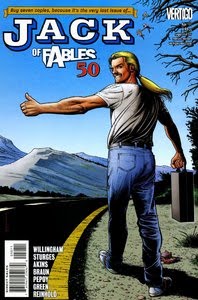
Jack of Fables 46-50 "The end"


FROM THE OUTSIDE LOOKING IN

After prolonged delays, this Wednesday brought the last issue of "Jack of Fables", which doubles not only as the finale of the "Fables"' spin-off, but the ending of it's last story arc as well. Writers Willingham and Sturges have spent five years working on solo adventures of Jack of stories, foreshadowing both the long time in planning "Great Fables crossover", as well as laying the seeds for this final storyline, which sees the ending on their satirical take on the character, at least for the moment.

The majority of the run has been illustrated by Tony Akins, a capable cartoonist who gave the title a distinctively manic look, that much better to differentiate it from the main "Fables" esthetic. Where in Marc Buckingham's hands the parent book sports a urban fantasy look, "Jack of Fables" was made to give off a more lurid atmosphere, mirroring the constant pattern of a never ending dirty joke that the writers strived for. Essentially, for all intents and purposes Jack of Fables had it's own tone, which is paramount for a successful spin-off. Even then, it was always a part of the broader Fables setting, even if purposely working in opposition to the more successful title.

A lot of the main Willingham/Sturges themes were resolved during the crossover, which was the first time the book close to matching the sales of the main title, but the writers were determined to continue for one more year of Jack's adventures. The sales swiftly returned to their previous levels, with the usual trend of continual decline, coming to roughly the half of monthly number of "Fables" copies sold in the Direct market (at least judging from the ICV2's estimates, which can be used to somewhat accurately describe the trends in American comic book publishing). At the time of cancellation, this was still a much higher average than that of a lot of Vertigo's ongoing series, but the creators are reportedly content with the decision, having already told all of the stories they wanted to tell with the character.

THE ULTIMATE JACK OF FABLES STORY

In any event, their last story arc serves as the finale to their work on the book, tying up all of the plot threads that weren't directly resolved during the "Great Fables crossover". Willingham and Sturges slyly start off with the spotlight on the three page sisters, and setting up their current agenda. Basically, the feisty librarians are trying to rebuild the Great library by tracking down the specific books they need to reinstate their Literal status. This is more or less typical Jack of Fables storytelling, serving to slowly reintroduce the reader to the status quo. The first sign of something unorthodox comes with the reintroduction of Jack and Gary, whose current predicament is illustrated in the manner of a Sunday page retro comic strip. And while the jokes told using this rigid layout are refreshingly straight forward, the context behind the change in Tony Akins' style is much more interesting.

Namely, there is a sense of a long time having passed between the story arcs which is finally made apparent by switching to Jack Frost's current whereabouts. Namely, that the de facto usurper of the book's previous two arcs is now relegated to a mere subplot should by itself be notable. Furthermore, seeing Akins' redesign of the character, who has transformed from the slender well-meaning fantasy protagonist to a full blown universe wide hero, further cements his companion, talking owl MacDuff's, 's endless prattling of their noble exploits. To put it bluntly, Jack Frost now looks like "Escape from New York"'s Snake Plissken, and his writers finally have him reconnect with the title's previous continuity. By giving the eye patch wearing, hyper muscled veteran one last mission in which he is to confront his father, now a caricature of a fairy tale dragon, Willingham and Struges are at first glance transparent about their motivations.

But it's only when the story continues, by shifting back to (present day?) Earth, and the rest of the supporting cast stuck working in a diner, that the full scope of their plans become revealed. That is, not only are Raven and his troop of runaway Fables also coming to the foot of Jack the dragon's cave, which is predictably where the Page sisters also find themselves going to, but that almost a decade has passed while the writers stubbornly kept the focus on his heroic son. This is no doubt the effect the creative team was going for, as the number of people finding their path leads them to Canadian countryside starts increasing, from every which way they are coming, all unaware of the company of the others.

Willingham and Struges seem to be saying that all of the characters previously encountered by Jack cannot move forward even after all these years of him going into retirement, and are seeking some kind of a resolution by confronting the reclusive anti-hero. The clever twist is that some of the foretold intruders upon Jack's soil never actually show up, but the sheer number of the ones that do more than dwarf them. Most importantly, Jack Frost, himself on the verge of retirement, rushes to meet the hideous dragon, one last act he needs to prove himself a true hero, even though MacDuff serves to remind the reader that his owner has done just this time after time, and across the whole galaxy. This is important on a metafictional level, as following the "Great Fables crossover", the book has basically jettisoned it's original, heavily flawed protagonist, in order to spotlight his estranged son, who as proven himself a hero without peer in the two story arcs preceding this last one.


Willingham and Struges went purposely so over the top with depicting a scenario that was the anti-thesis of their heavily post-modern parody of typical male, that they predict that the original "Jack of Fables" reader has by now found himself missing the original Jack. Horner's sexist power play and selfishness turned him into no less then a literal dragon, lying on the heap of the riches accumulated by tricking the other characters and thinking only of himself, but seeing his perfect son get all the glory since, it makes sense that two would go head to head for the book to return to it's meandering metafictional exploits.

THE WIDER POINT

Only, this confrontation is designed for the precise purpose of ending the book. The controversial choice actually makes sense on some level. "Fables" was always the more optimistic book, designed to find a place for fairy tale characters in the modern day and validate the struggles of fantasy authors trying to marry the two in literature. On the other hand, "Jack of Fables" from the start took to the negative of just this approach, singling out the various twist and turns the original fairy tales have taken in lesser hands, and trying to breathe some life in seemingly empty husks of Alice of Wonderland and Paul Bunyan, driven bland and lifeless after numerous revisions and adaptations. It was the book written by two people who admit that they have read a lot of bad writing in their decades long love of the genre, and are not afraid to call upon it.

By using this basic principle, Willingham and Sturges have created a very strange and obtuse storyline that kept hinting at it's most interesting parts, before being derailed by one or the other of Jack's completely unsympathetic schemes. Still, where it breaks off from "Fables" and establishes it's own take is that the role of characters in fiction still managed to be a central theme. The parent book launched from this premise and proceeded in world building, with the idea of contrasting the comparative fairy tales and making a coherent setting to place the fantasy adventures of lovable characters in. To it's credit, "Jack of Fables" never had such aspirations. It delighted in contradictions, and while being tangentially related to the overall Fables universe, the creative team insisted in telling a very particular story.

It was an exercise in using the least likable Fables character, and turning him into something even more monstrous, a horrible parody of manhood, while leisurely making their wider point. Meanwhile, the plots that were to further all these ideas were increasingly offbeat and manic, a far cry from the tongue in cheek romanticism of the parent book. Yet, that they were serious about their intentions, and that all of these ideas fed into the overall direction of the brand was clear during the "Great Fables crossover", that drew heavily on "Jack of Fables" plot lines.

Still, it's clear that, as imagined, the solo Jack book was never going to find the praise of the broader audience, and frankly, it's mainly on the strength of the franchise's overall popularity that it managed to survive as long as it did in the market notorious for it's resistance to new and experimental work. Willingham and Sturges actually make all of this a story point, stipulating that it was Jack Horner's sheer notoriety that kept the title from winning over new fans.

THE END

Still, by devoting two whole arcs to little more than a standard genre storytelling in order to subvert the expectations found little echo in industry. The joke seemingly fell flat, and thus a regular reader had every right to look forward to bringing back the rest of the supporting cast (along with the former protagonist), in what seemed the return to tackling the more nuanced stories a little more directly. Yet, the elegiac tone emanating from the surprised looks on the familiar faces, now supposedly several years older, preceded the official confirmation of the #50 being the book's conclusion.

Even then, the final storyline was plagued by delays and art assists (by Russ Braun), as well as the ink assists, that resulted in some of the pages sporting a hurried look, but did little to hinder the excitement of the fandom. Namely, the major comic book websites and it's devoted blogosphere took little note of the title's existence, and where likewise neutral to it's passing. Which is not to say that Jack of Fables#50 isn't an extra sized final issue precisely targeting a certain type of comic book fan.

A fantasy story featuring a battle to the death featuring the mythic hero and his dragon counterpart, told (mostly) using splash pages is certainly a call back to Thor #380, the high point of Walt Simonson's famous run on the character. Willingham being a creator debuting his own fantasy inspired superhero series at roughly the same time, "the Elementals" creator was surely aware of his colleague's work, that is still remembered favorably to this day. In lieu of the Simonson constructed poem that served to caption that 1987 Marvel comic, the "Jack of Fables" creative team reply by substituting it with color commentary, as if the final battle between their two competing leads was a football game. Likewise, without any kind of explanation one of the journalists is Jack Horner, as originally designed, who does not shy away from gives his own particular take on the proceedings.

What transpires certainly is certainly interesting, as the creative team envelops to tie up all of the multiple going concerns of their rich supporting cast in a huge one sided fight. The results are certainly amusing, and actually line up with the title's underpinnings. With the cancellation of "Jack of Fables", Willingham and Sturges are aware that all of their many problematic side Fables have no place to reside in, and once again directly refer to it in the story. This is done by having Raven, Jack Horner's Indian guide and protector, bring the assortment of escapees from the first story arc's Golden Boughs retirement village to Canada, on pretense of leading them to Fabletown. That none of these many quirky characters with impossibly complicated back story (particularly in relation to the their "Jack of Fables" adventures) seem destined to rejoin the main title seems an afterthought.

Thus the writers happily give them all, for their fate to be sealed, as much as any of the Fables can be effectively written off, at the hands of Tony Akins' wonderfully inventive full page showdowns. That the reader is meant to be caught in the unfairness of all of this is par for the course, but as always with this title, the initial shock is quickly replaced by the sense of elation, as Willingham and Sturges continually insist that these are all fictional characters designed to first and foremost to entertain. And considering "Jack of Fables"' trade record, that usually comes out as a deeply ironic black comedy, best illustrated by the revelation of the fate of tortoise that tried to escape Golden Boughs.

The final scenes show the eventual fate of Jack Horner. This is done by brining up a loose end from early on in the series, that nevertheless echoes a popular "Hellblazer" storyline, which might come at the expense of punchline, considering the potential overlap of the Vertigo imprint's audience. In any event, as the cover promises, the long time misadventures of Jack of stories come full circle, only with the character undergoing an obvious change in the process. Whether this means that following his solo outing Jack will still somehow be reintegrated back into the "Fables" main cast is still to be seen. Story wise, what is promised by creators (albeit in the back matter following the story, and not in any kind of formal epilogue) is that the baby introduced in the beginning of "The end", as well as presumably it's father, were slated to reappear in the Fables universe sometime down the line.

FABLES FUTURE FORETOLD

Once again, this ties into the speculation regarding the upcoming "Fables" plot lines. As for the overall strength of the brand, it is important to note that Vertigo is currently publishing the second "Cinderella" mini-series, written by Chris Roberson who penned the canceled title's solo fill-in issue in "Jack of Fables"#35. This not only indicates that DC's imprint is content in producing the material outside of the Fables' creator Bill Willingham's direct involvement, but more importantly, that they might as yet delay in authorizing another ongoing spin-off. This seems to mirror the decision to capitalize on the imprint's other current success, "American vampire", by likewise producing only a related mini-series.

In many ways, such caution is warranted, as the Direct market certainly doesn't seem to be receptive of the new ongoing commitments, even when tied to a more successful existing franchise, which mirrored Willingham and Sturges' experiences in writing the "JSA" and it's "JSA: All stars" spin-off respectively in the main DC Universe. And while the February cancellation of "JSA: All stars" seemingly has little to do with the Sturges co-written "Jack of Fables", it speaks to the same argument - whatever new projects the company plans around it's popular franchises should follow only after a serious rethinking at the company's part. That "Jack of Fables" was as ambitious as it was, and as long lasting, still doesn't guarantee that the potential "Cinderella" ongoing series would have a better chance of winning over the typical "Fables" reader.

At a time when existing comic book readers are already overtaxed with buying too many titles due to sheer loyalty or overblown hype, perhaps the best approach would be to continue with the mini-series until the company is sure exactly what kind of spin-off the majority of their readers are interested in,

Sunday, May 30, 2010

Scalped #35-38


With the release of the latest issue of "Scalped", Vertigo's premiere ongoing crime title has finished it's new spell of one-off stories. In preparation for a longer arc that is to come, Jason ("Other side", "Ghost rider") Aaron has scripted three accessible self-contained episodes, illustrated with the help of guest artists. Regular artist R.M. Guera was presumably so busy with the follow up story arc that he only found time to complete the final of these four issues.

Interestingly, the publisher has commissioned the work of expressionistic Danijel ("Plague", "Rex") Zhezhelj, with his issue being the first to open this latest cycle. The Croatian artist's style is so unique that anytime Vertigo uses him, he completely overpowers anyone's idea of a typical fill in. With his layered and painterly disposition, Zhezhelj is perhaps the publisher's most distinctive artist, which fits with Aaron's story providing a temporary break from the series' typical stylings.

Focusing on the farm life of an elderly couple, it brings to mind the independent work of recent Vertigo addition Jeff ("Essex county trilogy") Lemire, a slow, atmospheric work that seems an antithesis to "Scalped". Yet, the far more brutal ongoing still practices a leisurely pace, with it's frequent rotating points of view making such a connection possible. Zhezehlj picks up on this, and starts putting his rough brush strokes, and heavy inks at play, to try and capture a desperate family dynamic. Gulia Brusco's colors never let up from making the problems these people face appear anything less than bleak and unforgiving, while at the same time preparing the reader for the cathartic ending.

Acting as a complete break for the series, this is the most successful of the three latest short stories, yet it still falls short compared to some of the series' previous high points. As usual with these tales, Aaron's main writing contribution ends up being his choice of an interesting narrative perspective, for providing another view of the life on the Rez. This time, it centers on the farm outside the immediate casino surroundings, and it certainly provides for a distinctive experience. Yet, seeing the writer treat such a simple yarn through the medium of two dueling narrations, seems as excessive as some of the background recalled by the characters in captions. As a writing experiment, the story would have most certainly been better of by stepping back and leaving Zhezhelj to handle the bulk of storytelling with his distinctive visuals. Yet, even such an overwritten issue as "Listening to the Earth turn" doesn't prepare the reader for the story that follows.


And while it once again shares the writer's enthusiasm in creating a dense and layered backdrop, the very themes he chooses to spotlight provide for a very uncomfortable experience. On the face of it, by choosing to portray a solo mission the longtime background character Shunka is being sent to, it feels much more at home with the longer "Scalped" story lines. Yet, despite the plot-heavy approach, the writer once again aims for a decidedly simple emotional core, based on a very particular and polarizing aspect of Native American culture.

Davide Fuerno's art capably follows the series' conventions, easing the reader to deal with the controversial themes. Yet, the regular fill-in artist's work is so solid that it calls attention to itself, by reminding the reader of the artist's sheer improvement in technical prowess. Fuerno's soft penciling gives way for much rounder and realistic figures than before, instilling the characters with some much needed humanity and unique designs that are perfectly in tune with Guera's work, yet highly distinctive on their own. Gulia Brusco follows suit, with sepia toned coloring that maintains the pulpy black and white quality of the series' predecessors.

The story they illustrate is the one most adhering to the neo-noir conventions, which Aaron tries to subvert, while remaining true to the form at the end. yet, while the ending serves to bring the escapade in tune with the wider "Scalped" storyline, what precedes it is decidedly polarizing. On the one hand, the fractured narration, and chilling outbursts of violence are the series' forte, and they are used with great care and the precision in the first part of the story. Yet, the second half, with it's over the top narration that was it's only previous distraction leads to some very blunt storytelling choices.

And while the neo-noir trappings serve to round out the whole thing as an unexpected murder mystery, it still feels decidedly ham-fisted in both it's moralizing and the level of violence. Perhaps in retrospect, the excursion could be validated by picking up on the plot points down the line, and further integrating them with the larger narrative. As it stands, "a Fine action of an honorable and catholic Spaniard" is still certainly the most immediate of the short stories, and would likely headline the collection, should Vertigo decide to publish these issues on their own.


Finally, the last side story takes place completely in flashback, filling in the back story for Dash's father, and is once again a completely accessible entry to the series. It goes without saying that opening with a Vietnam war reminiscence takes a special note when taking into account Aaron's own biography. Being the nephew of the veteran combat correspondent Gustav Hasford, the writer was inspired to create his debut Vertigo work with "the Other side" mini-series, so that seeing him revisit the conflict in "Scalped" has much more than the immediate resonance. Even the issue's cover recalls the promotional poster to Stanley Kubrick's "Full metal jacket", that was adapted from his uncle's novel "Short timers".

That said, Aaron uses the opening pages dealing with the fighting to introduce Dash's father, exhibiting an air of the supernatural to his fellow troopers. This he proceeds to deconstruct, by detailing his life in the last days of the conflict. Even before Wade returns to America, Guera is once again set to illustrating the auto-destructive surroundings of a violent man's lifestyle, only set against a lush Asian backdrop, instead of the usual desert setting. Seeing the tragedy centered around a desperate man is nothing new to the series, and in fact the stylistic union proves something of a detriment to the episode as a whole.

The shootout that ends Wade's stay in Vietnam recalls Shunka's similar response in the preceding two-parter, and unfortunately brings to mind the many similar scenes from the accumulated thirty odd issues. That Aaron uses it to build up tension in the final scene taking place in America is a clever device, but one that doesn't make the story distinctive in it's own right. This is certainly fine in an ongoing series that needs to constantly redress it's core themes, but this far in "Scalped"'s history, a random graphic display feels largely inessential.

Moreover, the whole issue seems designed to close the short story cycle by returning the reader behind the typical parameters of Aaron and Guera's work, and it feels strangely limiting. "The Family tradition" ends up being memorable mostly for the regular series' artist returning in time to begin the next issue's "Unwanted" story arc, picking up on the shocking developments of issues 30-34. And with the series entering it's final phase, it seems that the self-contained stores that were so informative in it's beginning have settled into providing local color that is almost superfluous these days.


With three whole years behind it, "Scalped" has long since become the slow boiling neo-noir tale it's creators envisioned, thus making further fragmentation hard to justify. It could be excused previously, with the main character going into an extended seclusion, but certainly not now that he's in a different situation. Of course, the answer to that once again lies with Vertigo's decision to publish it's ongoing titles with no breaks in schedule. The editors count on the writer's fascination with the setting to provide for an entertaining diversion, but in doing so they harm the overall structure.

Faced with the artists increasingly incapable of fulfilling the monthly deadlines when producing highly detailed work, the imprint would do well to break the mold and at least try to publish their creator owned titles as series of mini-series. By forcing Aaron to adhere to a strict storytelling model employed by "the Sandman", the writer responds by saving the important story beats for the larger arcs, regularly bridged by short stories not illustrated by Guera, that seem to increasingly relish their tenuous grip on the series proper. One can't help but feel that with a looser artistic style enabling the artist to work faster, "Scalped" would have ended up a much shorter and more concise book, that still exhibits it's traditional methodical approach, without breaking clear to embrace the trivialities of it's bit players' background.

Friday, April 30, 2010

Jack of Fables 41-45 "Kings of earth and sky"


That "the Fables"' first spin-off was a controversial project was clear from the start. Putting the unlikable rogue Jack of tales in the lead role was always an ambitious choice, but the truly polarizing aspect of the Vertigo title's second ongoing series was always it's ambiguous co-writing credit. Yet, Bill Willingham and Matthew Sturges' "Jack of Fables" has preserved for years as the supporting title, with sales closely following the parent book. This has given it's creators a chance to freely enjoy their trademark multi layered self-aware storytelling that never tips it's hand to the readers.

Unlike "Fables", it's perennial troubled spin-off has always toyed with the metafictional aspects that fully acknowledge the difficulty of the ideas involved. It was always a title that spun some rather far fetched pulp inspired yarns, yet remained tongue in cheek the whole time, while teasing some rather improbable and unnerving events. Right alongside the black humorous bulk of the narrative involving Jack facing the basic tools of writing fiction, another subplot kept getting alluded to. And in "the Great Fables crossover", that was to wrap up the three years in the making saga, and have the character come full circle with Fables that he has come to stray from, it finally debuted.

Following on the heels of the parent series' new status quo, the mini event saw a new hero take center stage, and hinted at the changes to come for Jack's own series, all in a manner that was as literal as possible. yet, Jack's teenage son still seemed like merely one of the many new characters involved with the proceedings, while admittedly most of the others being even more obnoxious with their roles and titles. Still, following an unfortunately placed fill-in story, the co-writers stayed true to their promise, and started radically altering the series' premise.

The first arc of the new status quo still had to wrap up the loose ends of "Jack of Fables"' previous three years of stories, which in effect meant double billing the page count to host both the logical conclusion of Jack's adventures, and the introduction of his son's first adventure on his own. The shift in direction seemed sudden, but like always with the title, felt planned well in advance. In the new section, the reader was treated with an innocent fantasy episode played ironically typically, but there was still an expectation that the two narratives will collide in the last chapter. Interestingly, Willingham and Sturges had decided to play coy, and have Jack's tale end completely separately, while only soliciting his son's further pulpy adventures as a follow up. The reader, long treated to a purposefully murky storytelling and outright lies by the narrator as part of the standard comedy routine, expected everything but that, particularly considering the "Fables"' history, and the Vertigo's general trend of grown up fantasy storytelling.

And, of course, this is precisely where the co-writers decided to go next with the series. By transporting their hero to yet another new world, they opted for a full on epic fantasy science fiction mash up, with the previous protagonist mentioned only in passing. Thus, they got to graduate his long prepared successor to the title role, and even more importantly style the complete storyline after him. Even the opening text along with the hints at the end of each issue, long infamous for their sarcasm and general uselessness, thus turn into tried and ready hyperbole, hinting at the further adventures of the tragically noble hero.

The self sacrificing lead character is once again shown to be a complete departure from his egoistic father, which is exactly the point. Willingham and Sturges were well aware of how loathsome the never changing scoundrel Jack of tales has become, so following the crossover, they slyly set out to replace him with a much more likable new face. This meant making him the most naive and good-hearted of the protagonists, constantly trying to help those in need, while thankfully finding suitably grand quests lined up in wait for him. In "Kings of earth and sky", young Jack Frost has to try and liberate a whole kingdom from the giant ruler of the planet, while being constantly beset by the people he's trying to save.

On the face of it, it doesn't get more heroic than that, and also more bland. The co-writers have once again purposefully set out their new protagonist on a very generic quest, subtly following the tales that inspired his predecessor, and spiced it with typical subplots. The constant twists come at every turn, as Jack learns not to trust people unequivocally, while risking losing his only friend and mentor, the magical owl MacDuff. Seemingly, the reader is witnessing a slow coming of age story of a young man that could one day become a ruler of a magical kingdom, if he's not beset by sudden death. It's just that such stereotypical storytelling completely opposes the core concept of "Fables", and the entirety of the sinisterly clever "Jack of Fables" run.

The constant presence of Babe the blue ox's page (undergoing a particularly interesting blandification paralleling the main plot) reminds us that there is no chance that such a status quo will remain much longer beyond this introductory arc, meant to stun the readers into once again doubting the whole point of the series. Even the ending blurb hints at the return of Frost's father, by featuring a seemingly generic title of the next arc, that still reveals a clear link to the previous storyline. Willingham and Sturges are once again prepared to shock the readers, but the real question turns out to be how the ambitious idea is mean to work out.

Taking a lot of the readers' loyalty for granted, "the Kings of earth and sky" still doesn't stumbles in delivering it's promises. The execution is flawed on several levels, most apparently on the artistic front. Simply put, Tony Akins the series' regular penciller is called upon do deliver so much detail that he splits the artistic duties of the middle two issues of the arc with Jim ("Crossing midnight") Fern. This problem was sidestepped by having Russ Braun work on the whole of previous storyline, but in "the Kings of earth and sky", there's hardly a unity of style between the two different pencillers. Fern tries his best to continue Akins' initial ten odd pages each issue, but his figurework is completely at odds with the series' standard cartoony work. The jarring shift is very noticable in that the more realistic pages bring forth a completely different look to the "Jack Carter, warlord of Mars"-inspired storyline, immediately clashing with the pages surrounding them.

Thus, Akins' trying to incorporate layouts that echo Mark Buckingham's work on the main "Fables" series simply stop exhibiting the requisite dynamic in the fill in artist's pages, who more or less tells the story without any irony. This leads to Jack Frost's overblown heroics and his female friend's skimpy dressings turn from satire that was called for back into standard adventure story illustrations they were inspired by, before returning back to the norm with the start of every new issue. The colors maintain what little coherence remain, but the rest of the problems lie firmly with the writers.

While they are certainly to be complimented for presenting a well paced page turner, after so many "Jack of Fables" arcs that felt strained and overwritten, the most successful part of the storyline really belongs to their inspirations. And while they certainly find a way to channel the Michael ("Elric", "Jack Cornelius") Moorcock like pulp narratives steeped in the lurid haze of counter culture, Willingham and Sturges end up going too far in a single direction, risking the subversion of their own creative voices for the purposes of pastiche. And this is precisely what happens, as the series' traditional playful postmodernism becomes a distant subtext, easily overcame by ray guns firing through the sweaty psychedelic background.

Moorcock himself was always keen to stretch the form of the pulpy science fiction, but in sticking so close to his template, the co-writers gambled to entertain only the segment of readers familiar with his work, or otherwise generally susceptible to his hugely influential "Saga of the eternal warrior". What's missing is the concrete link to the series the readers have been following up till the beginning of this storyline, a knowing technique employed with potentially troublesome results.

It takes a lot of belief in the "Fables" brand as a whole to see "the Kings of earth and sky" for what it truly is, a middle chapter in the delightfully false new status quo that almost certainly won't last a year, before being tied together with the stylings that preceded it. It's just that read as a story in it's own right it might send a mixed signals message to its readers, who might not be so fond of the radical shift that "Jack of Fables" has undergone.

As an experiment in the continuing storytelling, the current direction of the series is in line with the title's constant ethos of subverting the readers' expectations of what they can expect from a spin off. Yet, as a story on it's own, it's completely dependent on future arcs to determine how the whole of this particular phase of the title measures up. This is certainly a bold decision, made by creators unafraid to follow their own creative impulses, instead of settling in the relative conformity of the tried and true status quo.

Sunday, February 7, 2010

Scalped #30-34 "the Gnawing"

Jason Aaron and R.M.Guera's "Scalped" has just finished it's new storyline, coming on the heels of "High lonesome", a series of mostly unconnected vignettes framed around a plot-heavy story. "the Gnawing", on the other hand, is a very tense thriller leading to the conclusion of a lot of the plot threads set up earlier in the series.

As with many of "Vertigo"'s ongoing series, it's difficult to consider the new story arc as a story standing on it's own, not only taking into account how seamlessly it fits in the overall series continuity, but also how little actual distinction "the Gnawing" has on it's own. Both the setting and the characters stay the same, and it even retains the usual perspective associated with "Scalped". Yet, none of this is to the series' detrimental, as it has always been first and foremost a serialized story. It's to the creators' credit that the plot beats are so convincing that one can hardly forget them, even though they've happened long months, and even years before.

"the Gnawing" takes it's name from the very bleak beginning showing a nihilistic perspective of the people and their world, as explained by an elderly Native American. It's difficult to see how much of the effect this thematic cue actually has on the heart of this particular arc, as the "Scalped" is nothing if not consistent in it's thorough examination of the elements introduced from the very first issue. In any event, the mythological metaphor serves to point out that the longstanding and developing conflicts are about to start developing more rapidly, as the book has officially went past the setting up phase. The book's writer, Jason Aaron has gone on record as saying that his original plan for the title was set up until this exact point, which is now marked as the half of the series' eventual run.

Yet, despite the fast pacing and rapid plot developments, the writer was sure to explain that the next several issues will mark a return to the slower, more methodical pace that has enabled the creators to flesh out so many different aspects of life on the Indian Reservation. This, in turn, makes "the Gnawing"'s particular take on the life in Praire Rose a rare, and much needed, change of pace, designed to be particularly effective coupled with the presence of book's regular penciller R.M.Guera for it's entire five parts.

Having used the preceding "High lonesome" to shake Dash Bad Horse back into the protagonist role, the creative team are keen to push him even further. By having Dash play an active role in a scenario that once again centers around his role as a double agent, it's all the more surprising to see the character actually use his more active role to relieve himself of at least a part of his problems. The hopelessly nihilistic phase indicated by the previous year in the title is for the moment abandoned, and it's impressive to see Dash that, even though he once again makes his fare share of mistakes, actually takes a stance amid all the chaos and resolves a particular conflict that has long since plagued him.

Still, for all his confusion, he is for once second to Red Crow when it comes to the rash decisions. "the Gnawing" is centered around the way Lincoln deals with the consequences of his own rather hasty way to deal with a very delicate matter that has disturbed him for some time. Yet, the creators haven't spent the past three years nuancing these familiar faces so as to have them act out of character. In fact, it could be said that there is no better showcase of Red Crow's demeanor than these five issues. The way he deals with the situation and eventually resolves it is nothing short of consistent with the way the Indian Chief has been portrayed before, but it's also extremely visual and cinematic.

Having talked of the main players and their characterization, it's important to note the violence that goes with their way of life. "Scalped" was always a character piece that took it's plot points in gritty shootouts and this volume of modern western is no exception. Guera's inks never stop using the tradition of European western artwork to etch the consistent state of despair into the mistakes the large cast of characters makes under the red-hot desert sun. And even though these people frequently move into circles, all but promising a quick and violent end, their desperation still causes for a lot of morally pointless havoc along the way. And "the Gnawing" for the first in a long while makes this apparently clear - for every scene of the characters pounding on the wall and turning to alcohol for escape, there are more than just enough shootouts to drive the plot forward, and make some changes to the story that really matter.


Of course, Red Crow and Dash's actions once more have an effect on the people most important to them, and this in particular colors the proceedings in this arc, and no doubt, many more to come. Both agent Nitz and and Carol are thus deeply affected, and by the end of the fifth issue, heavily removed from where they were before, paying dearly for their relationships with Dash. It is certainly ironic that in order for Dash and Lincoln to gain some kind of release the people they're closest to have to suffer so much, but it also speaks at length of the complicated relationships established by the characters for years ago.

For once, the incident that took place nearly 30 years ago is not referred to extensively, but that doesn't mean that Catcher has stopped playing his uniquely decisive and spiritual role. Having a thoroughly mystical character in such a gritty and realistic crime series might seem contradictory, but Aaron and Guera once again find a way to integrate him in proceedings while retaining the mystery. For all his intrigue, Catcher could have easily turned out a very annoying character, particularly considering Vertigo's tendency of inserting post-modernism and mythology into strange genre mixes, but in "Scalped" he has always been used in precisely the right way. After having slowly revealed the shocking bits of his past, proving how important this self-proclaimed outsider actually is to the series as a whole, Aaron and Guera are once again content to have him play a small but very interesting role in the plot.

Even the traditionally stunted to the side character of Shunka keeps playing his veteran bodyguard role extremely well. In fact, he is even more convincing this time around, making the Aaron promised prospect of his own two-parter storyline seem very interesting in finally revealing another part of the series' whole. More importantly for "the Gnawing", Diesel gets a definite characterization, as the situation of his imprisonment is finally resolved. This subplot is not tied as heavily into the Red Crow scenario that fuels the center of the arc, but it ends up being very important as a character piece.

The lessons these people teach one another are universally harsh and non-forgiving. "Scalped" remains a comic where Red Crow takes a former new helicopter to hunt down a man, where a truck wouldn't do, where every truth is hard gained, and in order to get to a resolution a man has to repeatedly make a lot of missteps. This is what makes it realistic, and a pleasure to read, with characters behaving not in the soap-opera cliches, but by presenting actual emotions that make their tragic lives all the more believable.

Saturday, November 28, 2009

A whole new world

An interesting thing happened while I was searching through the reviews of the some of the 'Jack of Fables' story lines. The engine gave me a slew of results concerning the spin-off of one of the industry's best selling non-superhero works, and unsurprisingly, very little of the links had to do with any kind of established critical venue, or indeed some of the more commercial sites considering the medium. For whatever reason, a large portion of comics fans seem intent to focus on continually analysing their love/hate relationship with Marvel and DC's superhero titles, but this was to be expected. What genuinely surprised me was that I found a bevy of commentary from the completely new source - that of the new readers that have managed to elude the market for so long.

This is no small thing, especially considering the overall quality analysis that covered all the fundamentals of the book's writing. The newcomers mostly shied away from a detailed comparative analysis of Tony Akins' art style, but they provided a very nuanced and informed perspective of the complex plot heavy series. Covering the book's general direction, and discussing the comedy angle, the readers patiently shared their thoughts regarding the controversial protagonist, and going to great lengths of contrasting the book to the main Fables title. Picking up on all the layered nuances, the new readers, presumably without access to the comics criticism, still provided an informed look at 'Jack of Fables'' back story, with the eye of gouging the creative team's future direction. All this, without a concrete platform to launch their opinion, the sheer enthusiasm for the story making them post semi-anonymous on the pages listing dozens of reviews, usually with the eye of selling their trade paperback back stock. It can't be overstated how rare this is in today's comics climate, and it's interesting to try to understand the reason.

It should be noted that these seem to be primarily readers who found the trade paperbacks through the means of book stores and libraries, seemingly avoiding the contact with the month to month Direct Market serialization. As such, it's unclear whether they discovered 'the Fables' brand slowly through the spotlight that the superhero movies, or through the more direct fantasy connection that the Neil Gaiman adaptations presumably brought to the Vertigo line. These new readers seem content to follow this manga-like distribution model, tracking down new volumes of the series they already like. Which brings us to the chief point, why is it that Fables seems currently the imprint's only title capable of drawing in the wider audiences, in a way reminiscent of the line's smash hit, 'the Sandman'.

It's deceptively simple to claim simple accessibility as the answer, as it seems notoriously hard to replicate the success, at least judging from the publishing history. For some reason, comics have a tendency on focusing on the obscure, fighting the uphill battle of reviving long dormant genre properties. Is it any wonder that 'Sandman mystery theatre' failed to engage the audiences of it's parent title, with it's noir-ish interpretation of a Golden Age mystery man's period piece adventures? Matt Wagner, the series' principal writer is currently facing similar problems with 'Madam Xanadu', and it's doubtful that the title will mimic the seven year life span of the Sandman spin off, launched at the height of the 90-ies comics boom.

Nowadays, there is nothing wrong with launching a series geared toward existing audience, providing that it includes the new readers. When starting a genre title that is not a spin-off though, the publishers should try to present a mainstream offering that uses the creators' craft and talent to tell a story first and foremost. That is, if they seriously attempt to attract the customers outside of their traditional, aging base. Focusing on the revamps of decades old superhero character minutiae doesn't seem to appeal to a modern, literate audience that wants to start at a ground level, with a clearly labeled first volume of a title that attracts them conceptually. Publishing a series with a concrete goal of tying up continuity trivia and half-heartedly revamping the ideas behind the original superhero team, that was the "Justice Society of America" before Bill Willingham and Matthew Sturges took over the writing reins doesn't get the new readers to post their reviews on online bookstore websites.

Instead, their "Fables" audience evidently doesn't want to crossover, leaving the publisher to hopefully try again to engage their attention, before they get too disillusioned with the self-referential nature of their new hobby.

Sunday, August 30, 2009

Vertigo - reimagining comics since 1993

"Vertigo" is the title of the well-regarded DC comics imprint, that has long been a home to the company's more ambitious, and usually creator-owned projects. It hat it's roots in DC's previous horror and fantasy line, undergoing it's more mature phase with titles like "Swamp thing", "the Doom patrol" and "Shade the changing man". Thus, their initial offerings were positioned very clearly as a bold and different continuation of the superhero-oriented properties. And yet, analyzing the starting points of the plot to some of the imprint's most famous comics acknowledges certain remarkable similarities.

Starting with "the Sandman", the series begins with the Lord of dreams reclaiming his title after a prolonged absence from his affairs. It's strange how this basic idea would repeat in the line's biggest sellers, from "Transmetropolitan" to "Fables". "Transmetropolitan", though initially published by the short-lived "Helix" imprint, begins with Spider Jerusalem, a newspaper columnist forced to reenter the field of politics after having entered a self-imposed exile. Even titles as diverse as "100 bullets" have come upon the same formula, that of characters reacquainting themselves with their previous lives, in a well developed setting. Surely these are all surface similarities, but perhaps there is a reason why "Vertigo" comics keep telling this kind of story.

And it is actually not at all exclusive to the mature readers imprint, with many superhero comics operating under the same premise. The difference is, of course, that the ongoing Marvel and DC serials are forced to tell these kinds of tales by their very nature. "Captain America" is arguably a book that starts with his reintroduction to the Marvel Universe in the pages of "the Avengers", with the character's WW2 actions in his original appearances providing the context for his modern set-up. With DC's "Justice Society of America", the first superteam introduced during the same real world conflict, their post-War status quo was defined from the more mainstream "JLA" exactly by their original adventures. The current premise of both books heavily relates to their origins, being comics that deal with previous continuity more than any other kind of theme.

With "Vertigo" comics, even the creator-owned books largely retain the similar approach, choosing to deliberately set the action at a later part of their characters' lives. Despite all the experimentation, they keep being genre books that still ignore the beginnings of their heroes' career, to concentrate on the latter days. This is true even with books like "Scalped", featuring a second generation of people living on the Rez' whose lives are defined by their parent's action. In that case, the continually referenced past events are inspired by real events relating to the civil rights movements.

At first glance, it seems strange that all of these creators would deliberately set-up a very complicated history to the characters' lives and times, before a series ultimately begins, one that directly informs their present actions. Yet, it is here where all of the imprint's philosophy comes to the core. Because, the basic idea of tweaking a common genre trope implies experimentation with the form, with the current example of "Fables", the imprint's flagship title being a modern follow-up to the well known fairy tales. In this case, the previous events all constantly referred to, subverted and built upon, are children's stories, familiar to every reader, even though the creators resist making way for having the series relate their own version of it.

Some of this may well have to do with the idea of setting a series in the past alienating a lot of readers, but such concerns could be avoided by a well-developed present day framing sequence. With "Vertigo"'s books, it seems that in order to integrate the spirit of the renowned books of films the creators seek to imitate, they all come up with a similar scenario. Because a lot of the imprint's appeal comes from applying the techniques of other media, that has experimented with the genre forms on a much higher scale than the American comics have done at that point in history, due to various limitations.

Regarding the plot, it seems that these inspirations seemingly become a part of the characters' past, which the creators then try to build upon, such as in "the Sandman" whose mythological past the book continues upon exists in the kind of real world culture that inspired it. Thus, the reader can get understand both the well-developed setting that the book starts out with, as well as the creator's own signature stylings, by getting acquainted with the ancient Greek and Roman history and culture, as well as the classical medieval literature. Similarly, "Scalped" focuses on the past that is actually a redressed as a crucial piece of the plot, based on the aforementioned real events.

Thus, it seems that by driving a clear line that abstracts the book from the fairy-tale basis that inspired it, that the "Fables" form the break with their past and are able to achieve their distinct notoriety. It seems that by starting well after the original events, these books serve to underline the differences in the creative approach. That seems to answer the question as why none of them are set in the times of their character's peak - because the more classical version already exists, and with the creators not being the original authors, they seldom seek to go back and rewrite the exact stories that inspire them. By setting "100 bullets" in modern milieu, the authors are free to think up of a new mix of the decades-old noir and detective stories that the book draws upon. At the same time, the criminal past that hangs over their characters' heads is that of a more classical time, undistinguished from the paperbacks that inspired it, which is why it's filled in only in flashbacks.

Placing an extended focus on the history that these series derive from, no matter how big a role it plays regarding the current events, would result in a period piece in which the creators could do little but pay homage and subvert the reader's expectations in small ways. By placing the story in the current time, the authors are able to apply their distinct view of the today, while conveniently placing their inspirations in the past where they belong to. It is the only way that acknowledges the literary and historical research that went into creating comics that are informed mature works on par with their other media genre peers.

Sunday, June 7, 2009

"Scalped" 25-29 - High lonesome


Jason Aaron and R.M.Guera's "Scalped" has just concluded it's most recent story arc, "High lonesome", thereby becoming the first "Vertigo" title in recent memory that has not been cancelled. The neo-noir series set on the Indian reservation has been consistent in it's slow pace and meticulous character work, set back against the wild western atmosphere.

It started out with the focus on Dash Bad Horse, an FBI agent going undercover back at his childhood home, and being faced with the decades-old secret and misgivings left by his mother. Having set up the central mystery, tying both the present and the past together, the series' brutal and very raw feeling has since gave way for the structure-minded vignettes fleshing out the supporting cast, while the inevitable vents realistically meander toward their final resolutions.

The "High lonesome" story arc is set up in a very unique way, with Jason Aaron's story spotlighting a different "Scalped" character every issue. Structurally, each of the chapters employs a specific view point, and their pace differs to provide the best glimpse into the narrator. "Scalped" has had a long tradition of telling side-tales that provide detail and color to the main plot, which in this five part tale serves to literally bookend them.

The story begins with the new player whose coming in the Rez', signifies the conflict directly continued and resolved in the fifth and last issue of the arc. The opening chapter, presented from his view is very active, showing all of the person's energy and intent in a somewhat manic way, rendered through a rambling and self-conscious voice of a unreliable narrator. The reader is forced to piece up the clues and forms his own theory of the individual, before the character's final actions demonstrate his true intentions in a very visual way. Even though Guera masterfully illustrates the moody and ambiguous issue, especially it's historical pages, his art is not to be seen on the pages of "Scalped" for the next two issues.

The subsequent episode does not up on the first chapter's cliffhanger, instead providing a side story, whose divergent narrative serves as the framework for the series' second look in the past of Diesel. Dash's erratic opposite number is a very different narrator, providing cold and unrelentingly sparse comments about his strange behaviour. Aaron trusts artist Davide Furno's soft earthy pencils set back against somewhat angular inking to present the reflection of the central event in the troubled man's life. The plot alternates with present days scenes acting as a parallel that reaffirms the change's lasting effect on the character.

The slight progress in the overall plot is addressed offhand at the beginning of the next issue's even more brutal story, featuring both Diesel and Dash's acquaintance, the hotheaded agent Nitz, whose drive from revenge has instigated the entire book's setup since the very beginning. Yet, it's only in the middle of the "High lonesome" arc that a more revealing light falls on the character, who was so far presented as being very one-dimensional. It's very revealing then, when the traditionally non-empathic Nitz, gets to follow Diesel, by revisiting his own past. Aaron contrasts the lawman's flashbacks to the defining moments in his life with their present-day after-effects. The agent's rare sentimental leave turning into a study of his bloody and violent underpinnings is brought to the reader by Francesco Francavilla's painterly hues. Francavilla's visuals only fail when portraying the difference in the characters' ages between the two decades, yet the colorist Gulia Brusco helps erase the confusion by alternating the blueish dream-like look of the thirty-two years ago with present-day's clearer, orange tones. Faced with some of the most intimate art the series has seen, Aaron counters with some of the story arc's most coarse and amoral moments. The character-work in the issue reads very access able and finally brings the Nitz some of the definition he desperately needed, concentrated as he is on the civil rights activist days of Dash's mother.

Despite being self-contained, the second and third issues of the arc work as reminders of Dash's perilous legal status, with Diesel and Nitz acting as comparisons. The stylistic changes in artwork provide for a different perspective on the viewpoints of characters away from the Rez'. The subsequent, co-creator Guerra pencilled tale once again rearranges the structure of "High lonesome", while still working in part as an intimate portrayal of a seldom-seen character. It brings back officer Fallsdown,who is forced to collaborate with agent Nitz's associate, providing the link between the chapters. The investigation calls back to the first, Guerra-pencilled issue of the story-arc, but seems mainly as a catalyst to finally reveal the truth that's been eluding agent Nitz for so long, about the bloody night from thirty two years ago. By focusing on the common past of all of the book's main characters, the issue's epilogue serves to set-up future events, recasting another series regular in the new light.

Yet, it's only after spending three issues on subplots, that Aaron and Guera use the arc's concluding chapter bring the sense of closure to the initial plot of "High lonesome", providing definition to the whole, disparate experience. Bringing the focus back on Dash, the writer is uncompromising in structuring the story to reveal the truth of his present state, and challenge the character to change, in the light of the catalyst memorably depicted by his co-creator. In effect, bringing Dash's hidden identity to the forefront of the heist-oriented plot is a very welcome idea, capable of sustaining the violence that surrounds it. Despite hinging the starting point of the drama on a coincidence, in the end Aaron offers no easy answers, in keeping with the book's return to the more grounded scenario.

In fact, perhaps "the Scalped"'s greatest strength might well lie in it's characters, and their decisions to acknowledge the events that shape their lives, sometimes taking the very long and life-like periods of time to come to grips with what their decisions should be. The story unfortunately loses some of it's focus due to the shift to other characters in it's three central three issues, making it appear as though they were intended for publication after the two parts that ended up framed around them. Strangely, Diesel, agent Nitz, and officer Fallsdown effectively make no direct impact on the main plot, making it appear that their stories could have been published verbatim after the events of thus much-shorter "High lonesome" arc.

It seems like no coincidence then, that the first two of these character pieces are pencilled by Furno and Francaville, with Guera's highly detailed and atmospheric style returning for the concluding issue in the story-within-a-story seeming almost misplaced. The fill-in artists are a necessity with the editorial's preference for the monthly publishing as a way to ensure the audience's enthusiasm doesn't decline for the relatively new title. Taking into account that "Vertigo" titles are traditionally strong trade paperback sellers, a more relaxed publishing approach could have perhaps made "High lonesome" a different reading experience.

In any event, with Jason Aaron as the constant, the book keeps it's gritty edge, most bluntly by various atrocities commited by the characters, that permeate the issues. The arc's negativity works to keep up the book's balance between wild-west inspired shoot-outs, and the carefully depicted acts of crime with long-lasting dramatic consequences, such as the tragic event in the Dash's mother past. No matter the artist, the grittiness and depression never seem to stop gnawing on the characters of the Rez', acting as both an explanation for their anti-social behaviour, and a catalyst for their further deterioration, with all of it's implied consequences.

As rendered by Guera, Dash is a perfect example of all the book's philosophy, trying to make sense of his violent tendencies colliding with long-suppressed emotions. Forced to endure a situation as traumatic as the one his mother faced thirty-two years ago, by the issue's end it's still unclear how will he proceed, given all that has befell him since coming to the FBI assignment. Still, the renewed focus on Bad Horse's exploits could only benefit the book as it comes closer to the inevitable resolutions it's been building up to, since the beginning.

Because, despite the many players influencing the events in Prairie Rose Reservation, and orchestrating random acts of violence on their own, "Scalped" never stops being a classical tale of a man trying to make piece with his past. Hopefully, it will end as it begun, with Dash getting past the details, to deal with the most important man in both his and his mother's life.