Showing posts with label captain america. Show all posts

Wednesday, October 10, 2012

Comic reviews for Wednesday, October the 10th

BATMAN #13

Scott Snyder and Greg Capullo debut the opening chapter of "the Death of the Family" crossover. The main story is set to run in "Batman", while spin-off titles tie-in, and for the moment, the creators deliver what they've promised. There is an ominous feeling to the episode from the start, building to the start of Joker's depraved revenge. With the character single-handedly executing his plan, the story maintains an atmosphere of the slasher horror movie, albeit one drenched in Batman mythos.

Snyder never forgets that he's writing a Batman story, structured as the traditional chase the villain ends the dark knight detective on. It's also just as much a Joker story, calling back to the character's numerous previous misdeeds, albeit with a ring of finality to it. Batman's nemesis launches his campaign of terror so aggressively, so relentlessly, that "the Death of the Family" seems poised to leave lasting ramifications to the title.

Capullo is likewise in full form here, making sure the reader sees every important detail of the grim proceedings, while drenching the story in unbearable paranoia. The artist keeps the Joker's character design a secret until the cliffhanger (which goes to explain his frustration when the posting of an upcoming cover spoiled the reveal on the Internet), but the character is still present throughout the issue. In contrast, the artist continually shows Batman under heavy light, caped and broad-shouldered, but woefully ineffective. Bruce is continually two steps behind his enemy, and it seems like he can barely follow the trail.

The story climaxes with Joker crossing the line and attacking a key Batman figure, revealing the extent of his knowledge of Bruce's operation. The rationale behind his enemy's current plan of attack works to establish the tie-in for the rest of the Batman line, but it remains to be seen how much it factors into the Snyder and Capullo's main story.

This is not to say that the start of the creator's second year of Batman stories is flawless, as the police station sequence and the later television broadcast announcing the villain's plan to the Gothamites exhibit some confusion in layouts leading to the lack of effectiveness. The fight in the factory that closes the issue is likewise so dense with details that it lacks a seamless storytelling flow (including an unfortunate prop that will momentarily take the reader out of the story), but in general the issue portrays both creators in a very strong light.

Snyder utilizes a lot of dialogue in these plot-oriented 24 pages, working in concert with Capullo's quirky, caricatural visuals to create a rare story that lives up to the hype surrounding it. The back-up reunites Snyder with Jock, the illustrator of his previous run on "Detective Comics". The painted pages are likewise disturbing, with the co-writer James Tynion IV elaborating on the plot point previous to Batman's arrival to the factory.

The story is no more than a vignette featuring Harley and the Joker, elaborating on their sick relationship in regards to a particular plot point. Tynion IV quickly achieves an atmosphere of abject dread, but his is a thankless task giving that the reader is already aware how the scene ends. In a way, the co-writer is being asked to shock the reader into a few moments forgetfulness, before the story returns to the relatively comforting reality of what the reader just saw in the final Snyder/Capullo pages.

Jock's work is traditionally angular and moody, but realized in the limited palette of reds and blues, except for the shock of Joker's hair.The close-ups on Joker's mouth are likewise effective, keeping the reader unaware of the character's position in regards to Harley. It goes without saying that the two character's share a very one sided abusive relationship, which excuses some of the violence on the part of creators, who thankfully restrain from depicting the full extent of implied depravity.

CAPTAIN AMERICA #18

The finale of "New World Orders" follows the pattern when it comes to this arc, being the end of the plot-based exercise that had little to show for it. The Bunn-scripted issue covers the three fronts of Captain America and SHIELD's battle against Codename Bravo and the Hydra, with a real sense that the heroes are over-matched. Yet, once the protagonists make their way to the enemy commanders, they prove relatively easy to beat.

It's doubtful that Brubaker would have realized his plot in much the same way had he written the arc on his own, but as it stands, the villains who have tormented Cap since this iteration of the title launched prove little more than braggarts, who have managed to brainwash the American public to their side. The issue continues last issue's Baron Zemo/Agent 13 fight in a decent way, but the co-writer's addition of Dum Dum Dugan's work behind the scenes ultimately ends the satellite in a way that is a little too easy and convenient.

In turn, this makes Falcon and Diamondback's efforts superfluous, but the co-writers choose to utilize their short scenes to show the effect of enemy manipulation on the common man and set up a new dynamic between the characters. The heavy handed real world relevance issue ultimately proves like little more than an afterthought, and gets little more than a mention in Cap's fight against Bravo and Queen Hydra. The duel is remarkably short and efficient, but is notable largely because of its finality and the way Marvel chooses to present it.

Throughout the issue, Eaton underplays the more brutal elements of the script and sticks to a superhero aesthetic that de-emphasizes the violence. The reader is not made privy to the body-count behind the fake Discordian invasion, with the dialogue carefully explaining that despite the appearance, the fights against Zemo and Bravo carried no fatalities. Scott Eaton's work is therefore allowed to maintain a darker edge, while still working in the artist's exaggerated superhero style.

Unfortunately, the careful framing only accentuates the feeling that "New World Orders" shows the creators at their most restrained, presenting a story that tries to provide an epic sendoff to the plots and themes of this volume of "Captain America", but only succeeding in the former. The co-writers try to use the character's out of costume appearance to provide for some measure of closure, but the lessons learned feel broad and obvious. The writers are ultimately use the sequence to spell out their intentions and clue the reader in on the eventual fate of the principal players.

The story concludes on a genre standard vignette aiming to provide some ambiguity to the heroes' victory, but a long-time reader will likely be more interested in the one page teaser for the next month's story. With #19, Ed Brubaker concludes his run on the title, with the relaunch already solicited as a part of the Marvel NOW! initiative. Reunited with Steve Epting, the primary artist of his original "Captain America" stories, Brubaker will no doubt leave provide a poignant coda for the title that never really gained a foothold in this latest iteration.

SCARLET SPIDER #10

Interestingly, the second part of the arbitrary "Minimum Carnage" crossover provides for a pleasant diversion. Chris Yost, the regular writer of "Scarlet Spider" scripts the issue himself (with special thanks to "Venom" writer Cullen Bunn), and the mini-event feels slightly more organic.

This is not to say that the "Minimum Carnage" is now free of the exposition that weighted heavily on its first part, but that it builds up some rhythm when its two leads finally start interacting. The repentant, yet still aggressive Kaine has little time for Agent Venom, following Carnage's disappearance, but at least for a short while it feels that the writer will forgo the cliche of having the two protagonists fight as soon as they meet.

Yet, utilizing Venom's symbiotic nature, Yost still gets to include the fight a mere few pages later, providing for the issue's major fight sequence. Flash losing control of the symbiote seems to be unconnected to Bunn's plot of demonic possession and seemingly operates in disregard to the set-up as presented in the character's own book. Pham and Brown illustrate the sequence in a clear and energetic way, providing a lot of the flair missing from the story's initial "Alpha" issue.

The Microverse sequences substitute the slaughter from the beginning of the story with the fantasy sequences, teasing the role of an evil mastermind that is profiting from Carange's actions. The hooded figure could well turn out to be an analogue for the "Micronauts" arch-villain Baron Karza, but so far he appears only in hologram.

Meanwhile, the story's two discuss crossing over into the microscopic world, with Yost doing his best to discern between two anti-heroes. Scarlet Spider reluctantly follows Agent Venom's lead, with both ultimately defining themselves after Spider-Man. Following the requisite comic book super science, the two are once again separated. Pham and Brown don't invest a lot in the backgrounds of these Microverse sequences, but the colors help make the setting distinctive.

The microscopic world has a truly alien feeling, especially when compared to the drabness of the ruined space center where the most of the issue takes place. When Micronauts finally show up, they feel entirely of the place in what has become Venom and Scarlet Spider's space opera adventure. The reader is not expected to be aware of the company's struggle to keep the characters created while they held the licence to the property, with the freedom fighters instantly recalling the better known "Masters of the Universe", or even "Star Wars" characters.

The issue ends with Yost going so far to explicitly mention the "Star Wars" connection, right before Scarlet Spider is subjected to the monster that would not feel out of place in George Lucas' movies. Keeping Carnage out of the spotlight has definitely helped the story settle in a pulpy, adventure story direction, but there is still no indication that the crossover will ultimately cohere into a satisfying whole. For the moment, "Minimum Carnage" appears to be a little more than an unlikely, but inoffensive outing for its well defined leads, playing out in a completely different fashion than the 1990s crossover that inspired it.

WALKING DEAD SPECIAL: MICHONNE

To tie-in with this Sunday's premiere of Season Three of "the Walking Dead" TV-series, Image and Skybound present a Special issue of the comic book that inspired it. The "Walking Dead Special: Michonne" is meant to reintroduce the character whom the TV audience briefly saw in the final episode of the last season, a katana wielding lawyer who has long since become a permanent fixture of the comic book.

Two days before the Season Two finale, the March issue of "Playboy" published a short presenting the character's origin story. The six page Kirkman/Adlard collaboration wasn't reprinted in "Walking Dead" #100, and it's only now that Image has decided to present it, along with the character's original appearance. "Walking Dead Special: Michonne" thus combines the "Playboy" short along with "Walking Dead" #19, and offers no new material except for the Charlie Adlard cover.

The 6-page "Michonne's story" basically presents the first days of zombie apocalypse from the titular character's point of view, without offering any new information. There is very little dialogue in the story itself, as Kirkman prefers to narrate the events using caption boxes. Reading Michonne's recollections largely dispenses with the excitement reserved for the series, as the character obviously survives to join the book's cast at a later date.

The main series has long abandoned the initial shock of the zombie invasion, thus seeing the creators revisit the "Days gone bye" setting has some novelty. In the end, the short, no matter how well put together proves no more than a promotional item. As for the longer story that follows it, it takes place relatively early in the series run, and mostly presents an extended fight scene. There is some initial confusion regarding the setting, and the characters opposing Rick, but it ultimately boils down to a decent episode of a longer serial.

Rick and his group are vying for control of the prison with the group that previously held it, with the new player using the ensuing confusion involving a zombie attack to join in with the cast. And while #19 is ultimately Rick's story, showing one of the first steps in the character's gradual loss of humanity, Michonne is given enough space to showcase her use to the group. Basically, she is a genre character initially divorced from the every day problems of the group.

Kirkman and Adlard choose to portray her value primarily in terms of her fighting prowess and the appeal a beautiful woman wholly capable of fending for herself has to the audience. The character has since enjoyed a couple of relationships, but is still largely defined by her ferocity, which is somewhat softened with the "Playboy" short. Michonne is still a long way from a rounded character (that role has gone to Andrea, who also appears in #19), but the Special does enough to make her stand out.

Beyond the return to earlier storytelling modes, "Michonne" also offers a look into the evolution of Charlie Adlard's artwork. Reading the two stories back to back, it's apparent how the artist has changed the way he approaches the series. For a start, Adlard now chooses much thicker inking lines and seems to rely more on Rathburn's gray tones. The artist was stylistically mature when he inherited the book from Tony Moore, but he seems much more assure in these newer pages.

There is a more natural flow to the pages of material that premiered in "Playboy", as well as a tighter grasp on the figures. It remains to see how the artist's style will further evolve, but for the moment both him and Kirkman are overshadowed by their popular character. Even if this tie-in Special doesn't work to increase the readership of the series, it works to increase the awareness of the connection between the TV-series and the comic book that inspired it, which is more than enough, given the latter's success.

Friday, September 28, 2012

Comic reviews for Wednesday, August 25th


GOON #42

Eric Powell's commitment to produce another year of monthly stories on "the Goon" has quickly returned to the devices the writer/artist used the last time he produced an extended monthly epic. Namely, this issue offers 17 pages of the main plot, while the back-up helps raise the page count to the traditional number.

Powell tries to offer a complete story as well as the one that sets up the larger conflict. The common ground the two plots share is the supernatural, particularly witches' magic, which works very well with the title's usual modus operandi. The issue opens and ends with the relatively serious story of a boxer going up against the Goon's pick for the fight.

The story's too brief to register as anything but a diversion meant to provide the issue with a story of its own, with the eponymous boxer simply not having enough space to develop into a more nuanced character. Powell finds much more inspiration in the events directly involving the Goon, as the protagonist is continually confronted with bizarre harbingers of his upcoming doom.

Seeing a skeleton loaded with dynamite serves to both amuse the audience and provide some measure of physical threat in an otherwise static issue. The series creator doesn't waste any space, making each of the altercations last no more than a page or two, and still manages to provide some color besides the bizarre fights. For example, the page contrasting Franky and the Goon's clothing choices has two solid gags on it, that momentarily slow down the pacing, and help give context to the brawls.

Despite the focus on the plot, such as it is, Powell remains a cartoonist and heart, and understands that the little details have enliven the relentless pacing. Seeing the one panel depiction of the toilet at Norton's bar is in many ways the highlight of the issue. Still, this doesn't prevent the writer/artist from granting the issue a more traditional ending, with the box match fight wrapping up and the Goon and Nameless priest exchanging a crucial and poignant dialogue.

Despite the last page being packed with panels so as to have the story wrap up as soon as possible, the focus on the character's faces manages to save the sequence. Powell's artwork is typically layered and well-realized, and just looking at the beautiful ink washes makes the reader appreciate the time-consuming process. Despite still retaining the zany edge to his drawings, the writer/artist has improved his craft to such a high level that both the stylized cartoons absorb the cozy, melancholy atmosphere they're set against.

At this point, the book occupies a niche all its own, and the creator's insistence on working on his own terms in regards the scheduling and the presentations certainly makes up for one of the nicest looking books on the stands. The back-up section, realized with the artistic talent of Marc Buckingham presents a portion of a fight scene, that can be read on its own, but it hardly presents anything more than a snippet of a larger story. The "Fables" artist continues to prove a surprisingly strong match for the material, which remains somewhat hindered by the lack of coloring. The characters are continually on model, and the gray tones help make the action clearer, but there is still no indication how long the story is supposed to run.

JOURNEY INTO MYSTERY #644 BURNS

The penultimate chapter of"Everything burns" starts slowly, covering several of the locations and major player, before choosing to concentrate on Loki's point of view. The co-writers try to give Thor's predicament a modicum of tragedy, but the focus is once again clearly on his half-brother.

Starting off with a scene spotlighting the role of Loki's demon dog Thori, the creators proceed to endear themselves to the reader. The follow-up sequence is ridiculously over the top but highly amusing, with Fraction and Gillen stopping just short of derailing into absurdity.

The co-writers use Desir, the "Journey into Mystery" to sober Loki, and get him back to solving the predicament he started in the first place. The follow-up scene directly picks up on the plot point in the title's "Fear Itself" tie-in arc, once again clearing up that the current mini-event is meant largely as the conclusion to Kieron Gillen's short run on the title.

Taken on these merits, "Everything burns" acts as a very successful final act in the run that started off strongly, before hitting a rough patch with the artistic changes and tangential stories. It's hard to consider that anyone but the title's biggest fans would have imagined that it would close on such a strong note, in essence providing a capstone for a whole era of "Thor" comics.

Fraction's run is largely represented by Volstagg's turn as the replacement king of Asgardia, which also builds up on his role in "Journey into Mystery". Carmine di Giandomenico's art remains heavily involved with the use of computer coloring and angular crosshatching, doing everything to overpower the reader. The effect remains muddled and distracting, sacrificing everything for the immediate effect.

The unclear layouts, excessive details, characters that fail to emote, all belie an artist not really interested in traditional storytelling possibilities of the medium, who is miscast drawing the character-focused epic. Giandomenico succeeds in some measure in instilling a broader range of expressions when it comes to Loki, but otherwise the artist is preoccupied with instilling the mood and the look that make "Everything Burns" much more chaotic than the script calls for.

PROPHET #29

The latest installment in the relaunched and renumbered "Prophet" series was originally supposed to be published as #25. Following up on the first Faryl Dalrymple illustrated episode, Image even published the cover to what was the direct follow-up, but instead went on with a different story on the inside. It's only now, months after the initial publication, that Image presents the second Dalrymple issue, under the cover that has no immediate bearing on the story contents.

Reading the story, the reader is immediately aware for the reasons behind the delays. Dalrymple is called to illustrate the story which excels in detailed depictions of interstellar warfare and repeated scenes of an alien society that seems inspired by the work of Hieronymus Bosch. The artist's style is loose and expressionistic, but fairly graphical, and he's called up to depict numerous of the (presumably Brandom Graham designed) aliens. Despite all of the minute details, Dalrymple's layouts are at all times clear and in service to the story, revealing an artist that has spent considerable time thinking about way the readers experiences the page when they first encounter it.

 The crowd scenes are simply packed with detail to be discovered on the rereading, but they carry over the most pertinent information even for the reader who reads the captions and gives the double pages spreads the briefest of the glimpses, before turning over the page. The artist's Prophet clone is much more heroically proportioned than in his debut in #24, and with a physical frame and long hair that directly betrays "Conan" as an influence on the Graham-written approach.

The story assumes that the reader has a basic familiarity with the series, but otherwise reads like a separate adventure, in keeping with each issue's stand alone quality. On the surface, it seems like a divergent adventure of a clone, that winds up in a repressive society and connects with the local rebel movement to fight back, but Graham uses the cliche to have it work on several different levels.

Satirically, Graham presents a war-oriented economy that numbs the slaves and noncombatants into a constant state of providing for a senseless war raging for 300 years. In the process, the Prophet clone is forced to confront his own loyalty to the Earth Empire, which suffers in the direct comparison, giving the series' first glimpse at the potential corruption behind the protagonist's masters.

In Graham's original plan, this issue was meant to precede the stories that have subsequently been published. When he first resurfaces, the reader had no reason to immediately sympathize with the Old Man Prophet's mission against the Earth Empire. Had this issue been published in spite of the story that was published in #25, the reader would have already seen the a more ambiguous portrayal of the Earth Mothers, whose manipulations are equated here with a society that brainwashes its members into servitude.

Beyond the justification of the original Prophet's mission, the story transcends the familiar set up by the way of the title's now standard odd character designs and the generous world building that goes far beyond the needs of the narrative needs to provide a unique atmosphere that makes each issue of the series a pleasant experience, no matter its relationship to the wider plot.

As of now, the series has wondered in and out different stories, and will remain fairly credible even if all of the plot threads never cohere into a traditional whole. Seeing the organic technology and the lived-in inventiveness of Graham's take on the Rob Liefield property is always an interesting experience that draws deep from a well of science fiction entirely out of touch with the pervading modern genre depictions.

Andy Risaino's back-up presents a much more subdued science fiction vision. The artist's simple style depicts the opening as an ironic approach to thoughtless space opera pulp, before pulling back and revealing the tragedy of a space mission gone horribly awry. The melancholic protagonist's story is still told in a minimalistic style, but with much more nuance. The somber colors work to prepare the reader for the final twist, which reveals the protagonist's predicament through Risaino's clear layouts. Despite its brevity, the writer/artist covers all of the necessary ground and establishes an atmosphere conductive to the philosophical query which finishes the story. The ending completes the story by answering the readers' questions and boiling down the predicament to a philosophical choice.

It's commendable that Image has decided to complement Graham's work by adding these vignettes after their highly acclaimed relaunch. It's highly doubtful that this kind of experimental work would have gained this level of market penetration if it was in a anthology or as a webcomic.

PUNISHER #16

Despite Rucka and Chechetto's careful work and attention to detail, this final issue of their "Punisher" relaunch, coupled with last issue's cliffhanger, do account for a rather quick wrap up. A sorrowful mood permeates the whole issue, as the tragedy that claimed a cast member's life last time stretches to endanger Frank's understudy.

Rachel Cole-Alves has been the reader identification figure from the start, and in this issue the creators finish her story, without even attempting a broader character arc for the title character. The whole affair with the Exchange seems to represent merely a phase in the Punisher's life, where he tried to train another in a stern but accepting way.

Frank deals with the fallout in his own way, accepting full responsibility, and acting upon it. His hand remains present until the end, but the police action taken against the pair ultimately resolves very quickly. Rucka wisely uses the two remaining supporting characters to play key roles in the final scenes, but it doesn't change the familiar feeling of a run being wrapped up before its natural end point.

Thankfully, Rucka eschews the familiar route of the police falling for the villain's ruse, and gives the officers a modicum of intelligence and respectability. The ending is tense and emotive, but once again slightly undercut on the artistic side. It's hard to determine whether the fault lies with Marco Chechetto or colorist Matt Hollingsworth, but the intense rendering of hail and rain that provides the cover for the title character in the final sequence quickly becomes distracting.

The clarity problems were somewhat present in the final pages of the last issue too, but this time it's clear that Rucka was writing for a technically more accomplished artist. Chechetto's figure-work remains appealing and dynamic, but the continual reliance on repeated panels and erratic panel flow have proven time and time again a hindrance to his work on the title. Chechetto is by no means a bad artist, but his tendency to concentrate on the pleasing visuals betrays an artist who has yet to develop the skills Rucka continually calls upon.

The writer's scripts are very precise and detailed, making them much more suited for an artist that cares much more about the sense of place and finds it natural to focus on the research as well as presenting characters whose conversations are as nuanced as the action he places them in. His association with the character is set to end with the upcoming "Punisher War Zone" mini-series, illustrated by Carmine di Giandomenico. The "Journey into Mystery" artist comes as a replacement for Marco Chechetto who withdraws due to a personal issue.

Rucka has since expressed his disapproval for the company's treatment of talent, stating that he will concentrate on creator owned projects for the time being. One of the reasons given is the Punisher's inclusion in the upcoming "Thunderbolts" title, adding to the bittersweet feeling of this final issue. Greg Rucka and Marco Chechetto have given Marvel their professional best on the character that the audience is so accustomed to that it remained largely unaware of this particular iteration.

WINTER SOLDIER #11

This issue of the "Winter Soldier" is perhaps the weakest in quite a while, in that it overly concerns with the plot mechanics, while not rewarding the reader with particularly impressive craftsmanship. After Michael Lark's short and stellar run on the title, the comic is for the duration back to where it was before.

Butch Guice is still trying his best at inventive layouts, without a firm handle on the experiment - basically, reinventing as the artist in front of the reader's eyes. Ed Brubaker is going through the motions of a complicated plot that doesn't inspire the reader to keep up with the details, and there's very little of personality besides the now familiar spy/superhero genre hybrid.

Both of the book's nominal protagonists are largely kept at the sidelines, even though it keeps a strong focus on Bucky. The gruff protagonist is neither very effective nor very interesting this time around, nor does it feel that his actions have any wider consequences beyond the cat and mouse game with Leo. Hawkeye doubles as a solid co-lead, but he mostly serves as the sound board to animate the weary Winter Soldier. Leo continues to formidably play the role of the dangerous psychopath, but with every passing issue his plan grow to be more and more convoluted.

Still, the character serves as a credible mirror version of Bucky, forcing him to continually confront his past and the methods shared on both of the Soviet sleeper agents. Despite having the issue start with an action sequence, the near continual voice-over and the relentlessly overdone artwork work to tire the reader, so that the action that takes over the latter third of the book feels ponderous. The creators try to give Bucky an interesting moment at the beginning of the attack, but it feels as wrongheaded as the character's casual slaughter of AIM agents that follow it.

After setting the central conflict between Leo and Bucky so well, the book seems to have entered the territory where the creators have simply misjudged the length of the story, and forced a dragged out, uninspired issue on the part of the audience. By this point, should Brubaker had decided to stay with the book beyond this story, he would have had to tinker with the series, and come up with new ground to cover. Seeing that his tenure ends before the end of the year, at least he'll be leaving a tonally coherent run behind him, that will hopefully wrap up the book's central conflict.

Thursday, September 13, 2012

Captain America #17, Winter Soldier #10

CAPTAIN AMERICA #17

The Ed Brubaker "Captain America" run inches towards finish with an issue that will be of interest only to the fans who have stuck with the writer for all this time. Cullen Bunn continues to co-write, as Scott Eaton provides the visuals for another tiring issue in the much maligned "New World Orders" arc. This installment begins at a heavy handed attempt at relevancy, linking the causes of social unrest to the media manipulation.

Beyond the obvious CNN substitute, the script repeatedly uses the term "couch potato" to refer to the average American affected by terrorist manipulation. The message is somewhat muddled by the genre requirement science fiction technology, but it carries through in a way that climaxes the ideological underpinnings of the relaunched title.

Brubaker's latest cycle of stories have tried to deal more directly with the always tenuous grasp at relevancy, and "New world orders" certainly delivers on the premise of Steve's one time allies challenging him where it hurts the most. The problem is that Bunn presents such a dry, super-serious script that it feels a slog to get through. Diamondback's moment of flirtation aside, the issue is weighted down by a ponderous dialogue, going over many of the points made over the previous issues.

When the heroes finally decide to confront the threat, the co-writers split them into three teams, with most of them only starting to begin their assault when the story comes to a halt. Despite the fact that the bulk of the fighting is set to take place next issue, there is a clear sense that the Sharon Carter sequence has progressed to a point where Cap and Falcon will have to quickly deal away with their share of the threats and help save Agent 13 from the clutches of the enemies.

At this point, it's clear that the inclusion of Baron Zemo II was largely unwarranted. He serves as a secondary villain in this issue, but even as such he takes the focus away from Codename Bravo and Queen Hydra, that have lingered in the shadows since the inaugural arc of the relaunched title. The latter has particularly been slighted by Brubaker's retreat from the title, as the writer is effectively leaving the title before giving her any kind of definition.

It will be interesting to see how Brubaker eventually wrap ups the loose ends in his remaining two issues, but the feeling remains that there is little left of the strength of the writer's initial stories. The Steve Epting illustrated issues were very ambitious and well executed, standing in stark contrast with the above average fare that is on display here. It's not to say that Scott Eaton is a lesser artist, but that he's in a position where he's contracted to illustrate the tail end of a well defined run, which has already been defined by a host of artists with complementary visual styles.

Forced to follow the established character redesigns and the visual style that is contrary to his own caricatural aesthetic, it's no wonder that even the artist is finding little inspiration in the storyline.

WINTER SOLDIER #10

The first chapter of Ed Brubaker's last arc on the title begins by properly following up on the last issue's cliffhanger. The scene is protracted but expertly executed, in the writer's typical methodical manner. Butch Guice, the returning artist adds an experimental dimension to the proceedings, as his art looks like a cross between Jim ("Nick Fury") Steranko and Jim ("Modesty Blaise") Holdaway.

Bettie Breitweiser colors the pages in a washed out look, in keeping with the tense and somber mood pervading the issue. The layouts are ambitious but never confusing, with Guice rendering these larger than life super-spy characters in a way that is energetic, but completely in tune with the script. Most importantly, the artistic team manages to execute a flashback sequence in a very natural way, without resorting to some sort of unwieldy formal effect.

The series' accelerated schedule helps with the seeming lack of forward momentum, resulting in an issue that seems perfectly content to provide the reader with all of the necessary facts and exposition needed to follow the chase after Black Widow. Brubaker confirmed exit from the title adds gravitas to the death of a supporting cast member, even if the character wasn't anywhere as developed as the two leads.

Guice's subtly redesigns Leo, but the character is recognizable even with the addition of a longer hair. The innovative artist renders some of the Avengers in his own, bulky and energetic style, but the writer's thankfully chooses the characters with a degree of personal history with Natasha. It's hard to think that these late additions are going to seriously derail the departing writer in finishing his story on his own terms.

Despite a somewhat unwieldy start, "Winter Soldier" has proven to be a book that exemplifies Brubaker at his genre best, working with talented creators that are not afraid to push their boundaries. Most importantly, he has managed to craft a run that still makes sense despite his early exit from the series, with this last story shaping up to be as strong as any Brubaker has told with the character.

Thursday, August 30, 2012

Reviews for Wednesday, August the 29th


AQUAMAN #12

This penultimate issue of "the Others" turns out to be largely a fight scene. Geoff Johns uses Mera as a reader identification figure, before he catches up to Aquaman and Black Manta, and the strategy largely works. The writer keeps Arthur's wife resourceful and resilient, even while maintaining that her husband is the more savage of the two. Seeing Arthur casually murder a Black Manta man brings realism to the conflict, and further underscores the creative team's efforts to legitimize the superhero that's been long an afterthought in DC's stable.

Furthermore, Arthur seems to be characterized as brash and reckless, wallowing in his tragic past and commanding a final showdown with Black Manta. The two's troubled relationship is underscored by one of the Others falling prey to the villain, going some way to try to validate Aquaman's decision.

In an interesting way, the break provided by the #0 issue will serve to lessen the tension and make the following confrontation that much more dramatic. Throughout, Reis' work is consistent and dynamic, despite the presence of multiple inkers. The visceral fight scenes featuring the muscled heroes carry over the script's cues in realizing this spotlessly paced issue.

A brief scene, flashing back to Arthur and Dr. Shin's mutual past enjoys a slightly different presentation, that not only manages to distinguish it from the surrounding pages, but moreover helps cast the beleaguered doctor in a more complex light. In all respects this is a solid issue, and while it doesn't complete the storyline before the beginning of the title's second year and the obligatory #0 issue, it more than maintains the momentum of a title that has largely succeeded in restructuring into a dynamic superhero book keeping up with the trends.

FLASH ANNUAL #1

The regular "Flash" creative team of Francis Manapul and Brian Buccellato extend the last issue's Rogues story into this Annual. Manapul provides the breakdowns, while each of the five artists handles a chapter of the story. Marcus To, who filled in for Manapul on Flash #10 and #11 provides a flashback pertaining to Barry remembering his father, which hints at providing context for an upcoming subplot. To's work here is clean and energetic, but the sparse setting and doesn't give the artist much space to showcase his strengths.

The longtime "Flash" artist Scott Kolins follows with a Captain Cold spotlight, showing a more traditional version on the Rogues. The chapter ends on a note tying in one of the book's subplots, but mainly serves to remind the reader of the strength of the title's onetime penciller/inker. Kolins' fluid, but detailed approach never worked as well as when paired with Geoff Johns on "the Flash", the book that served to launch both creators to the forefront of American superhero industry. Since then, the editorial has frequently made use of his talents in regards to "Flash" related projects, and the results remain impeccable. Even while working with the Jim Lee Flash redesign and the Manapul/Buccellato costume makeovers, Kolins makes manages to show off a lot of style, always employed in a way that mashes with the script to provide seamless storytelling.

Diogenese Neves, proceeds to illustrate the inciting incident that made the Rogues internalize their powers, which is undoubtedly the most crucial of the issue's three flashback stories. The co-writers provide a detailed origin for the Glider, a character they have spent the considerable time making a formidable female Rogues member. The opening narration feels overwrought, but the plot events and Neves' art quickly manage to regain the reader's attention. The artist's work is highly exaggerated and kinetic, with elongated figures and more then a tinge of the manga influence. By the time the segment is over, the creators have finally communicated Glider's exact predicament as well as the nature of her powers.

In contrast, the brief Marcio Takara illustrated chapter featuring Turbine and Patty Spivot works much more like a subplot segment that could have made its way into a regular issue of "the Flash". The three pages focus on the artist's ability to animate these characters in a tense conversation scene. The degree of success is overshadowed by the script hinting at the upcoming events involving Patty and Barry's relationship. As created by Manapul and Buccellato, Turbine has been an unbalanced character that is still a long way from establishing a believable personality. And while it's commendable that his creators are still working on making the character fit in their work on the title, they are still a long way from making the audience sympathize with him.

Finally, the last and most substantial chapter gets illustrated by Wes Craig, who is basically given the bulk of the pages involving the current confrontation between Flash and the Rogues. Given that the said fight is depicted over multiple double pages, this is also the chapter that would have most benefited from having been finished by Manapul. Craig works in a much more traditional style, with thick inks and only slightly exaggerated characters, which is hard to compare to the Filipino-Canadian's career defining work.

The script pairs up Flash with Captain Cold, whose temporary alliance forms as the result of some of the recent issues. The two quickly divide, with Snart proceeding to confront his sister, while the Flash tackles the rest of the Rogues in the Mirror World. The co-writers continue to focus solely on the Flash, saving the outcome of the fight between Cold and Glider until Flash returns to Central City. The last couple of pages serve to introduce the next arc's Gorilla City threat, after the book releases the next month's obligatory zero issue.

Looking at the Annual as the whole, it seems like there was no real reason to separate it from the regular series, aside from the fact that the title is a strong middle list seller for the company. At least a couple of the early chapters could have been relocated to another issue, or even dropped out of the series together. It remains to be seen how Manapul and Buccellato handle the rigorous schedule in the title's second year, as most of its appeal stems from their vibrant, water-colored art.

GOON #41

With this issue, after several irreverent one offs, "the Goon" returns to the strange tone that has characterized many of it's peaks as a longer narrative. In retrospect, Eric Powell is merely preparing the reader for the long-awaited showdown between the Goon and the Nameless Priest's magical superiors, but the story itself maintains the distance between two characters.

In fact, Powell spends most of it showing the one time primary antagonist at this particular point in his life, where he is downcast but still enjoying the fruits of his machinations. What starts out as a pauper's tale quickly becomes a sort of modern day fable, told in a sarcastic yet elegiac way that shows off the creator's diversity. There still remains a healthy dose of Powell's mischievousness, but its directed in service of a story that repeatedly shows the current balance of power between the Priest and the Goon.

The difference is that the Priest is finally content at the fact that he has won in the long run. In deconstructing the character, his creator prevents in making him powerless, but clearly telegraphs his intentions. The Goon is just about to face his much more powerful replacement and all his former antagonist hopes is that he will not be too involved in the conflict.

This dark, beautifully illustrated fairy tale ends final splashpage announcing the coming of the Indian, the sorcerer with every bit of the power that the Nameless Priest has lost (including a key part he loses in this very issue). It is commendable in giving the Priest back a small amount of respect, Powell is clearly recognizing his importance to the story. Despite everything that happened to him, the Nameless Priest remains a central part of the title, for as long as the creator decides that "the Goon" benefits from having him around.

As a back-up, Powell includes the first part of a Marc ("the Fables") Buckingham pencilled story, detailing the origin of Bog Lurk and its initial confrontation with the Goon. As usual with the Goon back-ups, the story is left in black and white, with Buckingham himself providing the gray tones. It nicely contrasts with the Powell-illustrated main story, in that it's much lighter and grounded in the whimsy that the title is more famous for. At face value, it seems to be a typical Frankie and the Goon, albeit well-paced and beautifully illustrated.

Buckingham utilizes the Powell's designs seamlessly and quickly integrates them in his style, that is not too dissimilar from that of the Goon's creator. It is fortunate that the collaboration will continue for at least another issue, as both the story and art feature "the Goon" at its lighthearted best.

JOURNEY INTO MYSTERY #642

After the prologue in "The Mighty Thor", the Everything burns mini-event begins in earnest in the pages of its sister title. "Journey Into Mystery" proclaims to be co-written by both Matt Fraction and Kieron Gillen, with Carmine di Giandomenico listed as primary artist.

After the prologue that managed to convey a lot of information in fast paced and exciting sequences, the first part of the story begins with in a fairly leaden fashion. It's not that there's a slight plot progression at hand, but more that the co-writers decide to spend even more time in properly setting up the stakes of the story-line.

Having the Second Asgard-Vanir war serve as the culmination of Fraction's "Thor" run and Gillen's "Journey Into Mystery" work becomes much more burdening this time around. Basically, the cast is forced to deal with the implications of everything that lead to the Surtur-powered invasion, and they are understandably hurting.

The problem is that all this information is conveyed in a somewhat convoluted way, no doubt in order to confuse the protagonists, but it still feels more than a little forced. The scene in which Loki shares with Thor the full scope of his plan feels much more honest. There is a certain logic in having the character feel full brunt of his machinations later on, but it comes a little too soon and forces several characters to assume non-traditional roles in order to shake up the status quo.

The scenes involving Vanir remain the book's strong point, as Asgardia's opposition seems credible and their grudge believable. Unfortunately, Giandomenico is forced to work side by side with Alan Davis, which goes a long way to mitigating any strong feelings toward the book. Simply put, the two artists boast completely different style, albeit in a weird way complementary to the issues they have been assigned. "Journey Into Mystery" boasts the same over-rendered and near confusing visualization that is at the heart of the script, challenging the reader to compare it infavorably with the prologue issue.

Giandomenico's moody, crowded panels are the antithesis of Davis' clean, functional work, and moreover fail to achieve the boldness presented in the "Mighty Thor" issue. Herein, and at this size, they put a strain on the eyes and prevent the reader for enjoying the undisputed quality of the draftsmanship beyond the chaotic details. The artist's strong inks overpower a lot of his layouts and bring a look that is not dissimilar to Walt Simmonson's celebrated tenure with the character, but without the greatest strengths of his European-inspired approach.

At this point, despite the interesting story, the dualism in the approach to Everything Burns seems to be working at cross purposes. It feels like a crossover and the tie-in at the same time, and largely limits the story's potential to the existing fans of both of the participating titles. Someone who is not already used to the dichotomy of Marvel's Thor universe, and the specific history of the two titles in their current configuration is likely to be penalized for expressing interest in what Fraction and Gillen seem to have decided to be no more than the mutual wrap-up of their respective runs, concentrated in order to cover the greater plot in a more epic fashion.

JUSTICE LEAGUE #12

Geoff Johns and Jim Lee finish the first year of their run on "Justice League" with an over-sized issue with several co-artists and nine inkers. The presentation varies from page to page, with clean and polished superhero artwork published side by side with much looser series of panels, preventing the reader from settling into the rhythm and enjoying the story on its own. For the moment, DC eschews the Shazam back-up, and devotes most of their organizational skills in making the final part of "the Villain's journey" ship in the last week of August, before the anniversary of the "New 52".

In keeping with the previous issues, the story is full of splash pages and over-sized panels, dramatizing a conflict that never stopped feeling misguided and ill-suited to the title. In the finale, Johns turns it into a lesson for the League, who are forced to recognize the true cost of their mission and the realities they face as the team. The message is muddled by the time scale adopted by DC's relaunch, as it feels like the "Villain's journey" should have followed directly from the introductory arc. Johns tries to implement the five year jump to provide a deeper motivation for the villain, but he remains nebulous both in character design and the very concept.

In crafting a personal foe for the League, the creative team has managed to produce a villain that is lacks both a clear name and a distinctive power-set. His undefined mystical abilities will hardly be ones that endear him to genre fans, existing as they do merely to visualize the League members' inner problems.

And while the shades of gray approach ultimately fails to cohere, the media angle that it enforces fares slightly better. That a team member ultimately deciding to leave the team in order to appease the media seems like an innovative technique to bring about a change in membership, signaling the creative team's second year of stories. The change in leadership feels much more sudden and arbitrary, but it pales in comparison to a plot point passed from DC to national media.

The much advertised relationship between Superman and Wonder Woman begins in the closing pages, and despite the inevitable sensationalism of the pairing, it actually feels right for the title. Wonder Woman's rejection of Steve Trevor has been a subplot from the beginning of the arc, and her eventual decision feels in keeping with her actions.

Typically, a superhero team book saves the character development for members that are not featured in solo books. In the introductory arc, Cyborg was the reader identification figure, but in "Villain's Journey" the spotlight has been firmly on Wonder Woman. Despite Johns' insistence on having the rest of the cast interact in a meaningful way, it was Diana that has received the majority of attention, and with a good reason.

So far, the character's solo book has yet to feature much of the character's superhero milieu. With Azzarello and Chiang centering on the character's origin and crafting their own stories inspired by ancient myth, Johns has taken upon himself to restore the rest of Diana's more familiar superhero background. Thus, it is only the "Justice League" that address her relationship with Steve Trevor, as well as her role in the superhuman community. Judging by the ending of the issue, it will be Johns as well who reintroduces her most famous villain to DCU. In a way, the writer is treating the Jim Lee illustrated book as the only vehicle for the more traditional version of the character, and he appears to be set on making the most of it.

The issue ends with the familiar page teasing the next year of stories for the title, as well as a two page advertisement for the second Justice League book. The Geoff Johns written "Justice League of America" is ostensibly taking the place of "Justice League International" in DC's lineup, and is set to be illustrated by another fan favorite artist. It remains to be seen how DC will work around Dave Finch's inability to keep a monthly schedule, as well as how the two titles relate to each other.

As a flagship, "Justice League" has so far managed to avoid the larger delays in keeping with having Jim Lee on the art. Yet, the compromises made were only a part of the title's problems, which, while not having a great effect on sales, have certainly meant that the readership wasn't treated with all of the possible benefits of the pairing of Johns and Lee. Whatever the reasons, the pairing has so far produced merely a couple of above average superhero stories, and it remains to be seen whether they manage to make good on the initial promise in the second year of their run, whatever form it may end up taking.

PROPHET #28

The latest issue of "Prophet" continues the revamp of Extreme Universe's property, as written by Brandon Graham. It is the third Giannis Milogiannis issue since the revamp, with the artist assigned on issues following the original incarnation of the character. Now referred to as the Old Man, John is reimagined as the Earth Empire warrior who rebelled against his masters.

Long after the demise of the Earth Empire, one of his clones reactivates the civilization, forcing the original Prophet out of retirement. The character has since reunited with Hiyonhoiagn, a tree-like creature. As the issue starts, they have been seeking the parts of Diehard, another Liefield creation, planning to have the android join them in the fight against the reawakened Earth Empire.

The latest issue is once-again self-contained, this time segmented into three parts. The issue starts with an interesting scene that serves both as a recap and a glimpse into John's inner workings. Following this, Milogiannis continues with the established imagery of run down science fiction interiors and bio-organic technology, with both script and the art maintaining a clarity that was not always apparent with the heavily atmospheric previous issues.

Despite the outlandishness of the concept, Hiyonhoiagn and his friendship with John feels authentic, and brings some much needed humanity into the series that has so far been very aloof. The fact that the characters finally enter our solar system further accentuates the feeling of increased intimacy. The civilization of the Jupiter's moon is in keeping with some of Graham's previous world building, but for once it works in a familiar role.

The aliens are merely a foil for John and Hiyonhoiagn, an obstacle to be passed on the road to complete Diehard's android body. Graham and Milogiannis spend only ten pages on the moon, with the understanding the alien culture necessitating a close reading. Joseph Bergin III's colors underline a strong sense of the book's identity, with the palette seemingly limited to blues, reds and yellows.

Graham tries to place Diehard in a role that doesn't hurt the book, but his very inclusion takes the reader out of the science fiction the creators are trying so hard to set up, and brings him to question its status in regard to the rest of Extreme universe. And while there is next to no chance that Youngblood and Supreme will be appearing any time soon, "Prophet" would have perhaps been better off without any kind of link to the wider body of work Rob Liefield created while at Image.

The following issue is supposed to continue the Farel Dalrymple story from #24, which appears to have been delayed. The Brandom Graham illustrated issue #26 has been collected before the first Milogiannis issue (the original #25), making it appear that the serial publication has definitely had sizable problems since the initial Simon Roy three parter. In any event, the self contained nature of Graham's scripts (with both Milogiannis listed as providing story input in this issue), as well as the fact that the story arcs run parallel to each other, provide a unique situation where this kind of scheduling doesn't actively hurt the book. It ends up being just another part of the appeal of this strange book, that rewards a particular type of reader, both patient and discerning.

WINTER SOLDIER #9

The "Broken Arrow" arc concludes, ending the current tenure of artist Michael Lark on the title. Along with his two inker, Brian Thies and Stefano Gaudiano, the penciller concludes the arc in the same heavily stylized representational style he started it. It's hard to find fault with comics this well-realized, except to make note of Ed Brubaker's announcement that he will be leaving the title with #15. When the only slight that can be directed towards a book is the fact that it wouldn't continue in this configuration, the reader is sure that he has a very solid title in his hands.

It comes as no surprise then that this issue works both as a story in its own right, as a concluding chapter of the wider arc and provides a natural transition to the next storyline. Bucky's impatient and violent temper dominates the issue and ultimately proves his undoing at this stage of the battle of wits between him and Leo. Despite the continued presence of Jasper Sitwell, Winter Soldier's SHIELD handler, the book remains centered around James and Natasha, who is benefiting from the increased focus.

In the "Captain America" run that preceded this title, she was more of a supporting character, but the writer finally gets to fleshing her out. The venerable Marvel character benefits from the increased spotlight, and its her unpredictable nature, despite the plot contrivances, that sets her apart from the role of a typical superhero girlfriend. The issue revolves around the opera house set-piece, a familiar location for showdowns in genre fiction, but one that manages to bring a lot of character in the proceedings. With the presence of Jasper and Leo, the creators manage to add some suspense to the shootout, but it is the cliffhanger that manages to achieve the most in shocking the reader with implied violence.

During Brubaker's eight year long tenure at the company, the readers had grown accustomed to his high quality spy/detective extrapolations of the superhero genre. It's doubtful that Marvel will find a match for his methodical and well developed writing style anytime soon. As for Lark, he will presumably continue with the publisher, who will hopefully find a way to employ his powerful, evocative style and clean figures on a title worthy of his talents.

For the time being, Brubaker has at least one storyline to complete until the ends of his tenure on "Winter Soldier", with Jackson "Butch" Guice set to rejoin him with the next issue. Hopefully, the departing writer will find a way to complete his work on the title with the level of skill matching his scripts for "Broken Arrow".

Friday, August 10, 2012

Reviews for Wednesday, 8th August

BATMAN #12

The latest issue in Snyder's sprawling Batman run is the definition of a fill-in. A supporting character from one of the previous issues gets fleshed out in a story without any real tension or a reason for its existence. In many ways, the Becky Cloonan illustrated pages bring to mind an indie aesthetic that's sympathetic to modern Gothamites spotlighted in the issue, but there is a real feeling of artificiality throughout the story.

The book tries for a controversial angle with the lead character's gay brother, but it all comes off as forced. In a lot of ways, Batman #12 recalls the vastly superior "Batman Year 100", but with a key difference. Paul Pope focused on the vigilante's helpers precisely because he wanted to keep the lead character as an enigma. Scott Snyder has continually let in the reader on Bruce's innermost thoughts, and in a story as personal as "Court of Owls", there is really little point to flesh out a minor character's inner life.

Had Greg Capullo been able to keep up with the grinding monthly schedule, it's doubtful that the writer would ever have come up with the story. As such, he tries to get the reader to sympathize with Harper, the electrician, and come up with the way how her little contribution impacts Batman's mission, but the results are ponderous.

Previously, the Greg Rucka/Ed Brubaker side characters were so strong and so well defined, that they managed to carry a whole book, that was for some time a standout in the Batman line of titles. There is no evidence that reading about Harper and her brother would be a pleasant experience, and something that the reader would cherish month in and month out.

The issue dispenses with the back-up, to provide additional pages that explain the tease Harper gives in the opening, but the presence of a different creative team jibes strongly with the intended purpose. If the idea was to have strong indie talent present a honest tale of real life young adults, then the presence of Snyder protegee James Tynion IV as a co-writer, and much more importantly, Andy Clarke, really dispenses with the intended effect.

Cloonan has repeatedly shown that she is adept at depicting action (in this issue even), thus having Clarke provide seven closing pages comes off very abrupt, considering the difference in style. The featured villain had previously shown up in the pages of Snyder and Jock's "Detective Comics" run, and comes off as cartoonish, but not much more exotic than the typical Batman rogues.

The next month's #0 supposedly sets up the forthcoming developments in the Snyder/Cappulo run. With the Joker mega arc opening the second year of the "Batman" stories, the Harper story will no doubt soon be a distant memory, a not to successful tangent reminiscent of the Vertigo side stories bridging the gap between two bigger stories realized by the title's regular penciller.

CAPTAIN AMERICA #16

The second part of "The New World Orders" maintains the same solid, if underwhelming tone of the opening issue, with Cullen Bunn trying his best to channel the Brubaker's plot into a semblance of a typical issue of the run. The results, coupled by Scott Eaton's continued competent, but unrefined work (this time inked by three inkers) seem a bit more accomplished than last time, but never approach the clarity and the definition of Steve Epting's cover.

Eaton's work is nevertheless more caricatural and works with more energy, reminiscent of Mark ("Ultimate Spider-Man") Bagley's work. His rendition of Agent 13 is particularly nimble and spunky, even if it sticks to the traditional rules of the genre when it comes to objectifying women.

As for the story, most of it deals with the TV pundit Reed Braxton, who comments on the Discordian invasion and riles the common man against Cap. It's a well paced issue, if ultimately slight on plot development, but it's unlikely to change a reader's mind on the last stretch of Brubaker's run. With most of #16 told from the perspective of Carter and Dugan, the next issue should return the focus on Steve, and bring him closer to the masterminds behind the invasion scenario.

By adding a third party to the Bravo-Captain America conflict, Brubaker was consciously prolonging the clash, making it more meaningful when Steve finally overcomes the enemy's barrage, but stylistically, the book offers the reader very little. By this point in his 8 year run on the title, the writer has told similar stories with much more energy, and its hard not to look at "New World Orders" and see much more than echoes of more accomplished stories from back when the Brubaker/Epting "Captain America" was routinely hailed as one of the best superhero monthlies.

FRANKENSTEIN, AGENT OF S.H.A.D.E. #12

On "Frankenstein", Matt Kindt brings his first arc to a close with a well-paced issue, framed as a conversation between the S.H.A.D.E. director and his chief scientist. By now, it's apparent that Kindt aims at making the book into more of a spy epic, and has used "Satan's Ring" as a test to see how well DC's Creature Commandos fit into the mold.

He manages to preserve Frank's relentlessness and personality, even adding to the mythos with the addition of flashbacks, setting up the arc where he squares off against his creator. The romantic subplot between him and Nina has likewise continued in a subtle and believable way, far surpassing the cues from the original "Flashpoint" mini-series.

The problem is that in the process of narrating some of the creator's wildly inventive ideas, the whole thing starts appearing beyond silly and childish. Seeing Frank dispatch the Leviathan goes a long way to cancelling the suspension of disbelief. A more nuanced portrayal, perhaps including the two agents who have yet to reappear in the book since the first part of the arc, would have brought some level of credibility to storytelling.

That the mole in the organization turns out to be an easily dealt with threat comes as a no surprise. Likewise, the eventual reveal of what is the significance of the Ring itself reveals it for a easily forgettable McGuffin. These two plot points would have proven anti-climatic in a better story, but in "Satan's Ring", they appear as just another underdeveloped bits of a strange, sprawling plot.

Alberto Ponticelli remains crucial to the book's consistency, as his visuals maintain the continuity and connect the disparate bits of the creator's imaginings. With the book's sales in the continual decline, its doubtful the connection to DC's better received Edge titles will convince the retailers to stick with the title in a firmer way. Hopefully, Kindt will find a way to make the strange mixture of Grant Morrison and Jeff Lemire ideas his own by then, and give the wannabe cult title a proper sendoff.

THE MIGHTY THOR #18

The start of "The Mighty Thor"/"Journey Into Mystery" crossover. Kieron Gillen and Matt Fraction write a very confidant beginning to the nine part saga, without drawing too much on the established continuity. Aided by the exceptionally solid artwork of Alan Davis (himself making a strong showing at Marvel, with the concurrent release of the Clandestine tie-in Annuals), the pair begin their story in a manner that recalls both Hitchcock's "Birds" and "the Lord of the Rings".

The Aesir/Vaenir war that preceded the events of the crossover gets spotlighted in an easily understandable and appeal way, ala the beginning of "Fellowship of the Ring", and the writers take pains to start their story properly. Both the lyrical quality of "The Journey Into Mystery", and the straightforward pseudo-mythological superheroics of "The Mighty Thor" find a way to these beautiful pages, showing the beginning of the renewed hostilities between two mythological races.

The plot tries hard to incorporate all of the segments of the Asgardian Realm, both to show how far reaching the Faustian gamble of their opponents are, as well as to set up the players in the game of the rising stakes. All in all, a surprisingly enjoyable beginning of the event that promises to unite the two titles for some memorable storytelling.

VENOM #22

This issue marks Rick Remender's final entry in "the Venom" series. After plotting the last arc that wound up written by Cullen Bunn, Remender writes the final issue of his run solo, illustrated more than adequately by Declan ("Hero Killers", "Thudnerbolts") Shalvey. The heavily narrated story brings thematic resolution to Thompson's father issues, while wrapping up the Jack-O'-Lantern subplot.

Obviously, both of these things are left for Bunn, and possible future writers to pick upon, but for now they are adequately dealt with. Once again, Remender appears very sincere when tackling Flash's inner life, and commits to tackling the dark subject matter in an adult way.

The flashbacks never feel like perfunctory origin sketches, but an actual attempt to get to the bottom of Flash's problems with aggression and substance abuse. Bringing in the father comparison does more than provide the back story, and ultimately ties back into his rivalry with Jack-O'-Lantern. The eventual clash feels a bit slighted, and even gratuitous, but is saved by Flash's eventual decision regarding the villain.

And while the parallels do eventually become heavy handed, Shalvey's artwork proves to be a very adequate conduit for Remender's final word on the character. The penciller/inker feels very sure when depicting superhero action, which has a great flow and clear line, while he adopts a softer tone for the flashback sequences. Lee Loughridge further separates the two by a limited palette of colors that further accentuate the quality presentation and reward the reading experience.

The writer's frank farewell on the letters page further reinforces the feel that he respects both the experience and the readers of the title, which he leaves in Bunn's capable hands. Hopefully, the editorial will pair the new writer with a regular artist, as the lack of visual consistency has proven the surprisingly strong title's chief problem.

Saturday, July 28, 2012

Reviews for July 27th, 2012


ALL STAR WESTERN #11

Despite providing the helpful recap of the previous issue, Amadeus Arkham has very little to do with the latest entry in DC's "All-Star Western" title. The scholar is present during most of what transpires in the growing conflict for the control of Gotham's underground, but the real star is Tallulah Black. It is in her and Jonah Hex's dysfunctional dynamic that the story manages to achieve a semblance of identity and survive the increasing continuity references.

Otherwise, the story could have easily vanished in the writers' efforts to integrate the last several years of DC continuity. As seen in the opening arc, the followers of the Crime Bible make for formidable masonic antagonists, and the Court of Owls could have easily been used in the similar role this time around. Yet, the decision to have two groups, developed independently to fulfill a similar role, come to blows was certainly made without seriously considering the merits of the story.

It's easy to be confused when one of Lord Bennet's costumed guardians gets wounded in the fight, only for the Court of Owls' Talon to appear and disappear with the nobleman in tow. Tallulah's plan for revenge is therefore postponed indefinitely, but the latter half of the issue, focused on the followers of the Crime Bible definitely feels like a step up.

Despite the elaborate names and a out of place Catwoman ancestor, the villains are given a solid introduction and a plan that only fails due to Tallulah's resourcefulness. Seeing the scarred beauty taking matters in her own hands definitely feels like a welcome change from the usual role of females in adventure narratives. As a carryover from Palmiotti and Grey's "Jonah Hex" title, it could be said that she manages to upstage the protagonists, but for the purposes of the arc, it feels welcome and natural.

Compared to Moritat's strikingly loose and expressive inks, Scott Kolins' art on the back-up provides much more definition. Featuring a Dr. Thirteen ancestor, this first part of the story works to establish the scientist as the professional debunker of the supernatural, and present him with the new case. The Haunted Highwayman is certainly not going to leave a lasting impression on the readers, but works to fulfill the remits of the story.

At times, Kolins' art, with heavy blacks and a steampunk bent brings to mind Mike Mignola, which is certainly a departure for the relatively traditional superhero artist. The next issue is likely to climax both the leading story and the back-up, and judging on the strength of the work presented in this issue, it should prove both capable and satisfying.

AQUAMAN #11

As a penultimate chapter of "the Others", Aquaman #11 reads decidedly choppy and slow paced. Just like his work on "the Justice League", Geoff Johns substitues the pulp twists and turns for a belated elaboration of the villain's motives and heavy exposition.

The initial three page prologue both shows us a relevant part of the Others' origin, introduces the final team member, and teases the ultimate goal of Black Manta. All of these prove integral for the issue, but they serve largely to slow down the pace and beg the question of why they haven't been elaborated upon in the previous four issues. Likewise, despite the mystery, it's still hard to look past the costumes of these international heroes, but to his credit, the writer does manage to establish them as a team. Seeing them argue with Aquaman over his abandonment of the Others to concentrate on the Justice League manages to make the reader forget that he's reading Aquaman's solo title for a moment, which is perhaps the greatest compliment that can be made to the world building involved.

The story picks up the pace once Aquaman gets close to Manta, who has finally gotten around to the object of his search, resulting in a cliffhanger that has the reader genuinely interested in the fate of Dr. Shin, as well as the status quo of Aquaman and Mera following the #0. Despite the presence of three inkers, Ivan Reis manages to give a lot of energy and definition to the proceedings, with his adherence to DC's house style resulting in a dynamic look for one of the most consistent titles of DC's "New 52".

It would be interesting if the creators followed up on the hinted clash between the Others and the JLA, but judging by their work so far, there is every indication that Johns' reinvention of Aquaman will stay strong in its second year.

CAPTAIN AMERICA #15

The last Brubaker "Captain America" arc begins with a patchy issue, that at least hints at wrapping up the plot threads accumulated since the last year's relaunch. Co-written by Cullen Bunn, the issue offers a typical opener of a veiled threat to America that physically stretches Captain America to the limit, while filling him with doubt regarding his mission. This time, it's nothing less than the alien invasion, with the Discordians quickly revealed to the reader as pawns of the Codename: Bravo, Queen Hydra and Baron Zemo.

Scot Eaton's rushed, cartoony artwork denies the reader the pleasure of watching widescreen action. His inexpressive characters likewise stay on model but fail to do much of acting. The reader will hardly be excited to see all the closed mouths and stilted posing, but the work is still done in the house style and doesn't call too much of attention to itself.

It's just that coupled with a very familiar story, it completes the impression that the creators are just going through the motions of wrapping a run that was, for all intents and purposes over at the end of the previous volume. By all accounts, a decent wrap up will provide a sense of closure to the readers, who are advised to check Brubaker's "Winter Soldier" for the true continuation of the themes, and accomplished with much more energy and enthusiasm.

FLASH #11

Brian Buccellato and Francis Manapul continue their run on "Flash" with another deeply flawed issue. Once again, Marcus To fills in on the art, and the results are sobering. The issue nominally deals with presenting a "New 52" version of Heatwave, but the focus is squarely on Barry Allen confronting the Rogues proactively by becoming a barman in the underground bar.

Thus, the reader learns very little about Heatwave and his operation, and instead the focus shifts to the ongoing plot of Flash and his relationship with Captain Cold, with a couple of subplots inserted into the middle, to remind the reader that the co-writers aren't abandoning any of their work so far.

This is a hard issue to recommend, and even harder to read with any enthusiasm. It ends with Heatwave and Captain Cold in place for the next part of the story, but the reader is kept unaware as to the specifics of their rivalry and motivations. We are left as much in the dark as the Flash, with To's capable rendition of the DC house style to tie us over. With the next issue's return of Manapul to the art, the series will regain its distinctive artwork, but at this point its clear that both him and his colorist/co-writer, lack the ability to even come close to the Geoff Johns and Mark Waid's writing on the title.

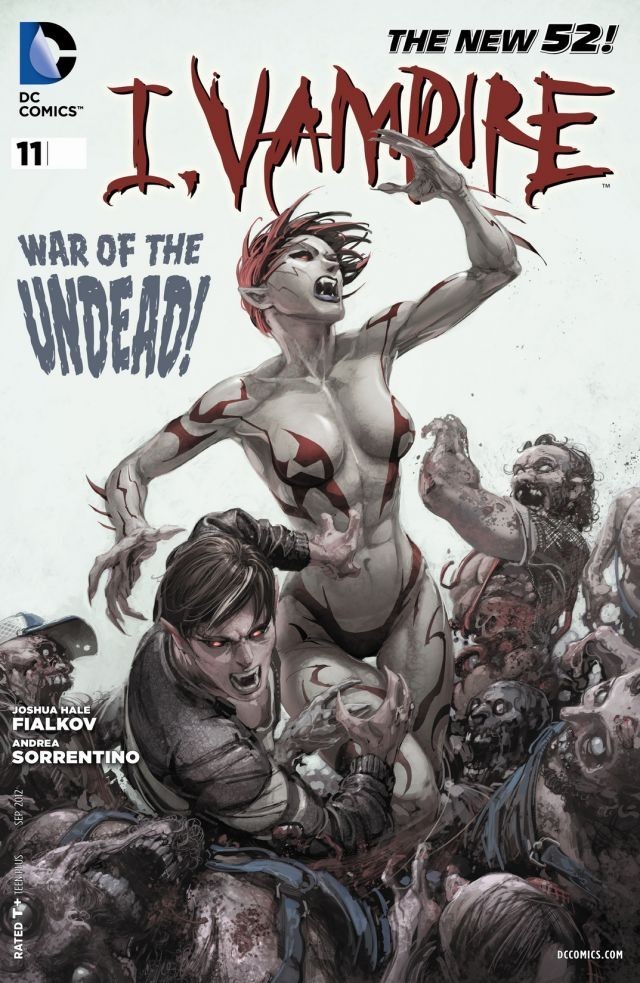
I, VAMPIRE #11

At this point in the Joshua Hale Fialkov and Andrea Sorrentino's "I, Vampire" series, it's not clear how serious the reader should treat the title. Following the "Justice League Dark" crossover, Andrew's new power levels have largely upended the status quo, with the vampires becoming much less of a threat to humanity.

Moreover, with the inclusion of the Van Helsing cult, the fate of the vampire clan seems to be an internal matter. Most of this issue's dedicated to mix and matching the horror movie cliches, with the results aimed primarily to amuse. The whole arc so far has been much lighter in tone than the issues that preceded it, and the result is some madcap, but easily disposable storytelling.

The new dynamic between Andrew and Mary seems too soon, and the Jae Lee-inspired artwork too stylized to deal with the high concept leanings of the plot. To his credit, Filakov doesn't forget about the cast, who stay in character and definitely bring their own flair to the title, but the book seriously needs to either return to the opening dynamic, or find a new workable direction.

JUSTICE LEAGUE DARK #11

The third part of "Black Room", by Lemire and Janin largely works better than the previous couple of chapters. Returning the Vertigo characters back to the DCU is still too bright and colorful, but the underlying superhero elements for once seemingly carry out the title's remit.

Most of the issue is taken up with a superhero fight against Felix Faust and the Demons Three, including the cliffhanger showing a member of the Justice League Dark betraying the team. Beat by beat, the book lives and dies on the premise that there is a whole world of interesting storytelling in the fantasy side of the DC Universe.

Most of the pages include a sparkling lightning bolt effect, with the magic of these characters ultimately amounting to shooting lightning bolt effects that cancel each other out. The Ulises  Arreola's computer colors give Janin's already stiff figures a new layer of artificiality, at least managing to liven up some of the rigidness in the pencils.

Ultimately, the subplot involving Madam Xanadu trying to win over Tim Hunter to help the team find the Books of Magic proves the most interesting. The remaining sixteen pages are capably executed, but at this point Felix Faust has already worn out his welcome, leaving the reader to be entertained by the actions of a continually of John Constantine. It would appear that no matter how well the creators apply superhero storytelling to these characters, the book's success with the individual readers largely hinges on how they react to the scenes such as "Hellblazer" sneaking into the titular Black Room to combat the villain with the mystical weapons from the magical history of the publisher's superhero universe.

THE MIGHTY THOR #17

The underwhelming "Marelock" storyline finally comes to an end in the pages of "the Mighty Thor". Ultimately, the plots involving Amora and the dream monsters finally intersect, but by this point they have little to offer to the readers. The Enchantress and her ever evolving Executioner replacement, they provide the physical threat for Thor, while bizzarrely, the protagonist of a "Mountain Goats" song fights off the Marelock invasion in the dream realm. The scene aims for poignancy but comes of as surreal as the final excerpt from Jeff' diary, written to his friend from "The Best Ever Death Metal Band in Denton".

Thankfully, the ultimate connection between two plot strands finally provides some measure of finality to Doctor Donald Blake, the real victim of Marvel's turning back to JMS' relaunch of the series. Unfortunately, Fraction's post "Fear Itself" Asgardia set-up has proven even more unmanagable, as we see here in Fraction's last issue preceding the crossover with "Journey into mystery" that will likely end both titles in their current incarnations.

By bringing in a teenager from Broxton, Oklahoma, the writer is adamant to stay true to Straczyinski's original idea of Norse Gods making a seat next to a middle American city. The problem is that the status quo he's up elaborated upon hasn't even been made feasable in the JMS issues, due to the creator's abrupt leaving after the disagreements with the editorial, and the resulting changes make for an unappealing mish mash of story concepts that are only broadly true in spirit to the Lee/Kirby originals. In Pepe Larraz's hands, the fantasy visuals break away from the Walt Simmonson's mythology-inspired approach, and present Fraction's "Thor" as a campy cartoon, divorced both from the trends of the industry and the rest of the Marvel's output.

Of course, the penciller is merely following Oliver Coipel and Pasqual Ferry's lead, but despite his clear layouts and powerful figures, there is never a chance that the artist is allowed to work in his own style. Just like Matt Fraction, the artist is trapped in the company's mandate on following up on the work of other creators, and at this point, "the Mighty Thor" is truly in a place where only the already announced "Marvel NOW" revamp can help to lay a foundation for a better integrated reinvation of the Silver Age superhero.


VENOM #21

The finale of "Savage Six" arc manages to be both action packed and poignant, as Rick Remender wraps up most of the story threads of his run so far. Cullen Bunn scripts the story that has Flash Thompson face off against Megatak and Toxin, with the fights being brutal but no more memorable than video game violence.

Megatak was introduced as a joke villain in Doug Moench's last issue of "Thor", but the high concept garishness of the character was apparently enough to grant him the role of token oddball. Still, despite Medina's efforts to present him as a credible threat, the character amounts to nothing more than a henchmen, justifying the necessary number of villains to parallel Spider-Man's nefarious grouping of enemies.

Eddie Brock is a much more integral presence, as Remender has for some time kept up with the actions of the previous Venom host. Unlike Human Fly, dispatched by Flash last issue, there is no real sense of finality to Toxin's fate, but the scene still acts to write out the character out of the series.

Finally, after delaying the showdown with Jack O Lantern for the next issue, Venom confronts Crime Master. The master villain's conversation with Betty frames the issue, and it is their relationship that ultimately resolves the threat that has come to dominate Flash's life. The fight is dynamic and clearly told, with the antagonist's weapon being particularly interesting in a clearly told sequence that leads to the climax.

Following the most engaging part of the issue, Medina somewhat stumbles when it comes to depicting the emotional fallout of the storyline. As a whole, the issue is as solid as the rest of the arc, whose wholesomeness almost comes as a surprise given it serves as the farewell for the original creative team.

WINTER SOLDIER #8

Ed Brubaker and Michael Lark's the second part of the three part "Broken Arrow" story slows down the action to focus on the procedural aspect of the Barnes/Sitwell operation. Both men continue searching for Natasha in their own ways, with the creative team naturally concentrating on the protagonist as he tries to beat the answers out of the hired help.

The fights are largely unmotivated and overly brutal, making it for once harder to sympathize with the impulsive anti-hero. On the other hand, his psychopathic opposite number Leo is starting to develop something of a personality, which helps the story considering that the book keeps shifting from the two points of view.

And while it's still unclear what the villain's ultimate scheme is, by showing his methods, the creative team has helped solidify his agenda. The book is so finely crafted, that even when it produces a largely transitory issue, it feels like Brubaker and Lark are showing us the events in the order that they happened.

Lark's time on the book is proving particularly exemplary. The one-time "Daredevil" artist is producing perfectly readable, well realized layouts, given weight and detail by inkers Thies and Guadiano. At this point, it's clear that the final issue of the arc will be at least as well realized as the two that preceded it, and there is every indication that Brubaker and Guice will try to match this level of professionalism with the already announced follow-up.