Showing posts with label venom. Show all posts

Wednesday, October 17, 2012

Marvel mini-events: EVERYTHING BURNS #6, MINIMUM CARNAGE #3

MIGHTY THOR #21

"Everything Burns" comes to a conclusion with Loki and Thor outwitting Surtur and halting his nihilistic plan. After meticulously weaving their summer crossover, the co-writers try to ambitiously wrap it up, settling for an ending akin to a typical coda for a "Journey to Mystery" story. The crossover certainly needed a wider and grander exit, but there is still a chance that the upcoming last issues of both Thor and Loki's titles will be able to smoothen the anti-climax.

The co-writers are certainly to be lauded for having Wilson and his Engels play a role in the Muspelheim gambit. Since coming to the fore, Surtur has largely overshadowed the other parts of the conflict, thus it makes sense that one of his allies would end up being key in his downfall. Unfortunately, the underrepresented Vanir receive no such coda, being relegating to the thematic resolution between Odin and "Frigga".

The focus on Surtur comes as no surprise given the threat he represents. Since Walt Simonson reintroduced the character as a major foe for the first third of his run, the publisher has been in a unique situation. The writer/artist had produced a  villain on the scale of Galactus, at the same time forcing Marvel into the same situation regarding the cosmic level threat. His rare appearances in the following decades attest to the fact that it's hard to find a story that justifies the scope involving the ultimate nihilist, with each defeat doing away with a bit of credibility when it comes to the threat he poses for the Nine Worlds.

Having the character use the phrase "I am your doom" twice in the space of two pages (no matter the emphasis) almost relegates him to a cartoon villain. Confining him to Muspelheim's caves and attacking the Asgardian armies with Twilight sword does little but establish him as a fire giant. His defeat is a foregone conclusion, and the heroes seem more concerned with where they will store the energy released in his fall.

Without the only visible losses once again relegated to a rare panel depicting the battles in the other realms, the co-writers have effectively put all their strengths into the trickery involved with bringing victory to Asgardia. Alan Davis certainly tries his best to make the scenes suitably epic, but the lack of proper dramatization relegates all his efforts to a reading of the script visualized in his style. The bizarre visual of Twilight's shadow grafted onto Mjolnir is a poor substitute for a heroic conclusion.

The trickery that the protagonists resort to amounts to a couple of overly verbose scenes tackling the mechanisms of Surtur's plot that have barely been mentioned since the story began. A crucial conversation between Loki and Wilson draws on the previous "Journey to Mystery" and quickly dissolves into endless exposition regarding the internal logic that seems primarily of interest to Gillen and Fraction. It doesn't help that Davis has trouble adjusting to Richard Elson's design of Wilson, with the scene saved primarily by the veteran artist's command of body language.

The co-writers make an effort to have Thor devise the final part of the plan, resulting in a scene that determines Odin's role following the crossover. The stylized dialogue is to blame for robbing the sequence of its proper impact, but even this is overshadowed by the increasingly experimental conclusion. Three whole pages are devoted to nothing more than a gag setting up the epilogue with a few irreverent lines and no art.

What follows basically sets up Loki's last adventure in the next issue of "Journey to Mystery", and feels largely extraneous to the wider crossover. Having Hellstorm, an unlikely supporting character in Gillen's run on the title announce that Thor's half-brother still has a one final crisis to, while hinting at the character's true nature has little bearing on the immediate aftermath of the mini-event. A true reunion with Volstagg and the rest of Asgardians would have provided for a more natural ending to the crossover.

As it stands, Marvel will likely be collecting the final issues of both "the Mighty Thor" and this iteration of "Journey to Mystery" along with the bulk of the mini-event, explaining the somewhat truncated ending of the crossover proper. Hopefully, Gillen will find space for more scenes involving Leah, as her interactions with Loki have been a highlight of this issue, possessing a human quality lacking in the interactions between the rest of the cast.

VENOM #26

What started out as a tedious mini-event has, after the largely entertaining sophomore issue, turned once more in the direction of randomness and irrelevance. At this point, the story seems scattered, with the primary players scattered around Microverse, a fantasy locale wholly unprepared for the symbiotic horrors.

The story tries to reassert Carnage as the chaotic murderer who does away with his Microverse hosts, with Bunn content to dismiss with the characters before the reader is has gotten accustomed to their strange character designs. Shalvey, the regular artist of "Venom" proves particularly adept at illustrating Kasady, whose elongated body is constantly boiling with madness. The writer/artist seems somewhat less convincing when called to illustrate fight scenes featuring Micronauts (calling themselves "Enigma Force", as per the recent Hulk mini-series), leading to dense pages with unclear layouts.

Both Venom and Scarlet Spider narrate their own scenes, with Venom's creative team being a chief factor in individualizing this chapter of "Minimum Carnage". The writer instills more of a challenge in Flash's scenes, given that symbiotes seem to be harmful to Microverse, but even than the conflict seems obligatory. Having Bunn make the protagonists comment on the arbitrary nature of their predicament has the opposite of the intended effect, and brings to the fore the main problems with the crossover.

Why are these characters interacting with Microverse? The story tries to link the alien nature of their symbiotes to the science fiction world they found themselves in, but the remits of the crossover preclude the creator's ability to do the requisite world building. In theory, placing Carnage in Microverse means that the character can do much more damage when compared to the confines of Marvel's New York centric universe, but so far the mini-event hasn't really been able to exploit this.

The chief source of intrigue in the story so far stems from the role of the ambiguous Redeemer, who instills a dose of mystery regarding his identity and the role in the wider story. To arrive to the middle point of the crossover and still be largely kept in the dark regarding the stakes and importance of the story beyond the need to get the Spider-Man supporting characters together and have them exit the dimension is very curious. On one hand, Marvel seems willing to slowly reintroduce the Micronauts characters to their broader audience, but "Minimum Carnage" is surely the wrong place for it (not to mention that a ongoing "Enigma Force" title could hardly be expected to succeed in the current market).

Wednesday, October 3, 2012

Comic reviews for Wednesday, October the 3rd

ACTION COMICS #13

After last month's Zero issue, Grant Morrison opts for another themed issue with #13. This time opting for a Halloween connection, he presents a complete story updating the Phantom Zone to a more modern aesthetic. Once again, the story centers around Clarke finding more about his Kryptionian origins, but the writer is determined to make the issue accessible.

In order to do this, Morrison even introduces story book narration, which largely proves superfluous expect for a brief scene near the end, where it sheds light on a sequence involving invisibility. The story is illustrated by Travel ("Animal Man") Foreman, who adopts a rich, computer enhanced style that complements the Kryptonian imagery of the flashbacks and imbues a futuristic haunted house look to the Fortress of Solitude. Where the artist falters is with the character design for the villain, doctor Xa-Du.

The character sports an overly busy look, suffering from the lack of clarity, and at times looks alternately like a mummy or a cloaked figure. The reader is not given a good look at the Ecto-suit he wears, which proves central to freeing Superman from the Phantom Zone trap. Otherwise, the pages look eerie and effective, washed in blues, blacks and browns, with splashes of red reserved for Superman's cape.

In many ways, Foreman's artwork recalls Gene Ha's contributions to the series, but he ends up lacking the veteran artist's definition when it comes to the character physiques. Interestingly, DC feels the need to imbue an outsider character in the Phantom Zone, giving the Phantom Stranger a role that consists of two pages of exposition.

The character is otherwise dubiously out of place, and presumably only shows up to prepare the readers for his place in an upcoming crossover. For the purposes of the story, General Zod could have taken his place, as the character was always closely associated with the Phantom Zone. Perhaps the writer has deemed the character too important to play only a small role in his first appearance following the flashbacks in the early issues of "Action Comics".

Otherwise, the issue is largely notable for reintroducing Krypto, last seen fighting Zod in the aforementioned flashback. The Clark-Krypto dynamic works on a level that the otherwise scattered "Action Comics" run constantly aspires to, but rarely succeeds. The Superdog's loyalty completely justifies Clark's desperate efforts to save the dog, and seeing the two reunited provides a pleasant respite before the final page teasing Morrison's last Superman storyline.

Sholly Fisch picks up this sentimentality in the back-up, providing a piece that unapologetically invites the reader to wallow in emotion. Showing the ghostly Krypto's loyalty and love for Clark quickly turns into a universal story about a boy and his dog, with the creators going so far to underline the notion both in dialogue and the title. There is little that is subtle about this back-up, but in its heavy handedness it does turn into a moving science fiction story.

Brad Walker's art is similarly bold, but lacking the polish that would make it noteworthy on its own. The layouts are clear, but suffer from occasional problems with proportions and clunky details. The pages showing Clark's adventures and the destruction of Krypton are needlessly cluttered and unappealing, but in general the artist does manage to visualize the script in a way that brings out the best in Fisch's narration.

BOYS #71

The penultimate issue of "the Boys" finishes up the last storyline, leaving only the next month's epilogue to complete the series. Ennis writes a slightly anti-climatic conversational story about the relationship between Hughie and Butcher, as the two men cope with the consequences of last issue's cliffhanger.

Butcher no longer a direct threat, Ennis comes clean about his methods, but the writer mostly concentrates on the differences between the pair and the dynamic they have established over years of working together. It goes without saying that the veteran character-oriented comics writer manifests a deep understanding of the human nature, supplemented by Braun's expressive artwork.

Faced with the script that features two immobile characters talking on the rooftop, the artist does his best to provide a variety of perspectives, moving us in and out of the the pair's faces and rotating the point of view to maintain the tension. Despite all this, the layout remains clear and functional at all times, the characters tense, desperate and melancholic.

In the middle, the script breaks from the blue-toned melancholy by using a four page sequence showing the eventual fate of Jessica Bradley. The break is short and logical, even as it leaves the character in a frenzy. Refusing to settle for shock tactics, Ennis goes on to cite the relevant bits of dialogue between Bradley and Sitwell, which put the events in their proper context.

Getting back to Hughie and Billy, the writer has them go through all of the questions that longtime friends would ask each other when facing certain death, in turn providing the characters with final definition. Butcher remains charismatic and manipulative to the very end, but it comes with a genuine sense of honesty and affection. Ultimately, "the Boys" is Hughie's story, and it ultimately falls to him who has to overcome one last challenge, revealing his true nature.

It's hard to say whether this is the best way the story could have ended, but there is no question that the creators commit to it and present it in a very accomplished way. It's refreshing to see a genre effort finishing up with such a downbeat character driven resolution, that both stays true to the characterization, and still remembers to offer an explosive ending, on par with the most exciting moments of the series.

MINIMUM CARNAGE ALPHA #1

The Venom/Scarlet Spider crossover begins with the "Alpha" issue, co-written by Cullen Bunn and Chris Yost, and pencilled by Lan Medina. The regular writers of both titles assume the reader is unfamiliar with the current premise and offer a very dense script. The story alludes to the events in the couple of recent "Carnage" mini-series, but otherwise functions as a thriller, in which the pair of vigilantes have to contain the escaping psychopath.

The absence of Zeb Wells, the writer of the aforementioned "Carnage" and "Carnage U.S.A." leads to a distinct lack of humor, or anything approaching a style of its own. Both Venom and Scarlet Spider are larger than life personalities, but they end up little more than civil servants, working closely with the local authorities to deal away with the threat. The story introduces some of the supporting characters from both books, but Flash's newspaper reporter ally, as well as Kaine's friends the policeman and doctor only serve to fill in the otherwise generic roles in the very plot-oriented script.

Lan Medina, his art inked by three inkers, likewise feels stifled by editorial mandate, turning in competent but uninspired work. The layouts are clear, the characters on model, but there is no illusion that anyone in the creative team is giving anything more than their professional best. Medina's Scarlet Spider thus becomes too bulky and generic, Carnage, while Venom stays on model, thanks to the artist's recent stint working on the solo title. The artist also takes time to warm up to Carnage, as his version of the symbiote initially appears as if Kasady is wearing a costume.

It's hard to judge the artist's take on the Micronauts characters, as they seem analogues to some of the Mantlo/Golden characters, but at the same time distinctively new. The publisher hasn't renewed the licence in years, but still retains the rights to the characters created during the long run the title enjoyed in 1980s. It's unlikely that much of the today's audience is familiar with the series, but "Minimum Carnage" is another chance to try and integrate bits and pieces of the continuity into the modern day Marvel universe.

Seeing Carnage associating with the derivative Micronauts characters and eventually escaping into what is essentially Microverse should add a layer of interest to the crossover, but comes off as random. The relatively grounded "Spider-Man" spin-offs seem like a last place to revisit the Micronauts following Marvel's cosmic crossovers, and it's highly doubtful that "Minimum Carnage", as seen in this prologue issue, will amount to more than a generic story meant to provide a short sales boost to "Venom" and "Scarlet Spider".

Wednesday, September 19, 2012

Comic reviews for Wednesday, 19th September

DAREDEVIL #18

The latest issue of "Daredevil" follows up on the Matt/Foggy split in a way that both introduces a new plot point, and teases a twist regarding our protagonist's mental state. Once again, Mark Waid focuses on Daredevil's legal career as a way of bringing in new characters and situations, while grounding the series in a semblance of reality.

Everything about this new story feels natural, and it works on a basic level that all superhero stories should follow. The creators offer an easily accessible issue that stands on its own, while being a part of the larger whole, that is informed by their previous work on the character. Samnee is equally adept in long conversation scenes, featuring Foggy and his new client, as he is in making the Daredevil sequences flow in a way that is organic and interesting.

His characters and expressive, and slightly exaggerated, which fits with the quirky script, The one page sequence the creative team devotes to Matt's burgeoning relationship with Kirsten likewise perfectly illustrates the pair's playful dynamic and the romantic tension that has been simmering between them. The subsequent inclusion of a character associated with previous runs on the title becomes both sudden and intriguing, with Waid giving the uninitiated the necessary information to follow the sequence.

The protagonist is as surprised by the sudden arrival, and the complicated continuity alluded to is anything but essential to understanding their current predicament. The imparted information was pertinent to justify Matt's reaction, which serves to reconnect him with Foggy, and in turn bring him in contact with the case. The writer uses Foggy's brashness to acknowledge that is too early for the two to start mending their relationship, but there is still a feeling that Waid could have found another way to get Daredevil in contact with the situation.

The following action sequence is as well executed as it is unlikely, but it serves to underscore the supernatural element of the situation, which is further cemented in the cliffhanger, that offers definite proof of a third party interfering with everyone's perceptions. This kind of stories, where the villain plants evidence and makes everyone assume the worst out of the protagonist can be as familiar as they are unrealistic, but thankfully, the creative team offers enough style and competence that it makes the reader enjoy the experience.

By focusing on the interplay of the characters, Waid and Samnee may be encroaching on the soap opera territory that was severely mishandled at Marvel during 1990s. Using a intuitive, detailed approach, the creative team (including the colorist, who notably changes the color scenes to avoid the captioned interrogation sequences slow down the book) successfully update the original Stan Lee/Bill Everett/Wally Wood "Daredevil". The continued audience support and the recognition when it comes to comics awards are the best example of how well the industry rewards such solid, wholesome entertainment.

JUSTICE LEAGUE #0

So far, DC's Chief Creative Officer Geoff Johns has allowed himself a great deal of fr`eedom in crafting the #0 issues of his books. Given that the entirety of the initial "Justice League" arc served to introduce the characters in their first adventure, the writer makes an unorthodox choice here, and uses the space as the continuation of the Shazam back-up.

The Gary Frank illustrated story largely serves as the character's superhero origin, and therefore fulfills the remit of a #0 issue, with additional emphasis on the subjective importance to the wider DC universe. On a structural level, there are a lot of problems with the issue, starting with the first page. A confusing layout choice makes it uncertain if the antagonist is present in the room, with the next page following up on Billy Batson.

Frank's representational artwork and a deep seated cynicism continue to sit uneasily with the traditional fairy tale elements, but the feature once again manages to provide a satisfying experience due to sheer experience of the creative team. Seeing the Seven Deadly sins of man in different colors, with their names floating under the designs in a graffiti-like font certainly seems like another in the line of heavy handed decisions made in revitalizing Captain Marvel.

The Golden Age property has proven so resistant to any kind of revitalization, and at this point the Johns/Frank effort seems like a credible attempt at keeping the characters around. Yet, seeing the Wizard, a confused old man who instantly rejects Billy as the champion seems as reactionary as the rest of the revamp. The creators stubbornly work in opposition to the naivety of the original premise, yet they don't go so far as to subvert it. The lesson seems to be that underneath the negativity, all of these are hopeful, optimistic characters, that just need a real chance to show their goodness.

This is the lesson Billy teaches the Wizard, who in trading with absolutes forgets the need for the Earth's magical champion, and ends up accepting the orphan so that he can combat the threat of Black Adam. After several hurried lines, Billy's mentor dissipates, leaving the problem child to find his own way with the powers and the maturity needed to wield them.

The creative team accomplishes this by bringing Shazam back to the streets of America, where he continues reacting to the situation in the way a pre-teen boy would. In Johns and Frank's hands this means leads to a series of quick confrontations, notable for their artificiality and the disturbing way Frank renders Shazam's face. The penciller/inker tries to recreate the C.C. Beck's design, which translates to the page in a very unnatural way. The popular artist, whose expressive characters owe a great deal to Steve ("the Preacher") Dillon's techniques felt much more natural when rendering the Christopher Reeve inspired Superman during his tenure on "Action comics".

At this point, he has yet to find a way to make the original Captain Marvel design his own. The feature remains ill-balanced and somewhat dishonest, translating the children's power fantasy into a forced retelling that will hopefully be discontinued following the protagonist's confrontation with Black Adam and Sivana.

Without a major rethinking, a misreading of the material on this scale seems like a waste of the time for both of the creators, whose talents could be better used in bringing another character to the forefront of the modern DCU (or even creating their own properties, however unlikely given the writer's status at the publisher).

The remaining four pages feature Johns once more collaborating with another of the company's most prized artist, Ethan Van Sciver. The "Green Lantern: Rebirth" creative team feature another of the ominous "Justice League" back-ups hinting at an upcoming major event. The feature follows up on the Wizard's eventual fate following his departure from Shazam, before setting up the Question for a seemingly important role in the shared universe's near future. The artist's detailed style meshes well with Frank's work on "Shazam" and the teaser is unoffensive enough, if overtly dramatic.

THE MIGHTY THOR #20

The fourth chapter of the "Everything Burns" crossover presents a largely transitory entry. Despite being told in an issue of "the Mighty Thor", this plot heavy issue continues the spotlight on Loki. Repeatedly the episode calls specifically to the events in the relaunched "Journey into mystery"'s initial arc, to the extent that Thor is perpetually sidelined. Beyond the "Fear Itself" call back, Matt Fraction's own work with the mythos is at the moment relegated to the obligatory renaming of Asgard.

Yet, despite having a firm basis in Kieron Gillen's work, the storyline works as if features the same group of characters, especially when rendered by Alan Davis. The penciller's clean figures, richly colored by Javier Rodriguez do provide some variations when it comes to the pages featuring Thor's struggle. The character is inked differently, and feels slightly out of place next to the rest of the cast, who are more traditionally realized.

Usually, there is a slightly caricatural bent to Davis' figures, which disappears in the ethereal scenes featuring Thor in Musspelheim. The character's features look exaggerated to the point that he almost appears as if he was rendered by Mike ("New Avengers") Deodato jr. Aside from this, the issue covers several different battlefronts and generally succeeds to establish the escalating threat of Surtur unleashed against the Nine Realms. At this point, Vanir are largely forgotten about as anything but his proxies.

Having established that Heimdal shares their ancestry, it would have been interesting to his changing role in the story brought up by a deeper conflict than mere mechanic possession. Still, this makes sense given that the story prefers to flesh out the roles of the two book's mutual cast instead of focusing on a number of new characters.

Thus, "Everything burns" continues to slowly build to a crescendo that will pit brother against brother and everyone against Surtur, while no doubt finding the space to satisfactory resolve Freya's role. Despite the presence of two pencillers, its a model example of two titles wrapping up in a satisfactory way, in a storyline that has the appropriate gravity and requisite storytelling quality.

VENOM #25

Cullen Bunn concludes his introductory storyline on "Venom" just before the title enters into the crossover. The three-part "Monster of Evil" nevertheless promises to carve out a new direction for the title, rooted in the occult and end of the world scenarios. Picking up from the loose end of the Ghost Rider-centered "Circle of Four" crossover, the new writer is adamant to continue pursuing the unlikely direction, with Thony Silas in tow as the regular penciller.

Three inkers are tasked with finishing the artwork, but the discrepancy only shows in the last several pages, serving as the epilogue to the monster fighting. The writer finds space to provide some background for the four demon possessed entities, but it still seems like there's too many of them. Even if the creators have found a way to introduce the titular Monsters of Evil earlier in the story, there is no guarantee that they would have left a better impression.

Silas seems particularly on form on the splash pages featuring the entities though, who remain colorful enough to capture the reader's attention. Beyond the fight scenes and Venom's scheming against Hellstorm, there is a nod to the traditional Spider-Man characters that made up the book's previous supporting cast. Yet, the writer seems very firm in taking the book in the new direction, one full of ominous portents.

Seeing that the creative team is apparently looking to expand the Son of Satan's role in the title, perhaps it's better that the readers approach him as a totally new character. The book plays fast and loose with the spiritual framework of Marvel universe in a similar way to Roberto Aguirre Sacasa in his work on "Nightcrawler", but for once the publisher's inter-continuity largely limits the implications.

As the story nears conclusion, Flash's actions become increasingly arbitrary. It's clear that the creators are committed to making the title their own, but it's hard to accept the change when it involves Venom keeping the demon who tried to possess him under control as he enlists his new supernatural aide to read up on the end of the world. By the time Katy Kiernan, the book's new Lois Lane analogue improbably declares that the Marvel mainstay Doctor Strange has repeatedly asked for her help, the readers will have to decide for themselves how much they trust the new creative team with the unlikely direction.

Flash's last page attempt to get back to Betty, a major link to the title's status as a Spider-Man spin-off, get cut off for the purposes of transitioning into the "Minimum Carnage" crossover. It remains to be seen how the book manages to continue once it stops functioning as a tie-in for the overarching Venom/Scarlet-Spider event.

WALKING DEAD #102

Robert Kirkman and Charlie Adlard wind down the latest arc of "Walking Dead", with an issue that serves to underscore the character's predicament. The issue is not in the least subtle, and basically features Rick coming to a decision regarding Negan's captured leutenant, and surveying the rest of the cast to see if they agree with his plan.

Charlie Adlard is called time and again to illustrate the close-ups of characters talking, with layouts frequently featuring seven or eight panels. Michonne's reaction is most interesting, and the three page conversation scene seems in many ways the highlight of the issue. Adlard is particularly inspired when it comes to illustrating her features, that are for once tender and defensive.

Still, the conflict between Rick and Andrea makes up the crux of the issue. The characters are separated in the emotional way too, as their intimate scene lacks the empathy the protagonist shares with Michonne. From the artistic point, the issue is obviously hurried, as the artist takes more than the usual amount of shortcuts, with several repeated panels, and a persistent lack of backgrounds.

The artist does get to achieve a strong effect with a panel featuring Rick behind the fence, illustrating the character's forced retreat. The issue sets up Eugene's new role in the story, which comes organically from some of the last developments regarding the long troubled character. Otherwise, it is the last page cliffhanger that suggest a more proactive future for characters.

With "Something to fear", Kirkman has achieved a semblance of a story that stands on its own after several of the last arcs that had much looser structure. The last time the sprawling series tried a similar feat was with "the Hunters", and it's nice to see the creators returning to the more conventional format. Having said that, the effects of the last few issues (particularly #100) have come to more or less define the new status quo, and there is every indication that the series will return to exploring it in its own meandering way, a slow burn strategy that is not without its obvious strengths.

WONDER WOMAN #0

Both Brian Azzarello and Cliff Chiang are confident creators, and it comes as no surprise that they try something new with #0. The perfunctory prequel issue is used to set-up the title's next story arc featuring Ares, but it stands out more for the way in which the story is told. Namely, the creators use the prequel issue to tell the story in a way reminiscent of a Silver Age Marvel comic.

Thus, the laconic Azzarello persists in using outdated techniques such as excessive captions and thought balloons, spelling out what is readily apparent on panel. Just like the superheroes of 1960s, the characters speak in banalities and frequently reference Greek heroes, leaving no trace of the writer's usual highly stylized dialogue. Chiang likewise tightens up his inks and provides a much more defined look for his pages, filled with familiar panel layouts. The colorist shies away from an over-reliance on the primary colors, saving the book from devolving into outright pastiche. Yet, the tribute is apparent in little details like teenage Diana's huge expressive eyes, and the Minotaur wearing purple shorts.

By deliberately slowing down the pacing, the writer forces the reader to appreciate this accessible entry point into the creative team's controversial rebuilding of the Wonder Woman story. Surprisingly, Stan Lee's trademark self-doubt does prove to be a viable technique to understanding Diana's views on the Golden Age fairy tale society.

At first glance, Ares' dialogue sounds like deities from Marvel's "Thor", but there is some genuine emotion between his actions. At first, it may be hard to respect the character clearly modeled on the writer's current look, but the Wonder Woman/Ares dynamic eventually does make up for an interesting conflict. Eventually, the addition of Daedalus' labyrinth and Theseus-like battle with the Minotaur end up being so derivative that they make a full immersion next to impossible.

The artificiality of both the trappings and storytelling comes as an in-joke between the creative team and the readers, whose attachment to Diana's conflict with her mentor will likely determine their enjoyment of the issue. In any event, one must respect Azzarello and Chiang's audacity to satirize DC's Zero month, who have certainly found a way to follow the company's edict, set up the upcoming storyline and enjoy themselves in the process.

Thursday, September 6, 2012

Comic reviews for Wednesday, September the 5th

ACTION COMICS #0

Grant Morrison's "Action Comics" run started very early in the career of the first and most famous superhero, making the company's prerequisite #0 prequel issue largely superfluous. Both Clark's origins and his early days have been the topic of countless retellings, but this issue purports to reveal the exact circumstances behind his origin in "New 52".

Penciller/inker Ben ("Vigilante") Oliver for the moment replaces Rags Morales as the artist behind the T-shirt and jeans Superman's debut. His work here is somber and figure oriented, serving to ground the fantastic events in the sepia toned uneasiness. It works to instill a sense of past the recent past, but it still imbues the story with a wearisome tone, that works better with the subplot involving the titular "Boy who stole Superman's cape".

Morrison chooses an early transitory period in Clark's life in Metropolis, and frames the story around the question of how he ended up with the Superman moniker. The writer uses a couple of pages showing the protagonist settling in to his new apartment to set up the forthcoming arc starring Mr. Mxyzptlk, but he mostly focuses on the regular supporting cast. It's Clark's colleagues in the rival Daily Planet that get to asks the questions regarding his cape and the nature of his powers.

Typically, this kind of story doesn't really challenge Morrison's sensibilities as the writer. The departing scribe tries for his professional best, but it's hard to exhibit much enthusiasm when tackling material this well tread. As for the Luke, the child that steals the cape to confront an abusive father figure, his story is about as perfunctory as the rest of the issue. It serves to both encapsulate the wish fulfillment behind the Superman's powers, as well as to remind the reader of his role as the champion of the oppressed.

Yet, the regular reader of the title is deeply aware how quickly Morrison dismisses with the more grounded elements of Superman's accomplishments. The issue even climaxes with the scene featuring Clark stopping a train, a clear callback to his actions in Morrison's first issue. It's not to say that there's no style on display here, but there is a definite sense that the company is forcing the writer to repeat himself very soon after debuting with what is essentially the same story. It is unfortunate that the company did not simply reschedule the story as an Annual, and have commissioned a script from one of their other freelancers.

Of course, this is exactly what the company is already doing with the back-up. This time, Sholly Fisch returns with a simply story detailing the origins of Captain Comet. The writer's script is very accessible and more traditional, as is CAFU's art. The reader follows a scientist researching the truth behind the Blake Farm ghost story, who ends up meeting Adam at a crucial point, which forever alters his life. The short ends with a hint linking the events to the Andy Kubert pencilled fill-in arc from issues #5 and 6, but it reads just as well for the reader who is unaware of the connection.


BOYS #70

With the series set to conclude with #72, the biggest impression this issue makes is how calm it appears. There is no sign of rushing through the plot lines, character behavior that feels sudden and off key, and a general sense of the creators losing control of the series, unable to properly finish their work. If anything, Ennis and Braun treat this issue like any other in the series, quickly setting the somber mood and following the rising tension until the cliffhanger.

The spotlight is kept firmly on Wee Hughie, and his fragile state of mind, as the character tries to cope with last issue's cliffhanger. Throughout "the Boys", Hughie has been the reader identification figure, a flawed and sensitive young man, whose presence has managed to ground the series in the best way.

Throughout the series, the Scotsman has been surrounded by veterans of the decades of superhero conspiracy, who exhibited a great deal of patience regarding his many misgivings. At this point in the series he has been left without their help, and for once there is no one around to shoulder his pain. Realizing this, Hughie goes about his way, encountering two of the series' odder mysteries.

It should be noted that both of these are of a nature that would have made it extremely unlikely that would have passed the original publisher DC/Wildstorm's consent. The first of these is quickly wrapped up, but there is a sense that the writer is deliberately focusing of the body horror aspect of the scene, to distract from what it could signify story wise.

Russ Braun's artwork likewise skirts the line of horror and parody, with his design of the "monster" in the basement going completely over the top. The Vought-American subplot gets its requisite three pages, this time a lovely choreographed dialogue scene that finally starts addressing the obvious question of the choice of the scapegoat for the company's failings.

The slowly escalating plot allows for one final diversion before the finishing set piece, dealing with another minor series' mystery. This time, Ennis uses the opportunity to directly tie it into Wee Hughie's forthcoming confrontation with the Butcher. Faced with even more evidence of his tutor's shady dealings, the writer lets the protagonist gathers his thoughts, before heading off to finally meet him face to face.

A particular coloring choice carried out through the issue becomes more than apparent in this sequence, as the texture used to indicate Hughie being covered in soot somewhat distracts from the more traditional colors otherwise employed. The use of water colors (or more likely, a computer filter fulfilling the same purpose) feels somewhat distracting when placed over Braun's rendering of Hughie, even though it adds to the feeling of the hopelessness emitted by the character who faced with overwhelming odds.

The episode ends with the sequence featuring another New York landmark, which has added resonance following last issue's end. The slow burning conflict feels natural, with Ennis' dialogue perfectly pitched and life like. Braun's frames the sequence in a way that competently dramatizes the deeper conflict, which breaks only for the cliffhanger.

In the end, the readers get to benefit for having two more issues of the series to look forward too. Each of the plot lines has been given a proper send off so far, and barring any last minute rushing, the eventual fate of Vought-American superhuman handler, Annie, Hughie and Butcher, is likely to be a culmination of everything that's lead up to this point, in the best possible way. It's extremely rare for a series to be executing its final arc this well and "the Bloody doors off" is at this point setting up to be the title's best arc.

HAWKEYE #2

Having established his take on the character last issue, Matt Fraction and David Aja use the second entry in the series to set up their story. In essence, the creative team seems to be using the backdrop of global depression to tell the adventures of Clint Burton as a modern day Robin Hood, while still working in the milieu of Marvel universe.

Starting with this issue, the book includes Young Avengers' Kate Bishop, the teenager that used the Hawkeye moniker as a spunky sidekick. Matt Hollingsworth provides a palette of differing shades of purple, the color traditionally associated with the Avenger, helping the creative team realize their stylish superhero book.

In trying to maximize the effectiveness of the artist's detailed, intuitive panels, Fraction deliberately slows down pacing with a combination of naturalistic narration and quirky dialogue. In effect, this frequently breaks down Aja's pages into a high number of panels, trying to capture the details of the mood and atmosphere, imbuing the book with another layer of personality.

 At this point, the book lacks the sense of fluidity that characterized Waid and Rivera's "Daredevil", the book's closest match when it comes to the publisher's output. Both of the creators seems to be trying hard to make the experience special both for them and the reader, in the process creating a comic that tries to be too many things at once.

On one level, "Hawkeye" wants to be a slick heist story in the vein of James Bond. Unfortunately, the addition of Marvel supervillains serves to remind the reader that they are reading a variation on a superhero formula that can only go so much before circling back to the same tropes. For the moment, the writer may be concentrating on Hawkeye's circus past and not on his more traditional days, but it's only a couple of pages later that the he brings in the Swordsman connection.

In trying to honor the essence of the character, Fraction is well aware that he has to include Hawkeye as a superhero, but he tries to keep his archery skills in the background, making it all the more special when the character finally uses them in action. Even then, the protagonists helpfully point out that they are using nonlethal violence, another hallmark of the limitations placed on the superhero storytelling.

There is no doubt that both of these accomplished creators have a plan with "Hawkeye", and it may be that in time they'll manage to build upon the foundation laid here, but at the moment the book feels labored and less than the sum of its parts.

MIGHTY THOR #19

"Everything burns" continues in "Thor", with Alan Davis returning to pencil this part of the crossover. Once again, the writers reiterate the information pertinent to the new Aesir/Vanir war, maintaining the tone of the event focused on character conflict. It's telling that a two page sequence tries to inform the reader that this is the conflict raging in huge battles all over the Nine Realms, but in practice it feels like nothing as such.

Until now, the war has consisted of an opening barrage and is more or less still in the opening stages of the conflict. Mainly, Thor and his friends are still debating the way to deal with the Surtur-powered threat, with the creators adding in the aforementioned sequence precisely for the purpose of fulfilling genre expectations.

This is not to say that "the Mighty Thor" features no fight sequences. The issue starts by picking up on the cliffhanger from "Journey into Mystery", featuring a fight between Thor and the Warriors Three. It is is a familiar image, if not the most welcome one, but Fandrall's subsequent derision works to make it a bit more authentic than the average clash between heroes.

These characters have traditionally be prone to speechifying, but their actions so far feel somewhat out of character. Seeing Thor address the Loki by putting the child in the choke-hold further undermines the strange state of the series the event is spinning out of. With Freya's characterization, Fraction and Gillen have finally managed to get some storytelling opportunity from the character's raised profile, but the wider trinity of Allmothers still feels strange and out of touch.

Idunn and Gaea‘s role never managed to stretch beyond the symbolism, with Odin continuing to play a larger role even though he is absent from the proceedings. The issue finishes up on a promising cliffhanger that further integrates how personal the conflict feels to both Thor and (especially) Loki.

All things considered, despite the creators' best efforts, the crossover is unlikely to prove relevant beyond the current moment in both "the Mighty Thor" and "Journey into Mystery", but the story certainly feels larger and more important than anything following "Fear Itself". And while "Everything burns" lacks the more universal appeal of the wider Marvel universe crossover, it more than makes up in its tone that is respectful to both the Lee/Kirby interpretation of the Norse mythology, as well as everything that Fraction and Gillen brought to their respective titles.

PUNISHER #15

The penultimate issue of the Rucka/Chechetto run on "the Punisher" (before the title transforms into the "War Zone" mini-series that will wrap up this take on the character) deals with the fallout of Frank and Rachel's last issue's mission. After last issue's flawless showdown with the Exchange, the vigilantes are forced to contend with one last bit of unfinished business.

The things quickly spin out of control, as one loose end overreacts to the shootout, leading the Exchange leader to maniacal lengths. As always, it goes without saying that Rucka's script works as a story in its own right, providing everything the reader needs to understand the events in motion, without resorting to expository monologues.

The creators are depicting an ugly situation, but the approach their utilizing is anything but. The bulk of the realization falls on the hands of Chechetto, with the returning penciller/inker realizing all of the disturbing events in the way that is both concise and powerful. The reader is at all times aware where each of the characters are in opposition to one other, except for the very end, where the lack of perspective becomes an important story point.

Marco Chechetto's return to these pages after two fill-in issues feels very welcome, as his powerful, animated figures have come to define this approach. The artist naturally feels much more at home with the character designs than Mico Suayan, even though he lacks the latter's darker edge. The brighter colors do somehow re-frame the horrible massacre into something approaching video game violence, but for better or worse, this was the way the title has always worked in the hands of these two creators.

The crux of the issue revolves around Frank's tactical approach in a situation going haywire, which ends with a seeming demise of a cast member. The antagonist willingly sacrifices himself to bring Frank and Rachel in conflict with the authorities, providing the impetus for stories now that two have dealt away with the Exchange organization.

At this point, it's pure speculation whether Rucka's original series overview included provided for the inclusion of superheroes that will have large roles in the "War Zone" mini-series. The conclusion of this issue certainly hints at an extended hostility with the local authorities, but the creative team's insistence that their story takes place in the superhero universe certainly provides for a possibility of a larger role for the superhuman community.

VENOM #24

The greatest compliment that could be given to Cullen Bunn's second issue as a solo writer of "Venom" is that the story stars to read as a comic in its own right. Even though it recasts Daimon Hellstorm as a generic sadistic monster, and has very little to do with Venom or Flash Thompson, "Monsters of Evil" is at least starting to function as an entity of it own.

The story legitimizes itself as the follow-up of the "Circle of Four" crossover, which only complicates the matters. In order to get to the pulp thrills that Bunn is trying to carry over, the writer has to meander through both the internal logistics of Marvel universe and the series' own continuity. At this point, the reader is made to feel every leaden step of his way through both of these, resulting in an overloaded synopsis.

Flash Thompson is the man who has had the Venom symbiote grafted to him, whose soul has been marked by Blackthorn the devil as part of the story in which he met Hellstrom. Following up on a McGuffin, Venom ends up being duped by Hellstorm, who possesses the symbiote with a demon. Having discovered that he still has a measure of control due to the mark on his soul, Flash tries to get the demon out of his body, first by visiting a local exorcist, before confronting Hellstorm and trying to force Daimon to restore him to his previous condition.

It's a needlessly convoluted set-up, that substitutes the title's inherent possession analogy with a literal demonic possession, in order to tell the story the writer is interested in. Bunn is purposefully distancing the title from its roots as a Spider-Man spin-off, which again makes the story all the more generic and unnecessary. The reader is to forget that he is reading about Flash Thompson, and instead try to embrace the new supporting characters lacking both the charisma and the sense of family of the original Spider-Man supporting cast.

In many ways, Bunn's story is struggling with both the format and the title it's appearing in, and Tony Silas does little to provide the individualization the writer strives so hard for. The penciller exhibits solid designing skills when it comes to the exorcist and the titular Monsters of Evil, that appear on the ending double page spread. Otherwise, his linework is neither caricatural enough to compare to the opening Tony Moore issues, nor does he exhibit a strong sense of naturalistic draftsmanship that Lan Medina had in his issues of the title.

Silas' Venom seems credible enough when in the traditional Agent Venom mode, but he fails to find a way to make the demonic transformations work in a consistent way. The images are gross but random, without the full demon-Venom form appearing particularly uninspired. Yet, despite the lack of embellishment, Silas' layouts maintain a clarity that helps his inherently dramatic art carry the story.

It's a shame that Bunn wasn't allowed to start a brand new volume of "Venom" stories on his own, as "Monsters of Evil" would have certainly read more organically had he been allowed to set the story up on his own. This way, in light of Rick Remender's scripts, Bunn's more traditional genre adventure work lacks the personal touch Rick Remender had managed to graft onto the grim an gritty villain fused with the body of a longtime Spider-Man supporting character.

Monday, August 27, 2012

Reviews for Wednesday, August 23rd

ALL STAR WESTERN #12

The fourth major "All Star Western" storyline concludes, wrapping up the "War of Lords and Owls". At this point, it's clear that the creative team's initial plan for the title stretched to the end of the first year. There is a distinct feeling of closure as the characters get back to the Crime Bible cultists that they initially banded together to confront. Therefore, the inclusion of Court of Owls gets revealed for what it was - a late addition to the already plotted storyline, providing a tie-in to the well-selling "Batman" story arc.

Tallulah Black continues to feature extensively, and basically takes the lead on most of the action sequences. This is fitting considering Palmiotti and Gray's decision to incorporate her as the permanent addition to the cast, which proves very justified. The character based storytelling has continually benefited the company's only period piece title, and Hex's lover brings a unique dynamic to the proceedings.

The use of chapter breaks continues to provide for an abortive pacing, but the stylishness of Moritat's pencils and inks and the unique subject matter more than make up for the shortcomings. The artist boldly realizes these bulky characters whose wrinkled period clothing fills up the pages. In this issue, the artist finds space (and time) for little else but the figures in his panels, leaving it mostly for the colorist to provide mood and atmosphere. The female character's manga-like features have yet to fully integrate with the style he strives for on this book, but otherwise, the art continues to imbue the book with a lot of energy and identity.

The Terrence 13 backup wraps up the Scott Kollins illustrated story in a way that focuses on debunking the story behind the Haunted Highwayman. The issue sets him up as a tragic villain, whose makes Dr Terrence's intervention personal, bringing out the doctor's cold, scientific mind to its rational extreme. It's a decent story, finishing up on a point that links the character to his original Silver Age  incarnation.

FLASH #12

Francis Manapul returns on art, as the title begins a two-part story, building on the string of oneshots that preceded it. Aided by Brian Buccellato, the artist is quick to restore the title back to its position as a lush, gorgeously realized book. The creative team uses several double page spreads and inventive layouts that maximizes the reader's goodwill, and makes them more tolerable when it comes to the story.

On the other hand, the creative team feels much more comfortable presenting the Glider's debut as the new leader of the Rogues. By returning to a broader canvass of episodic storytelling and interweaving subplots, Manapul and Buccellato go a long way to regaining the narrative footing lost since "Mob rule".

Such an open, plot-heavy approach seems to merge well with what DC wants the book to be. Having an art-centered traditional superhero title go through the motions of updating the Silver Age Flash stories for an audience grown up on "Heroes" and "Lost" certainly seems as a valid approach. As such, the wholesale Rogues revamp still feels chaotic and underdeveloped, despite the buildup in the previous issues.

Having all these characters running around Keystone at the same time, in the same issue, leads to most of them having little more than a cameo role. Just focusing on the Heatwave/Glider/Cold dynamic would go a long way to covering pretty much the same ground, despite limiting the somewhat epic scope of the arc.

On the other hand, having the threat escalate so fast makes it very hard for the creative team to properly wrap up the arc in the upcoming Flash Annual #1. In any event, the creators will likely use the double-size issue merely to establish the size of the threat. So far in their run, the Rogues have proven largely ineffective, which goes a long way to justifying the decision.

It remains to be seen whether Manapul and Buccellato ultimately succeed in making the Rogues into an interesting team of villains they have proven to be in Geoff Johns' run. There is certainly a lot of potential inherent in the both these characters and the title. The creators have for a time stepped away from grounding the title in the police procedural, and it will be interesting to see where they ultimately choose to go with "the Flash". For the moment, a still largely generic Barry is forced to contend with Dr. Elias, another character that begs for some fleshing out.

I VAMPIRE #12

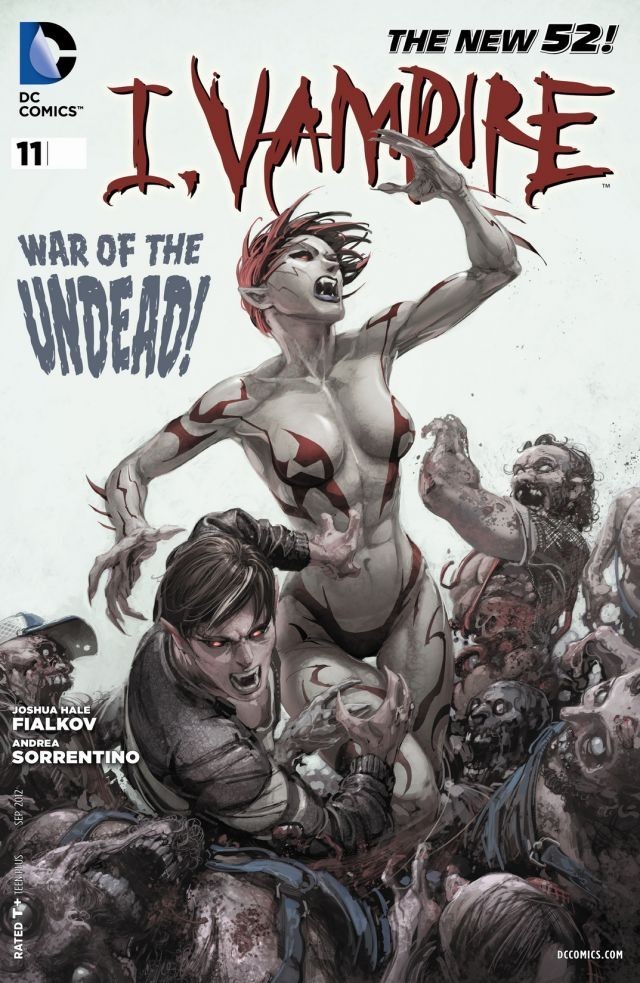
The Fialkov/Sorrentino title reaches the end of the arc starring the Van Helsing cult. Surprisingly, the editorial choose this point to foster a crossover with "Stormwatch", with the characters of the former Wildstorm title providing a fresh, superhero perspective on the complicated events of "I, Vampire".

A lot of the issue is thus spent on recapping previous events, while the vampire/zombie situation keeps spinning out of control. By the middle of the issue, it's an absolute mess, that the characters recognized as being unmanageable. Fialkov provides a version of Stormwatch that basically represents a rebooted Authority, with a single reference to the secret society aspect of the team.

Besides the generally well depicted members of Stormwatch, the writer manages to have the main "I, Vampire" remain in the spotlight, and many of the issue's best moments involve Tig, Mary and Andrew. Sorrentino remains solid throughout, with layouts kept clear and characters largely distinctive. The sepia-toned colors maintain the specific atmosphere of the title, but the issue derives most of its impact from the ending, that features yet another status quo change.

And while the creators keep their sense of humor in the tense last moments of their first year of stories, there is no doubt that many DCU crossovers have burdened the title to the point of preventing the creative team from introducing new characters, and fully exploiting the premise. Hopefully, following the #0 issue, the editorial will see fit to enable the title to tell its own stories without the crossovers and tie-ins - providing Fialkov and Sorrentino with a platform for their creative best for as long as they are able to preserve retailer attention.

JUSTICE LEAGUE DARK #12

Picking up from the cliffhanger of the previous issue, "Justice League Dark" #12 opens with a one page origin for the character that betrayed the team, before setting the course that will take the book to the end of the storyline. Both heroes and villains regroup as the mastermind behind Faust's plan announces his intentions and declares his revenge against Constantine.

At this point, the mystery villain's working mainly as John's opposite number, and it's not entirely out of the realm of possibility that he is DCU's version of Golden Boy, John's unborn twin from his venerable "Vertigo" title. At the same time, Lemire hints that the character is known to other DCU magic users so that it could might as well be a new rendition of an occult villain that has yet to show up in the title.

For the moment, the Lady Xanadu/Tim Hunter part of the plot appears to have been a red herring. The aforementioned opening page hints at a personal value the Books of Magic may have for the turncoat superhero, with the writer trying hard to make them mean more then a typical McGuffin. Yet, for all intents and purposes that's exactly what they are, as Justice League Dark splits to follow the leads on Faust.

Breaking up a superhero team into two plot strands to make the scenes both more manageable and the characters more distinctive is a tried and true superhero convention, which coupled with the mystery villain kept in the dark really amounts to reminding the reader of the title's modus operandi. This really is a Justice League title focusing on DC's seldom seen shadier characters. It's issues like this one that serve to strengthen the reader's resolve considering the Lemire/Janin collaboration, as the experience seems to be worth it.

The penciler/inker continues to adapt to the challenges of the title, as his characters start displaying a broader range of emotions that jibes much closer with their dialogue. Ulises Arreola's greens and purples continue to accentuate the stiffness in the art though, as the computer coloring never truly cohers into a satisfying whole. Taking a cue from the constant barrage of colorful spells the team members cast, DC seemingly aims at a video game esthetic, but despite the redesign, these characters and the story they are starring in seem decidedly informed by a decades old esthetic.

Still, the creative team's choice of the immediate villain's for the #13 seem as reasonable and fitting, as most of the creative decisions made by Lemire and the editorial since Peter Milligan left the title. Despite a gratuitous death of a woefully underused character that closes the issue, "Justice League Dark" seems finally to be fulfilling its mandate by being an enjoyable superhero-informed romp that abandons the Vertigo imperative for a refreshingly irreverent take on these characters.

PUNISHER #14

On "Punisher", Mico Suayan continues as a fill-in artist, in an issue that spotlights Greg Rucka's unique contribution to the genre. In itself, the story is a complete chapter in the wider Rucka/Chechetto run, but more importantly, it showcases a tactical operation of the Punisher, a vigilante existing in the Marvel universe. The storytelling is patient and economic, hitting all the necessary beats to make it an action thriller.

The wholesomeness of Ruck's craft shows as he illustrates both sides of the conflict, reminds the reader of the particularities of the conflict, which finally culminates in the confrontation that makes up the bulk of the issue. Throughout, both the tone and the pacing never falter, as the creators work in synch to deliver their genre best.

Suayan's photo referenced work feels much more suited to the action at hand than in the previous issue, that introduced the McGuffin. The faces retain an unnatural stiffness, but the tension and the dialogue help distract the reader away from all the close mouths and strange facial expressions. The Bulgarian artist tries, and largely succeeds, to echo a cinematic experience that is the dominant visual of these stories, justifying the use of photo reference in service of the representational art style.

The only other major problem with the story is that, for all of his effort, Rucka never manages to contort the rules of the Marvel Universe, and have his story seamlessly fit into New York that also has Spider-Man in it. Despite his debut in the publisher's flagship, the Punisher has never felt at ease in the superhero surroundings, and contorting the script to provide for the logistics of the fantasy universe only serves to call attention to the problem.

Despite this, for all intents and purposes, "the Punisher" remains the sole title that provides a crime fiction outlet in the publisher's output, and illustrates a high level of competency in delivering what would be a purely generic story in the hands of lesser talents.

VENOM #23

The beginning of Cullen Bunn's solo run as the writer of Marvel's "Venom" starts off very unevenly. Picking up the thread from the "Circle of Four"crossover, the writer presents the first part of the occult storyline, featuring Thony ("Spider-Man: Ends of the Earth") Silas on art. "Monsters of Evil" begins with the recap of the issues so far, and presents Venom with both a new mission and a possible new love interest.

Supposedly acting on Secret Avengers mandate, Flash goes on to oppose the Department of Occult Armaments, an secret society featured in his "Fear Itself: Fearless" work. For story purposes, they are just another evil cult that Venom cuts loose on, before fully comprehending their new scheme, and who is standing behind it. Considering how uninformed Flash is at this point, his continual narration consist mostly of conveying his emotions and letting the reader sympathize with him.

This becomes crucial as the issue climaxes and the villain exploits his weakness to bring out the monster in him. Compared to the issues preceding it, at this point the story feels arbitrary and off-kilter.  Silas' works here in the expressionistic, caricatural style that evokes artists such as Phil Hester, while exhibiting the typical strengths and weaknesses of the approach. His work here has a lot of energy, but a lack of definition without strong, original stylization, maintains the long struggle the title has endured since Tony Moore's early departure.

At this point, there is little to recommend the title, and unless Bunn finds a way to make the title his own following the"Minimum Carnage"crossover, this incarnation of Venom will likely be remembered for the Rick Remender issues preceding "Monsters of Evil".

Friday, August 10, 2012

Reviews for Wednesday, 8th August

BATMAN #12

The latest issue in Snyder's sprawling Batman run is the definition of a fill-in. A supporting character from one of the previous issues gets fleshed out in a story without any real tension or a reason for its existence. In many ways, the Becky Cloonan illustrated pages bring to mind an indie aesthetic that's sympathetic to modern Gothamites spotlighted in the issue, but there is a real feeling of artificiality throughout the story.

The book tries for a controversial angle with the lead character's gay brother, but it all comes off as forced. In a lot of ways, Batman #12 recalls the vastly superior "Batman Year 100", but with a key difference. Paul Pope focused on the vigilante's helpers precisely because he wanted to keep the lead character as an enigma. Scott Snyder has continually let in the reader on Bruce's innermost thoughts, and in a story as personal as "Court of Owls", there is really little point to flesh out a minor character's inner life.

Had Greg Capullo been able to keep up with the grinding monthly schedule, it's doubtful that the writer would ever have come up with the story. As such, he tries to get the reader to sympathize with Harper, the electrician, and come up with the way how her little contribution impacts Batman's mission, but the results are ponderous.

Previously, the Greg Rucka/Ed Brubaker side characters were so strong and so well defined, that they managed to carry a whole book, that was for some time a standout in the Batman line of titles. There is no evidence that reading about Harper and her brother would be a pleasant experience, and something that the reader would cherish month in and month out.

The issue dispenses with the back-up, to provide additional pages that explain the tease Harper gives in the opening, but the presence of a different creative team jibes strongly with the intended purpose. If the idea was to have strong indie talent present a honest tale of real life young adults, then the presence of Snyder protegee James Tynion IV as a co-writer, and much more importantly, Andy Clarke, really dispenses with the intended effect.

Cloonan has repeatedly shown that she is adept at depicting action (in this issue even), thus having Clarke provide seven closing pages comes off very abrupt, considering the difference in style. The featured villain had previously shown up in the pages of Snyder and Jock's "Detective Comics" run, and comes off as cartoonish, but not much more exotic than the typical Batman rogues.

The next month's #0 supposedly sets up the forthcoming developments in the Snyder/Cappulo run. With the Joker mega arc opening the second year of the "Batman" stories, the Harper story will no doubt soon be a distant memory, a not to successful tangent reminiscent of the Vertigo side stories bridging the gap between two bigger stories realized by the title's regular penciller.

CAPTAIN AMERICA #16

The second part of "The New World Orders" maintains the same solid, if underwhelming tone of the opening issue, with Cullen Bunn trying his best to channel the Brubaker's plot into a semblance of a typical issue of the run. The results, coupled by Scott Eaton's continued competent, but unrefined work (this time inked by three inkers) seem a bit more accomplished than last time, but never approach the clarity and the definition of Steve Epting's cover.

Eaton's work is nevertheless more caricatural and works with more energy, reminiscent of Mark ("Ultimate Spider-Man") Bagley's work. His rendition of Agent 13 is particularly nimble and spunky, even if it sticks to the traditional rules of the genre when it comes to objectifying women.

As for the story, most of it deals with the TV pundit Reed Braxton, who comments on the Discordian invasion and riles the common man against Cap. It's a well paced issue, if ultimately slight on plot development, but it's unlikely to change a reader's mind on the last stretch of Brubaker's run. With most of #16 told from the perspective of Carter and Dugan, the next issue should return the focus on Steve, and bring him closer to the masterminds behind the invasion scenario.

By adding a third party to the Bravo-Captain America conflict, Brubaker was consciously prolonging the clash, making it more meaningful when Steve finally overcomes the enemy's barrage, but stylistically, the book offers the reader very little. By this point in his 8 year run on the title, the writer has told similar stories with much more energy, and its hard not to look at "New World Orders" and see much more than echoes of more accomplished stories from back when the Brubaker/Epting "Captain America" was routinely hailed as one of the best superhero monthlies.

FRANKENSTEIN, AGENT OF S.H.A.D.E. #12

On "Frankenstein", Matt Kindt brings his first arc to a close with a well-paced issue, framed as a conversation between the S.H.A.D.E. director and his chief scientist. By now, it's apparent that Kindt aims at making the book into more of a spy epic, and has used "Satan's Ring" as a test to see how well DC's Creature Commandos fit into the mold.

He manages to preserve Frank's relentlessness and personality, even adding to the mythos with the addition of flashbacks, setting up the arc where he squares off against his creator. The romantic subplot between him and Nina has likewise continued in a subtle and believable way, far surpassing the cues from the original "Flashpoint" mini-series.

The problem is that in the process of narrating some of the creator's wildly inventive ideas, the whole thing starts appearing beyond silly and childish. Seeing Frank dispatch the Leviathan goes a long way to cancelling the suspension of disbelief. A more nuanced portrayal, perhaps including the two agents who have yet to reappear in the book since the first part of the arc, would have brought some level of credibility to storytelling.

That the mole in the organization turns out to be an easily dealt with threat comes as a no surprise. Likewise, the eventual reveal of what is the significance of the Ring itself reveals it for a easily forgettable McGuffin. These two plot points would have proven anti-climatic in a better story, but in "Satan's Ring", they appear as just another underdeveloped bits of a strange, sprawling plot.

Alberto Ponticelli remains crucial to the book's consistency, as his visuals maintain the continuity and connect the disparate bits of the creator's imaginings. With the book's sales in the continual decline, its doubtful the connection to DC's better received Edge titles will convince the retailers to stick with the title in a firmer way. Hopefully, Kindt will find a way to make the strange mixture of Grant Morrison and Jeff Lemire ideas his own by then, and give the wannabe cult title a proper sendoff.

THE MIGHTY THOR #18

The start of "The Mighty Thor"/"Journey Into Mystery" crossover. Kieron Gillen and Matt Fraction write a very confidant beginning to the nine part saga, without drawing too much on the established continuity. Aided by the exceptionally solid artwork of Alan Davis (himself making a strong showing at Marvel, with the concurrent release of the Clandestine tie-in Annuals), the pair begin their story in a manner that recalls both Hitchcock's "Birds" and "the Lord of the Rings".

The Aesir/Vaenir war that preceded the events of the crossover gets spotlighted in an easily understandable and appeal way, ala the beginning of "Fellowship of the Ring", and the writers take pains to start their story properly. Both the lyrical quality of "The Journey Into Mystery", and the straightforward pseudo-mythological superheroics of "The Mighty Thor" find a way to these beautiful pages, showing the beginning of the renewed hostilities between two mythological races.

The plot tries hard to incorporate all of the segments of the Asgardian Realm, both to show how far reaching the Faustian gamble of their opponents are, as well as to set up the players in the game of the rising stakes. All in all, a surprisingly enjoyable beginning of the event that promises to unite the two titles for some memorable storytelling.

VENOM #22

This issue marks Rick Remender's final entry in "the Venom" series. After plotting the last arc that wound up written by Cullen Bunn, Remender writes the final issue of his run solo, illustrated more than adequately by Declan ("Hero Killers", "Thudnerbolts") Shalvey. The heavily narrated story brings thematic resolution to Thompson's father issues, while wrapping up the Jack-O'-Lantern subplot.

Obviously, both of these things are left for Bunn, and possible future writers to pick upon, but for now they are adequately dealt with. Once again, Remender appears very sincere when tackling Flash's inner life, and commits to tackling the dark subject matter in an adult way.

The flashbacks never feel like perfunctory origin sketches, but an actual attempt to get to the bottom of Flash's problems with aggression and substance abuse. Bringing in the father comparison does more than provide the back story, and ultimately ties back into his rivalry with Jack-O'-Lantern. The eventual clash feels a bit slighted, and even gratuitous, but is saved by Flash's eventual decision regarding the villain.

And while the parallels do eventually become heavy handed, Shalvey's artwork proves to be a very adequate conduit for Remender's final word on the character. The penciller/inker feels very sure when depicting superhero action, which has a great flow and clear line, while he adopts a softer tone for the flashback sequences. Lee Loughridge further separates the two by a limited palette of colors that further accentuate the quality presentation and reward the reading experience.

The writer's frank farewell on the letters page further reinforces the feel that he respects both the experience and the readers of the title, which he leaves in Bunn's capable hands. Hopefully, the editorial will pair the new writer with a regular artist, as the lack of visual consistency has proven the surprisingly strong title's chief problem.

Saturday, July 28, 2012

Reviews for July 27th, 2012


ALL STAR WESTERN #11

Despite providing the helpful recap of the previous issue, Amadeus Arkham has very little to do with the latest entry in DC's "All-Star Western" title. The scholar is present during most of what transpires in the growing conflict for the control of Gotham's underground, but the real star is Tallulah Black. It is in her and Jonah Hex's dysfunctional dynamic that the story manages to achieve a semblance of identity and survive the increasing continuity references.

Otherwise, the story could have easily vanished in the writers' efforts to integrate the last several years of DC continuity. As seen in the opening arc, the followers of the Crime Bible make for formidable masonic antagonists, and the Court of Owls could have easily been used in the similar role this time around. Yet, the decision to have two groups, developed independently to fulfill a similar role, come to blows was certainly made without seriously considering the merits of the story.

It's easy to be confused when one of Lord Bennet's costumed guardians gets wounded in the fight, only for the Court of Owls' Talon to appear and disappear with the nobleman in tow. Tallulah's plan for revenge is therefore postponed indefinitely, but the latter half of the issue, focused on the followers of the Crime Bible definitely feels like a step up.

Despite the elaborate names and a out of place Catwoman ancestor, the villains are given a solid introduction and a plan that only fails due to Tallulah's resourcefulness. Seeing the scarred beauty taking matters in her own hands definitely feels like a welcome change from the usual role of females in adventure narratives. As a carryover from Palmiotti and Grey's "Jonah Hex" title, it could be said that she manages to upstage the protagonists, but for the purposes of the arc, it feels welcome and natural.

Compared to Moritat's strikingly loose and expressive inks, Scott Kolins' art on the back-up provides much more definition. Featuring a Dr. Thirteen ancestor, this first part of the story works to establish the scientist as the professional debunker of the supernatural, and present him with the new case. The Haunted Highwayman is certainly not going to leave a lasting impression on the readers, but works to fulfill the remits of the story.

At times, Kolins' art, with heavy blacks and a steampunk bent brings to mind Mike Mignola, which is certainly a departure for the relatively traditional superhero artist. The next issue is likely to climax both the leading story and the back-up, and judging on the strength of the work presented in this issue, it should prove both capable and satisfying.

AQUAMAN #11

As a penultimate chapter of "the Others", Aquaman #11 reads decidedly choppy and slow paced. Just like his work on "the Justice League", Geoff Johns substitues the pulp twists and turns for a belated elaboration of the villain's motives and heavy exposition.

The initial three page prologue both shows us a relevant part of the Others' origin, introduces the final team member, and teases the ultimate goal of Black Manta. All of these prove integral for the issue, but they serve largely to slow down the pace and beg the question of why they haven't been elaborated upon in the previous four issues. Likewise, despite the mystery, it's still hard to look past the costumes of these international heroes, but to his credit, the writer does manage to establish them as a team. Seeing them argue with Aquaman over his abandonment of the Others to concentrate on the Justice League manages to make the reader forget that he's reading Aquaman's solo title for a moment, which is perhaps the greatest compliment that can be made to the world building involved.

The story picks up the pace once Aquaman gets close to Manta, who has finally gotten around to the object of his search, resulting in a cliffhanger that has the reader genuinely interested in the fate of Dr. Shin, as well as the status quo of Aquaman and Mera following the #0. Despite the presence of three inkers, Ivan Reis manages to give a lot of energy and definition to the proceedings, with his adherence to DC's house style resulting in a dynamic look for one of the most consistent titles of DC's "New 52".

It would be interesting if the creators followed up on the hinted clash between the Others and the JLA, but judging by their work so far, there is every indication that Johns' reinvention of Aquaman will stay strong in its second year.

CAPTAIN AMERICA #15

The last Brubaker "Captain America" arc begins with a patchy issue, that at least hints at wrapping up the plot threads accumulated since the last year's relaunch. Co-written by Cullen Bunn, the issue offers a typical opener of a veiled threat to America that physically stretches Captain America to the limit, while filling him with doubt regarding his mission. This time, it's nothing less than the alien invasion, with the Discordians quickly revealed to the reader as pawns of the Codename: Bravo, Queen Hydra and Baron Zemo.

Scot Eaton's rushed, cartoony artwork denies the reader the pleasure of watching widescreen action. His inexpressive characters likewise stay on model but fail to do much of acting. The reader will hardly be excited to see all the closed mouths and stilted posing, but the work is still done in the house style and doesn't call too much of attention to itself.

It's just that coupled with a very familiar story, it completes the impression that the creators are just going through the motions of wrapping a run that was, for all intents and purposes over at the end of the previous volume. By all accounts, a decent wrap up will provide a sense of closure to the readers, who are advised to check Brubaker's "Winter Soldier" for the true continuation of the themes, and accomplished with much more energy and enthusiasm.

FLASH #11

Brian Buccellato and Francis Manapul continue their run on "Flash" with another deeply flawed issue. Once again, Marcus To fills in on the art, and the results are sobering. The issue nominally deals with presenting a "New 52" version of Heatwave, but the focus is squarely on Barry Allen confronting the Rogues proactively by becoming a barman in the underground bar.

Thus, the reader learns very little about Heatwave and his operation, and instead the focus shifts to the ongoing plot of Flash and his relationship with Captain Cold, with a couple of subplots inserted into the middle, to remind the reader that the co-writers aren't abandoning any of their work so far.

This is a hard issue to recommend, and even harder to read with any enthusiasm. It ends with Heatwave and Captain Cold in place for the next part of the story, but the reader is kept unaware as to the specifics of their rivalry and motivations. We are left as much in the dark as the Flash, with To's capable rendition of the DC house style to tie us over. With the next issue's return of Manapul to the art, the series will regain its distinctive artwork, but at this point its clear that both him and his colorist/co-writer, lack the ability to even come close to the Geoff Johns and Mark Waid's writing on the title.

I, VAMPIRE #11

At this point in the Joshua Hale Fialkov and Andrea Sorrentino's "I, Vampire" series, it's not clear how serious the reader should treat the title. Following the "Justice League Dark" crossover, Andrew's new power levels have largely upended the status quo, with the vampires becoming much less of a threat to humanity.

Moreover, with the inclusion of the Van Helsing cult, the fate of the vampire clan seems to be an internal matter. Most of this issue's dedicated to mix and matching the horror movie cliches, with the results aimed primarily to amuse. The whole arc so far has been much lighter in tone than the issues that preceded it, and the result is some madcap, but easily disposable storytelling.

The new dynamic between Andrew and Mary seems too soon, and the Jae Lee-inspired artwork too stylized to deal with the high concept leanings of the plot. To his credit, Filakov doesn't forget about the cast, who stay in character and definitely bring their own flair to the title, but the book seriously needs to either return to the opening dynamic, or find a new workable direction.

JUSTICE LEAGUE DARK #11

The third part of "Black Room", by Lemire and Janin largely works better than the previous couple of chapters. Returning the Vertigo characters back to the DCU is still too bright and colorful, but the underlying superhero elements for once seemingly carry out the title's remit.

Most of the issue is taken up with a superhero fight against Felix Faust and the Demons Three, including the cliffhanger showing a member of the Justice League Dark betraying the team. Beat by beat, the book lives and dies on the premise that there is a whole world of interesting storytelling in the fantasy side of the DC Universe.

Most of the pages include a sparkling lightning bolt effect, with the magic of these characters ultimately amounting to shooting lightning bolt effects that cancel each other out. The Ulises  Arreola's computer colors give Janin's already stiff figures a new layer of artificiality, at least managing to liven up some of the rigidness in the pencils.

Ultimately, the subplot involving Madam Xanadu trying to win over Tim Hunter to help the team find the Books of Magic proves the most interesting. The remaining sixteen pages are capably executed, but at this point Felix Faust has already worn out his welcome, leaving the reader to be entertained by the actions of a continually of John Constantine. It would appear that no matter how well the creators apply superhero storytelling to these characters, the book's success with the individual readers largely hinges on how they react to the scenes such as "Hellblazer" sneaking into the titular Black Room to combat the villain with the mystical weapons from the magical history of the publisher's superhero universe.

THE MIGHTY THOR #17

The underwhelming "Marelock" storyline finally comes to an end in the pages of "the Mighty Thor". Ultimately, the plots involving Amora and the dream monsters finally intersect, but by this point they have little to offer to the readers. The Enchantress and her ever evolving Executioner replacement, they provide the physical threat for Thor, while bizzarrely, the protagonist of a "Mountain Goats" song fights off the Marelock invasion in the dream realm. The scene aims for poignancy but comes of as surreal as the final excerpt from Jeff' diary, written to his friend from "The Best Ever Death Metal Band in Denton".

Thankfully, the ultimate connection between two plot strands finally provides some measure of finality to Doctor Donald Blake, the real victim of Marvel's turning back to JMS' relaunch of the series. Unfortunately, Fraction's post "Fear Itself" Asgardia set-up has proven even more unmanagable, as we see here in Fraction's last issue preceding the crossover with "Journey into mystery" that will likely end both titles in their current incarnations.

By bringing in a teenager from Broxton, Oklahoma, the writer is adamant to stay true to Straczyinski's original idea of Norse Gods making a seat next to a middle American city. The problem is that the status quo he's up elaborated upon hasn't even been made feasable in the JMS issues, due to the creator's abrupt leaving after the disagreements with the editorial, and the resulting changes make for an unappealing mish mash of story concepts that are only broadly true in spirit to the Lee/Kirby originals. In Pepe Larraz's hands, the fantasy visuals break away from the Walt Simmonson's mythology-inspired approach, and present Fraction's "Thor" as a campy cartoon, divorced both from the trends of the industry and the rest of the Marvel's output.

Of course, the penciller is merely following Oliver Coipel and Pasqual Ferry's lead, but despite his clear layouts and powerful figures, there is never a chance that the artist is allowed to work in his own style. Just like Matt Fraction, the artist is trapped in the company's mandate on following up on the work of other creators, and at this point, "the Mighty Thor" is truly in a place where only the already announced "Marvel NOW" revamp can help to lay a foundation for a better integrated reinvation of the Silver Age superhero.


VENOM #21

The finale of "Savage Six" arc manages to be both action packed and poignant, as Rick Remender wraps up most of the story threads of his run so far. Cullen Bunn scripts the story that has Flash Thompson face off against Megatak and Toxin, with the fights being brutal but no more memorable than video game violence.

Megatak was introduced as a joke villain in Doug Moench's last issue of "Thor", but the high concept garishness of the character was apparently enough to grant him the role of token oddball. Still, despite Medina's efforts to present him as a credible threat, the character amounts to nothing more than a henchmen, justifying the necessary number of villains to parallel Spider-Man's nefarious grouping of enemies.

Eddie Brock is a much more integral presence, as Remender has for some time kept up with the actions of the previous Venom host. Unlike Human Fly, dispatched by Flash last issue, there is no real sense of finality to Toxin's fate, but the scene still acts to write out the character out of the series.

Finally, after delaying the showdown with Jack O Lantern for the next issue, Venom confronts Crime Master. The master villain's conversation with Betty frames the issue, and it is their relationship that ultimately resolves the threat that has come to dominate Flash's life. The fight is dynamic and clearly told, with the antagonist's weapon being particularly interesting in a clearly told sequence that leads to the climax.

Following the most engaging part of the issue, Medina somewhat stumbles when it comes to depicting the emotional fallout of the storyline. As a whole, the issue is as solid as the rest of the arc, whose wholesomeness almost comes as a surprise given it serves as the farewell for the original creative team.

WINTER SOLDIER #8

Ed Brubaker and Michael Lark's the second part of the three part "Broken Arrow" story slows down the action to focus on the procedural aspect of the Barnes/Sitwell operation. Both men continue searching for Natasha in their own ways, with the creative team naturally concentrating on the protagonist as he tries to beat the answers out of the hired help.

The fights are largely unmotivated and overly brutal, making it for once harder to sympathize with the impulsive anti-hero. On the other hand, his psychopathic opposite number Leo is starting to develop something of a personality, which helps the story considering that the book keeps shifting from the two points of view.

And while it's still unclear what the villain's ultimate scheme is, by showing his methods, the creative team has helped solidify his agenda. The book is so finely crafted, that even when it produces a largely transitory issue, it feels like Brubaker and Lark are showing us the events in the order that they happened.

Lark's time on the book is proving particularly exemplary. The one-time "Daredevil" artist is producing perfectly readable, well realized layouts, given weight and detail by inkers Thies and Guadiano. At this point, it's clear that the final issue of the arc will be at least as well realized as the two that preceded it, and there is every indication that Brubaker and Guice will try to match this level of professionalism with the already announced follow-up.