Showing posts with label All Star Western. Show all posts

Wednesday, October 3, 2012

All-Star Western #0, Aquaman #0, Flash #0, I, Vampire #0

ALL STAR WESTERN #0

The Zero Month issue of "All-Star Western" dismisses with the back-up to present a 30 page story, with artist Pia ("Y the Last Man") Guerra helping out with the epilogue. The Moritat-drawn pages depict Jonah Hex's origin, telling a decades spanning story involving the complex set of circumstances that birthed the violent bounty hunter.

The back-up reveals the story as a drunken ramble related by Hex, but this doesn't really account for many of its problems. Namely, the writing duo of Gray and Palmiotti choose to depict the numerous events by briefly setting up the context and following it up with an action scene. What should have been a graphic novel is thus relegated to a vulgar string of fight sequences that cover the character's contradictory back story of growing up an Indian and serving in the confederate army.

The reader invests in each of these scenes thinking it will show the signature scarring of the character. Instead, this is how the flashback ends, supposedly climaxing the theme of Jonah being "a man of two minds, a man who is both good and evil". Yet, as depicted in this issue, Hex seems more selfless and naive, trying to make the most out of a thankless life.

In retrospect, given the limited page count, the story would have benefited from being confined to Jonah's time with the Indians. That way, the co-writers would be able to properly set up the dynamic between Hex and his Indian foster father, as well as the rivalry between Jonah and his Indian "brother". Alternately, the additional focus on his childhood could have made for a more involving story as well.

Moritat's artwork likewise starts off loosely, but finishes up in very broad strokes. Perhaps DC would have been better off to pair him with an inker, as the artist clearly has troubles with the Zero Month increasing the page count by half. The abstraction that serves as the establishing shot of Fort Donelson clearly has no place in a DC comic, especially when compared to Guerra's clean and controlled look that finishes the issue.

To be fair, the climatic fight between Hex and Noh-Tante likely fails because of the density of the script, serving as yet another reminder that the series could have done without this prequel issue. It's doubtful that the story would have been much improved with the changes in the creative team, as the Zero Month format inherently limits the potential of a sprawling western epic. This is presumably why the co-writers concentrate on using the Pia Guerra illustrated pages to set up the next month's story, involving Dr. Jekyll's potion.

AQUAMAN #0

The #0 issue of Aquaman is almost equally split in the way it serves as a showcase for Aquaman's powers and the set-up required for the second year of stories regarding the character. All of this is conveyed via the flashback tale of Aquaman searching for his mother.

Geoff Johns and the artistic team of Ivan Reis and Joe Prado hardly achieve an uneasy balance, with an immature Aquaman substituting a father for a mentor figure in Vulco. More importantly, this prequel issue sets up Arthur's half-brother, Orm the Ocean-Master as the credible new threat for the character.

Unfortunately, due to scheduling, this inclusion comes on the heels of the last issue's unresolved cliffhanger. The creative team makes no effort in presenting this prequel story as something that in any way follows up on the previous issue, and will likely be eventually collected separately.

As a story in its own right, the issue is still lacking, as it discards the characters Aquaman spends the most dynamic part of the story saving. They wind up merely as innocent bystanders justifying the use of an action sequence in what is otherwise a static issue, setting up the upcoming stories. There is a some closure regarding the issue of Arthur's search, but the story nominally tries to entice the reader with the additions to the mythology.

Yet, the audience is likely to be continue with the title based on the strength of the creators. The consistently competent work, dressed in the lush colors of Rod Reis, helps complete this version of Aquaman, that is in keeping with the current trends. Working from a similar model to the Johns and Reis' work on "Green Lantern", "Aquaman" is set to crossover with "the Justice League", no doubt in another attempt to keep the relaunch to the forefront of the company's output. Despite the teases of Atlantean mysteries, the real question will be how the title fares once the penciller officially leaves to work on "JL".

FLASH #0

For their part in contributing to DC's "Zero Month" Francis Manapul and Brian Buccellato undertake to updating the Flash's Silver Age origin with the Geoff Johns' invented retcon. The resulting story feels a bit more poignant than their recent efforts, but still succeeds primarily in delighting the reader on a visual level.

The creative team uses watercolors to highlight the moody origin of the Flash, recasting the archetypal superhero as the victim of family tragedy. In their hands, Barry Allen is a smart and talented child, who dedicates himself to police work following the death of his mother in what appears to be a domestic quarrel. Manapul and Buccellato concentrate on the love triangle that lead to the tragedy, with the mystery of Flash's powers treated almost as an afterthought.

The limited space relegates the character's eventual appearance in costume to a two page sequence, just one of the many flashbacks that make up this zero issue. The constant back and forth is eased by the use of captions, which try to make the reader sympathetic to the events shown. The character of lieutenant Frye adds some much needed nuance to the continuity implants, but the origin of the Flash still feels somewhat extraneous to the creators' own vision.

It seems to be devoted to a version of the character directly preceding the "New 52" reboot, which was in turn inspired by Marvel's own flawed heroes. Manapul and Buccellato's take on "the Flash" has so far been decidedly lighter and plot-based, with Barry himself mostly defined by his powers and the role of the superhero. Having the character of Miguel (whose friendship with Barry was the backbone of their first "Mob rule" story arc) completely missing from this prequel is very telling.

Finding themselves hard pressed to boil down a graphic novel sized plot into a mere twenty pages, the creators have decided to proceed with an origin that will be relevant beyond their immediate take on the character. It remains to be seen whether the duo will still be involved with the character in a year's time, while Chief Creative Officer Johns's reinterpretation of the Flash is set to remain as definite status quo.

Where Manapul and Buccellato are allowed to leave a much stronger mark is once again consigned to the visuals. It cannot be overstated that their delicate, well realized artwork stands up as the most gorgeous rendering of the property since the days of Scott Kolins and Mike Wieringo. The sepia toned, kinetic pages seem equally lively when they are laid out as a double page spread or as a single image filled with dozens of tiny panels. The characters still exhibit a limited set of expressions when speaking to one another, forcing the dialogue to assume an additional layer of directness that seems unnatural, but otherwise it's hard to find fault in the visual presentation of the material.

I VAMPIRE #0

The "I, Vampire" title offers a Zero Month flashback to 1591, when Andrew was originally turned into a vampire. Fialkov adjust the dialogue to correspond to mimic Shakespeare, but despite the tragic events the tone never becomes too serious. The issue basically consists of a single scene, framed by the letters Bennet writes to his mother and Mary, with Sorrentino having to draw merely a handful of characters.

As per usual, the artist resorts to double page spreads and large pages featuring these costumed characters, helping the pacing and imparting a singular mood to the proceedings. The artist assumes a very graphical Gustave Dore -inspired art style in one of the double pagers, depicting the villain's Biblical-inspired past.

Returning to Cain, the issue gets back to a plot point that set in motion the "Rise of Vampires" crossover, explaining what at the time seemed like a particularly unlikely twist. The confrontation between Andrew and Cain hinges upon a very on the nose premise, but it helps that the writer doesn't belabor upon it. The execution, particularly Sorrentino's inventive layouts help the story along, even if the point of view sequence following Bennet's turning lasts at least a page too long to enable the eventual reveal to work to its full effect.

Eventually, the story doesn't end so much as stops, without elaborating on the character's relationship with Mary, and her eventual transformation. Thus #0 of "I, Vampire" feels more like a prologue to the longer story, featuring the two's original Renaissance pairing. Faced with the title's financial realities, i's doubtful that DC will decide to flesh out that story with a follow-up mini-series. Taking this in consideration, Fialkov and Sorrentino by and large present an interesting pseudo-historical vignette, that sheds light on the protagonists' past, while never forgetting to entertain the reader already aware of the outcome.

JUSTICE LEAGUE DARK #0

It's impossible to discuss "the Justice League Dark" #0, spotlighting John Constantine and Zatanna's shared past, without comparing it to their past incarnations. "Hellblazer" is a Vertigo title still published by DC, but with this issue, the editorial takes great pains to separate the two continuities.

John that appears on the opening page wears a Mucous membrane T-shirt and makes a reference to Newcastle, but otherwise shares only the most superficial characteristics to his appearances in his own title. Lemire replaces his years of hospitalization in Ravenscar asylum (which is admittedly a point that most of the writers had to find a way around when talking about his past) with the character's literal migration to America.

Lee ("the Highwaymen") Garbett's style, previously associated with various Wildstorm titles, likewise presents a standard modern occult superhero aesthetic, akin to that found in "Witchblade" and "Darkness". There is no understatement when it comes to Zatanna, "a backwards-talking gothic princess", who spends most of the story in corsets, and serving as little more than a point of contention between two of the rivaling mages. There is an effort on the part of Lemire to tie her to the cult that keeps interfering with their activities, but it hardly elevates her beyond the level of love interest.

The story serves to shed light on the mastermind behind the still yet to conclude "Justice League Dark" storyline, and is defined by his relationship to Constatine. Nick Necro turns out to be a little more than a more experienced version of John himself, tainted by greed and corruption. He is chiefly distinguished by his hair color, with the whole of the prequel serving to explain the two character's shared past, and their split, which feeds into Lemire's ongoing story regarding the Books of Magic.

This prequel sacrifices everything to depict a simple mentor/understudy dynamic, and the reasons it went awry, but it primarily disappoints on the technical level. As if he was following Garbett's superficial renderings, the writer incorporates lines like "He was the greatest mage I knew. He was the best... the king", which have no places in a professional script, especially when associated with the character that had a rare privilege to be consistently well-written by the group of the genre's most talented scribes.

As a statement of intent regarding a younger, more superhero-friendly John Constantine, this #0 issue of "Justice League Dark" could not be more clear. It also does much to flesh out the character of the group's current villain, even if the character proves beyond derivative. The writer could be excused for extending what is by all merits a flashback sequence when faced with the editorial dictate, but the presence of four inkers indicates that even the artist was assigned to work against a very tight deadline.

Monday, August 27, 2012

Reviews for Wednesday, August 23rd

ALL STAR WESTERN #12

The fourth major "All Star Western" storyline concludes, wrapping up the "War of Lords and Owls". At this point, it's clear that the creative team's initial plan for the title stretched to the end of the first year. There is a distinct feeling of closure as the characters get back to the Crime Bible cultists that they initially banded together to confront. Therefore, the inclusion of Court of Owls gets revealed for what it was - a late addition to the already plotted storyline, providing a tie-in to the well-selling "Batman" story arc.

Tallulah Black continues to feature extensively, and basically takes the lead on most of the action sequences. This is fitting considering Palmiotti and Gray's decision to incorporate her as the permanent addition to the cast, which proves very justified. The character based storytelling has continually benefited the company's only period piece title, and Hex's lover brings a unique dynamic to the proceedings.

The use of chapter breaks continues to provide for an abortive pacing, but the stylishness of Moritat's pencils and inks and the unique subject matter more than make up for the shortcomings. The artist boldly realizes these bulky characters whose wrinkled period clothing fills up the pages. In this issue, the artist finds space (and time) for little else but the figures in his panels, leaving it mostly for the colorist to provide mood and atmosphere. The female character's manga-like features have yet to fully integrate with the style he strives for on this book, but otherwise, the art continues to imbue the book with a lot of energy and identity.

The Terrence 13 backup wraps up the Scott Kollins illustrated story in a way that focuses on debunking the story behind the Haunted Highwayman. The issue sets him up as a tragic villain, whose makes Dr Terrence's intervention personal, bringing out the doctor's cold, scientific mind to its rational extreme. It's a decent story, finishing up on a point that links the character to his original Silver Age  incarnation.

FLASH #12

Francis Manapul returns on art, as the title begins a two-part story, building on the string of oneshots that preceded it. Aided by Brian Buccellato, the artist is quick to restore the title back to its position as a lush, gorgeously realized book. The creative team uses several double page spreads and inventive layouts that maximizes the reader's goodwill, and makes them more tolerable when it comes to the story.

On the other hand, the creative team feels much more comfortable presenting the Glider's debut as the new leader of the Rogues. By returning to a broader canvass of episodic storytelling and interweaving subplots, Manapul and Buccellato go a long way to regaining the narrative footing lost since "Mob rule".

Such an open, plot-heavy approach seems to merge well with what DC wants the book to be. Having an art-centered traditional superhero title go through the motions of updating the Silver Age Flash stories for an audience grown up on "Heroes" and "Lost" certainly seems as a valid approach. As such, the wholesale Rogues revamp still feels chaotic and underdeveloped, despite the buildup in the previous issues.

Having all these characters running around Keystone at the same time, in the same issue, leads to most of them having little more than a cameo role. Just focusing on the Heatwave/Glider/Cold dynamic would go a long way to covering pretty much the same ground, despite limiting the somewhat epic scope of the arc.

On the other hand, having the threat escalate so fast makes it very hard for the creative team to properly wrap up the arc in the upcoming Flash Annual #1. In any event, the creators will likely use the double-size issue merely to establish the size of the threat. So far in their run, the Rogues have proven largely ineffective, which goes a long way to justifying the decision.

It remains to be seen whether Manapul and Buccellato ultimately succeed in making the Rogues into an interesting team of villains they have proven to be in Geoff Johns' run. There is certainly a lot of potential inherent in the both these characters and the title. The creators have for a time stepped away from grounding the title in the police procedural, and it will be interesting to see where they ultimately choose to go with "the Flash". For the moment, a still largely generic Barry is forced to contend with Dr. Elias, another character that begs for some fleshing out.

I VAMPIRE #12

The Fialkov/Sorrentino title reaches the end of the arc starring the Van Helsing cult. Surprisingly, the editorial choose this point to foster a crossover with "Stormwatch", with the characters of the former Wildstorm title providing a fresh, superhero perspective on the complicated events of "I, Vampire".

A lot of the issue is thus spent on recapping previous events, while the vampire/zombie situation keeps spinning out of control. By the middle of the issue, it's an absolute mess, that the characters recognized as being unmanageable. Fialkov provides a version of Stormwatch that basically represents a rebooted Authority, with a single reference to the secret society aspect of the team.

Besides the generally well depicted members of Stormwatch, the writer manages to have the main "I, Vampire" remain in the spotlight, and many of the issue's best moments involve Tig, Mary and Andrew. Sorrentino remains solid throughout, with layouts kept clear and characters largely distinctive. The sepia-toned colors maintain the specific atmosphere of the title, but the issue derives most of its impact from the ending, that features yet another status quo change.

And while the creators keep their sense of humor in the tense last moments of their first year of stories, there is no doubt that many DCU crossovers have burdened the title to the point of preventing the creative team from introducing new characters, and fully exploiting the premise. Hopefully, following the #0 issue, the editorial will see fit to enable the title to tell its own stories without the crossovers and tie-ins - providing Fialkov and Sorrentino with a platform for their creative best for as long as they are able to preserve retailer attention.

JUSTICE LEAGUE DARK #12

Picking up from the cliffhanger of the previous issue, "Justice League Dark" #12 opens with a one page origin for the character that betrayed the team, before setting the course that will take the book to the end of the storyline. Both heroes and villains regroup as the mastermind behind Faust's plan announces his intentions and declares his revenge against Constantine.

At this point, the mystery villain's working mainly as John's opposite number, and it's not entirely out of the realm of possibility that he is DCU's version of Golden Boy, John's unborn twin from his venerable "Vertigo" title. At the same time, Lemire hints that the character is known to other DCU magic users so that it could might as well be a new rendition of an occult villain that has yet to show up in the title.

For the moment, the Lady Xanadu/Tim Hunter part of the plot appears to have been a red herring. The aforementioned opening page hints at a personal value the Books of Magic may have for the turncoat superhero, with the writer trying hard to make them mean more then a typical McGuffin. Yet, for all intents and purposes that's exactly what they are, as Justice League Dark splits to follow the leads on Faust.

Breaking up a superhero team into two plot strands to make the scenes both more manageable and the characters more distinctive is a tried and true superhero convention, which coupled with the mystery villain kept in the dark really amounts to reminding the reader of the title's modus operandi. This really is a Justice League title focusing on DC's seldom seen shadier characters. It's issues like this one that serve to strengthen the reader's resolve considering the Lemire/Janin collaboration, as the experience seems to be worth it.

The penciler/inker continues to adapt to the challenges of the title, as his characters start displaying a broader range of emotions that jibes much closer with their dialogue. Ulises Arreola's greens and purples continue to accentuate the stiffness in the art though, as the computer coloring never truly cohers into a satisfying whole. Taking a cue from the constant barrage of colorful spells the team members cast, DC seemingly aims at a video game esthetic, but despite the redesign, these characters and the story they are starring in seem decidedly informed by a decades old esthetic.

Still, the creative team's choice of the immediate villain's for the #13 seem as reasonable and fitting, as most of the creative decisions made by Lemire and the editorial since Peter Milligan left the title. Despite a gratuitous death of a woefully underused character that closes the issue, "Justice League Dark" seems finally to be fulfilling its mandate by being an enjoyable superhero-informed romp that abandons the Vertigo imperative for a refreshingly irreverent take on these characters.

PUNISHER #14

On "Punisher", Mico Suayan continues as a fill-in artist, in an issue that spotlights Greg Rucka's unique contribution to the genre. In itself, the story is a complete chapter in the wider Rucka/Chechetto run, but more importantly, it showcases a tactical operation of the Punisher, a vigilante existing in the Marvel universe. The storytelling is patient and economic, hitting all the necessary beats to make it an action thriller.

The wholesomeness of Ruck's craft shows as he illustrates both sides of the conflict, reminds the reader of the particularities of the conflict, which finally culminates in the confrontation that makes up the bulk of the issue. Throughout, both the tone and the pacing never falter, as the creators work in synch to deliver their genre best.

Suayan's photo referenced work feels much more suited to the action at hand than in the previous issue, that introduced the McGuffin. The faces retain an unnatural stiffness, but the tension and the dialogue help distract the reader away from all the close mouths and strange facial expressions. The Bulgarian artist tries, and largely succeeds, to echo a cinematic experience that is the dominant visual of these stories, justifying the use of photo reference in service of the representational art style.

The only other major problem with the story is that, for all of his effort, Rucka never manages to contort the rules of the Marvel Universe, and have his story seamlessly fit into New York that also has Spider-Man in it. Despite his debut in the publisher's flagship, the Punisher has never felt at ease in the superhero surroundings, and contorting the script to provide for the logistics of the fantasy universe only serves to call attention to the problem.

Despite this, for all intents and purposes, "the Punisher" remains the sole title that provides a crime fiction outlet in the publisher's output, and illustrates a high level of competency in delivering what would be a purely generic story in the hands of lesser talents.

VENOM #23

The beginning of Cullen Bunn's solo run as the writer of Marvel's "Venom" starts off very unevenly. Picking up the thread from the "Circle of Four"crossover, the writer presents the first part of the occult storyline, featuring Thony ("Spider-Man: Ends of the Earth") Silas on art. "Monsters of Evil" begins with the recap of the issues so far, and presents Venom with both a new mission and a possible new love interest.

Supposedly acting on Secret Avengers mandate, Flash goes on to oppose the Department of Occult Armaments, an secret society featured in his "Fear Itself: Fearless" work. For story purposes, they are just another evil cult that Venom cuts loose on, before fully comprehending their new scheme, and who is standing behind it. Considering how uninformed Flash is at this point, his continual narration consist mostly of conveying his emotions and letting the reader sympathize with him.

This becomes crucial as the issue climaxes and the villain exploits his weakness to bring out the monster in him. Compared to the issues preceding it, at this point the story feels arbitrary and off-kilter.  Silas' works here in the expressionistic, caricatural style that evokes artists such as Phil Hester, while exhibiting the typical strengths and weaknesses of the approach. His work here has a lot of energy, but a lack of definition without strong, original stylization, maintains the long struggle the title has endured since Tony Moore's early departure.

At this point, there is little to recommend the title, and unless Bunn finds a way to make the title his own following the"Minimum Carnage"crossover, this incarnation of Venom will likely be remembered for the Rick Remender issues preceding "Monsters of Evil".

Saturday, July 28, 2012

Reviews for July 27th, 2012


ALL STAR WESTERN #11

Despite providing the helpful recap of the previous issue, Amadeus Arkham has very little to do with the latest entry in DC's "All-Star Western" title. The scholar is present during most of what transpires in the growing conflict for the control of Gotham's underground, but the real star is Tallulah Black. It is in her and Jonah Hex's dysfunctional dynamic that the story manages to achieve a semblance of identity and survive the increasing continuity references.

Otherwise, the story could have easily vanished in the writers' efforts to integrate the last several years of DC continuity. As seen in the opening arc, the followers of the Crime Bible make for formidable masonic antagonists, and the Court of Owls could have easily been used in the similar role this time around. Yet, the decision to have two groups, developed independently to fulfill a similar role, come to blows was certainly made without seriously considering the merits of the story.

It's easy to be confused when one of Lord Bennet's costumed guardians gets wounded in the fight, only for the Court of Owls' Talon to appear and disappear with the nobleman in tow. Tallulah's plan for revenge is therefore postponed indefinitely, but the latter half of the issue, focused on the followers of the Crime Bible definitely feels like a step up.

Despite the elaborate names and a out of place Catwoman ancestor, the villains are given a solid introduction and a plan that only fails due to Tallulah's resourcefulness. Seeing the scarred beauty taking matters in her own hands definitely feels like a welcome change from the usual role of females in adventure narratives. As a carryover from Palmiotti and Grey's "Jonah Hex" title, it could be said that she manages to upstage the protagonists, but for the purposes of the arc, it feels welcome and natural.

Compared to Moritat's strikingly loose and expressive inks, Scott Kolins' art on the back-up provides much more definition. Featuring a Dr. Thirteen ancestor, this first part of the story works to establish the scientist as the professional debunker of the supernatural, and present him with the new case. The Haunted Highwayman is certainly not going to leave a lasting impression on the readers, but works to fulfill the remits of the story.

At times, Kolins' art, with heavy blacks and a steampunk bent brings to mind Mike Mignola, which is certainly a departure for the relatively traditional superhero artist. The next issue is likely to climax both the leading story and the back-up, and judging on the strength of the work presented in this issue, it should prove both capable and satisfying.

AQUAMAN #11

As a penultimate chapter of "the Others", Aquaman #11 reads decidedly choppy and slow paced. Just like his work on "the Justice League", Geoff Johns substitues the pulp twists and turns for a belated elaboration of the villain's motives and heavy exposition.

The initial three page prologue both shows us a relevant part of the Others' origin, introduces the final team member, and teases the ultimate goal of Black Manta. All of these prove integral for the issue, but they serve largely to slow down the pace and beg the question of why they haven't been elaborated upon in the previous four issues. Likewise, despite the mystery, it's still hard to look past the costumes of these international heroes, but to his credit, the writer does manage to establish them as a team. Seeing them argue with Aquaman over his abandonment of the Others to concentrate on the Justice League manages to make the reader forget that he's reading Aquaman's solo title for a moment, which is perhaps the greatest compliment that can be made to the world building involved.

The story picks up the pace once Aquaman gets close to Manta, who has finally gotten around to the object of his search, resulting in a cliffhanger that has the reader genuinely interested in the fate of Dr. Shin, as well as the status quo of Aquaman and Mera following the #0. Despite the presence of three inkers, Ivan Reis manages to give a lot of energy and definition to the proceedings, with his adherence to DC's house style resulting in a dynamic look for one of the most consistent titles of DC's "New 52".

It would be interesting if the creators followed up on the hinted clash between the Others and the JLA, but judging by their work so far, there is every indication that Johns' reinvention of Aquaman will stay strong in its second year.

CAPTAIN AMERICA #15

The last Brubaker "Captain America" arc begins with a patchy issue, that at least hints at wrapping up the plot threads accumulated since the last year's relaunch. Co-written by Cullen Bunn, the issue offers a typical opener of a veiled threat to America that physically stretches Captain America to the limit, while filling him with doubt regarding his mission. This time, it's nothing less than the alien invasion, with the Discordians quickly revealed to the reader as pawns of the Codename: Bravo, Queen Hydra and Baron Zemo.

Scot Eaton's rushed, cartoony artwork denies the reader the pleasure of watching widescreen action. His inexpressive characters likewise stay on model but fail to do much of acting. The reader will hardly be excited to see all the closed mouths and stilted posing, but the work is still done in the house style and doesn't call too much of attention to itself.

It's just that coupled with a very familiar story, it completes the impression that the creators are just going through the motions of wrapping a run that was, for all intents and purposes over at the end of the previous volume. By all accounts, a decent wrap up will provide a sense of closure to the readers, who are advised to check Brubaker's "Winter Soldier" for the true continuation of the themes, and accomplished with much more energy and enthusiasm.

FLASH #11

Brian Buccellato and Francis Manapul continue their run on "Flash" with another deeply flawed issue. Once again, Marcus To fills in on the art, and the results are sobering. The issue nominally deals with presenting a "New 52" version of Heatwave, but the focus is squarely on Barry Allen confronting the Rogues proactively by becoming a barman in the underground bar.

Thus, the reader learns very little about Heatwave and his operation, and instead the focus shifts to the ongoing plot of Flash and his relationship with Captain Cold, with a couple of subplots inserted into the middle, to remind the reader that the co-writers aren't abandoning any of their work so far.

This is a hard issue to recommend, and even harder to read with any enthusiasm. It ends with Heatwave and Captain Cold in place for the next part of the story, but the reader is kept unaware as to the specifics of their rivalry and motivations. We are left as much in the dark as the Flash, with To's capable rendition of the DC house style to tie us over. With the next issue's return of Manapul to the art, the series will regain its distinctive artwork, but at this point its clear that both him and his colorist/co-writer, lack the ability to even come close to the Geoff Johns and Mark Waid's writing on the title.

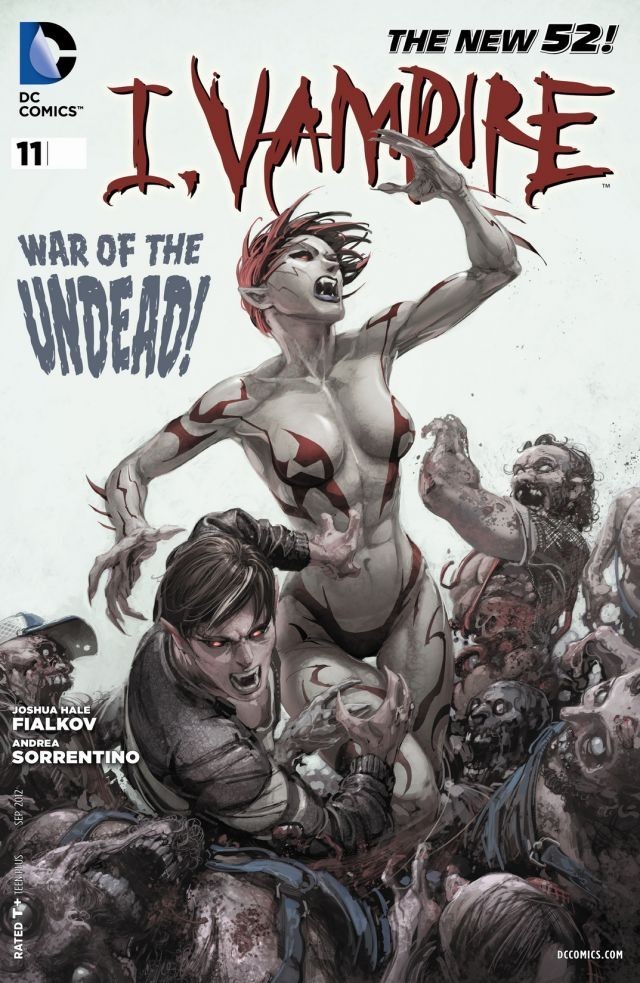
I, VAMPIRE #11

At this point in the Joshua Hale Fialkov and Andrea Sorrentino's "I, Vampire" series, it's not clear how serious the reader should treat the title. Following the "Justice League Dark" crossover, Andrew's new power levels have largely upended the status quo, with the vampires becoming much less of a threat to humanity.

Moreover, with the inclusion of the Van Helsing cult, the fate of the vampire clan seems to be an internal matter. Most of this issue's dedicated to mix and matching the horror movie cliches, with the results aimed primarily to amuse. The whole arc so far has been much lighter in tone than the issues that preceded it, and the result is some madcap, but easily disposable storytelling.

The new dynamic between Andrew and Mary seems too soon, and the Jae Lee-inspired artwork too stylized to deal with the high concept leanings of the plot. To his credit, Filakov doesn't forget about the cast, who stay in character and definitely bring their own flair to the title, but the book seriously needs to either return to the opening dynamic, or find a new workable direction.

JUSTICE LEAGUE DARK #11

The third part of "Black Room", by Lemire and Janin largely works better than the previous couple of chapters. Returning the Vertigo characters back to the DCU is still too bright and colorful, but the underlying superhero elements for once seemingly carry out the title's remit.

Most of the issue is taken up with a superhero fight against Felix Faust and the Demons Three, including the cliffhanger showing a member of the Justice League Dark betraying the team. Beat by beat, the book lives and dies on the premise that there is a whole world of interesting storytelling in the fantasy side of the DC Universe.

Most of the pages include a sparkling lightning bolt effect, with the magic of these characters ultimately amounting to shooting lightning bolt effects that cancel each other out. The Ulises  Arreola's computer colors give Janin's already stiff figures a new layer of artificiality, at least managing to liven up some of the rigidness in the pencils.

Ultimately, the subplot involving Madam Xanadu trying to win over Tim Hunter to help the team find the Books of Magic proves the most interesting. The remaining sixteen pages are capably executed, but at this point Felix Faust has already worn out his welcome, leaving the reader to be entertained by the actions of a continually of John Constantine. It would appear that no matter how well the creators apply superhero storytelling to these characters, the book's success with the individual readers largely hinges on how they react to the scenes such as "Hellblazer" sneaking into the titular Black Room to combat the villain with the mystical weapons from the magical history of the publisher's superhero universe.

THE MIGHTY THOR #17

The underwhelming "Marelock" storyline finally comes to an end in the pages of "the Mighty Thor". Ultimately, the plots involving Amora and the dream monsters finally intersect, but by this point they have little to offer to the readers. The Enchantress and her ever evolving Executioner replacement, they provide the physical threat for Thor, while bizzarrely, the protagonist of a "Mountain Goats" song fights off the Marelock invasion in the dream realm. The scene aims for poignancy but comes of as surreal as the final excerpt from Jeff' diary, written to his friend from "The Best Ever Death Metal Band in Denton".

Thankfully, the ultimate connection between two plot strands finally provides some measure of finality to Doctor Donald Blake, the real victim of Marvel's turning back to JMS' relaunch of the series. Unfortunately, Fraction's post "Fear Itself" Asgardia set-up has proven even more unmanagable, as we see here in Fraction's last issue preceding the crossover with "Journey into mystery" that will likely end both titles in their current incarnations.

By bringing in a teenager from Broxton, Oklahoma, the writer is adamant to stay true to Straczyinski's original idea of Norse Gods making a seat next to a middle American city. The problem is that the status quo he's up elaborated upon hasn't even been made feasable in the JMS issues, due to the creator's abrupt leaving after the disagreements with the editorial, and the resulting changes make for an unappealing mish mash of story concepts that are only broadly true in spirit to the Lee/Kirby originals. In Pepe Larraz's hands, the fantasy visuals break away from the Walt Simmonson's mythology-inspired approach, and present Fraction's "Thor" as a campy cartoon, divorced both from the trends of the industry and the rest of the Marvel's output.

Of course, the penciller is merely following Oliver Coipel and Pasqual Ferry's lead, but despite his clear layouts and powerful figures, there is never a chance that the artist is allowed to work in his own style. Just like Matt Fraction, the artist is trapped in the company's mandate on following up on the work of other creators, and at this point, "the Mighty Thor" is truly in a place where only the already announced "Marvel NOW" revamp can help to lay a foundation for a better integrated reinvation of the Silver Age superhero.


VENOM #21

The finale of "Savage Six" arc manages to be both action packed and poignant, as Rick Remender wraps up most of the story threads of his run so far. Cullen Bunn scripts the story that has Flash Thompson face off against Megatak and Toxin, with the fights being brutal but no more memorable than video game violence.

Megatak was introduced as a joke villain in Doug Moench's last issue of "Thor", but the high concept garishness of the character was apparently enough to grant him the role of token oddball. Still, despite Medina's efforts to present him as a credible threat, the character amounts to nothing more than a henchmen, justifying the necessary number of villains to parallel Spider-Man's nefarious grouping of enemies.

Eddie Brock is a much more integral presence, as Remender has for some time kept up with the actions of the previous Venom host. Unlike Human Fly, dispatched by Flash last issue, there is no real sense of finality to Toxin's fate, but the scene still acts to write out the character out of the series.

Finally, after delaying the showdown with Jack O Lantern for the next issue, Venom confronts Crime Master. The master villain's conversation with Betty frames the issue, and it is their relationship that ultimately resolves the threat that has come to dominate Flash's life. The fight is dynamic and clearly told, with the antagonist's weapon being particularly interesting in a clearly told sequence that leads to the climax.

Following the most engaging part of the issue, Medina somewhat stumbles when it comes to depicting the emotional fallout of the storyline. As a whole, the issue is as solid as the rest of the arc, whose wholesomeness almost comes as a surprise given it serves as the farewell for the original creative team.

WINTER SOLDIER #8

Ed Brubaker and Michael Lark's the second part of the three part "Broken Arrow" story slows down the action to focus on the procedural aspect of the Barnes/Sitwell operation. Both men continue searching for Natasha in their own ways, with the creative team naturally concentrating on the protagonist as he tries to beat the answers out of the hired help.

The fights are largely unmotivated and overly brutal, making it for once harder to sympathize with the impulsive anti-hero. On the other hand, his psychopathic opposite number Leo is starting to develop something of a personality, which helps the story considering that the book keeps shifting from the two points of view.

And while it's still unclear what the villain's ultimate scheme is, by showing his methods, the creative team has helped solidify his agenda. The book is so finely crafted, that even when it produces a largely transitory issue, it feels like Brubaker and Lark are showing us the events in the order that they happened.

Lark's time on the book is proving particularly exemplary. The one-time "Daredevil" artist is producing perfectly readable, well realized layouts, given weight and detail by inkers Thies and Guadiano. At this point, it's clear that the final issue of the arc will be at least as well realized as the two that preceded it, and there is every indication that Brubaker and Guice will try to match this level of professionalism with the already announced follow-up.

Thursday, June 28, 2012

Reviews for June 27th, 2012

ALL STAR WESTERN #10

The beginning of the new arc for Jimmy Palmiotti and Justin Grey's "All-Star Western" title picks up from the closing pages of the previous issue. Moritat once again renders the late 19th century version of Gotham in an interesting style, similar to the work of Sergio ("Lone Ranger") Cariello, albeit with a hint of manga to it. This is apparent in female faces, making Tallulah Black stand out from the more caricatural faces of Jonah and Dr. Arkham. The longtime "Jonah Hex" supporting character provides Hex' motivation for getting tangled up in the confrontation between the followers of the Religion of Crime and the Court of Owls.

"All-Star Western" is once again forced to provide history for the elements of Batman mythos, but at least in this particular case they've been seeded throughout the series so far. The interesting dynamic between Hex and Arkham continues to provide the spirit of the series, which is particularly apparent in the scenes with Tallulah Black. While certainly a far cry for a historical comic, "All-Star Western" continues to fill in an interesting niche of the DC universe.

The steampunk western series is not without its flaws, as the spotty pace continues in #10. Palmiotti and Grey seem to be fond of chapter breaks, structuring their story so that each arc effectively ends in the middle of the third issue, but the stops and starts sometime prevent the more natural scene transitions. Likewise, the unlikely duo is basically without clear motivations of their own, making them merely agents of someone else's interest. In a story like this, it seems that Hex and Arkham act primarily to appease the interest of the Batman editorial, which prompted the "Night of the owls" tie-in, which is less than ideal, no matter how much the creators try to present their involvement as siding with Tallulah.

In the back-up, the writers are joined by Jose Luis Garcia-Lopez for a story featuring Bat Lash. The smug gambler uses his ten pages to portray himself as a charming rogue, but comes off conceited and obnoxious. The story is merely a sketch trying to carry over the appeal of the character, by escaping the obvious approach of scaring away the new reader with trivia. The longtime western character's unbearable portrayal is hardly going to win him any new fans, but the veteran artist presents the story in clear, lavishly detailed style that makes the most impression on the reader.

The back-up primarily acts to justify the 4$ price tag, but it also seems to be there to justify the title, as the constant riffing on Gotham's history largely prevents the company to feature their cowboy characters similarly to the way they were used in Grey and Palmiotti's previous "Jonah Hex" series.

AQUAMAN #10


Geoff Johns and Ivan Reis continue their second arc on the revived "Aquaman" title with a solid issue, featuring two action sequences that derive most of their intrigue from the uncertain status quo of the "New 52" continuity. Even then, the opening featuring the Operative feels overlong and largely superfluous to the wider plot. The superspy sequence works to introduce the character in the context of the wider "The Others" arc, but it serves largely to prolong Johns' decompressed storytelling. The writer does get around to following up on the last issue's cliffhanger, and the addition to Aquaman's past feels tragic enough to have the character's origin mirror that of some of Marvel's superheroes. Otherwise, the cliffhanger provides the only other important plot point, reminding the reader of the infamously decompressed issues of Brian Bendis' "New Avengers".

On the other hand, Reis' pencills, as inked by Joe Prado and Andy Lenning continually betray a rushed and look that breaks from the more polished look of the series debut. And while DC's schedule necessitates that Reis' layouts fall short of Bryan ("the Ultimates") Hitch's detailed style, there is no such excuse for the clumsy insertion of the one page sequence featuring the supporting characters that stand on the margins of the Aquaman/Black Manta fight. The problematic page both breaks from the visual continuity and disturbs the pacing, once again spotlighting the structural problems of the issue. As a chapter in the wider story arc, illustrating Aquaman's ties to a group of Atlantic superheroes, #10 feels like an entry on par with the ones preceding it. The particularly strong flashback sequence is a definite standout, feeding into the mythology reestablished by Johns and Reis, but otherwise, "Aquaman" continues to be the titles best sampled in collected form.

FLASH #10

The Francis Manapul/Brian Buccellato take on "Flash" continues with another self-contained issue, picking up on the plot thread introduced several issues ago. The book has so far been a solid piece of superhero action, distinguished primarily through Manapul and Buccellato's innovative art. This issue is primarily distinguished by Manapul's absence from the artistic contribution, with Marcus To filling in as the book's penciller. Therefore, a lot of good will directed towards the series is put to the test, as To brings in a standard house style that, coupled with a decidedly sub-par script forces the readers to rethink their commitment to the series.

Is the increasingly strange angle of looking at Speed Force, reminiscent of the mythology of TV's "Lost", coupled with a decent try to reinvent little Flash's Silver Age cast enough to make the audience stick with the book in a crowded marketplace? The weirdly generic plot of the opening "Mob Rule" arc was in many ways elevated by the formal techniques used to provide lush art with innovative layouts. Since then, the story has settled into a pattern of single issues building upon the reestablished mythology, while presenting the creative team's take on Barry Allen's enemies. The final page of #10 strongly implies that the Rogues will be forming a new alliance, but until then the reader is left to judge each issue on its own.

Weather Wizard is a typical example of a gimmick villain that works better as part of a concentrated attack on Flash. The character is primarily defined by his powers, and by merely retaining the color scheme of his costume and his last name, Manapul and Buccellato had a chance for presenting a more innovative take on the character. The creative team ultimately opted to have him as a part of their South America drug cartel story, and it's hard to call the result satisfying.

The creators posit a scenario that is a colorful break from the previous stories, focusing on the Flash's background as the police forensic expert. The problem is that the cold case Barry's girlfriend investigates naturally rejects the superhero elements. The visit to Guatemala and the workings of the crime cartel beg for more space to be fully established, and never really allow for the addition of superpowers on the part of the champions of both sides.

The story is slight enough to be inoffensive, but the relationship between Patty and Barry once again feels strained and unnatural. From the start, its clear that the creators are gearing toward uniting the Flash with his long-time girlfriend and wife Iris, while his strange relationship with Patty, feels perenially rushed and wrongheaded. At the end, due to the predicament Patty has found herself in, the creators make their over-reliance on the girlfriend hostage trope a story point, but there's little doubt that Manapul and Buccellato are using the situation merely to get Barry together with Iris, who is herself still trapped in the science fictional prison from the previous arc.

I VAMPIRE #10

Following the "Rise of Vampires" crossover with "Justice League Dark", the Joshua Hale Fialkov and Andrea Sorrentino are free to follow their own plots on "I, Vampire". The leisurely paced title is a rare DC book with a more personalized art style, and while Sorrentino's pages routinely feel like they follows Jae ("the Sentry") Lee's example, the highly contained minimalism adds up to a whole that feels like a rare genuinely creator-driven book in the line-up.

Amusingly, Fialkov starts the story by a conversation between Andrew's allies and their captors, the Van Helsing sect. The scene carries to the fight between Andrew and Mary, juxtaposed by the continuing dialogue between the professor and the vampire hunters' leader. The color coded caption boxes act to help keep the two apart, but the voices inevitably get confused by the reader, while sapping the vampire fight from most of it's impact.

The one saving grace is that he philosophical confrontation gets refreshingly high minded, despite the familiar arguments seen on both sides. Both the professor and the cult leader are human bystanders forced to react to the vampire threat. That the fanatical Van Helsings ultimately decide to attack Bennett's servants comes as little surprise, but at least their plan does provide for an interesting cliffhanger.

Mary's comments remind the reader that her former lover has amassed a lot of power following the crossover, but Fialkov and Sorrentino shy away from any of the more traditional displays associated with the idea. In the end, #10 is but an early chapter in the new arc, yet it reminds the readers that the title posits a welcome diversion in the bloated superhero line, while avoiding the trap of taking itself too seriously.

JUSTICE LEAGUE #10

Geoff Johns and Jim Lee continue "the Villain's Journey" with another issue of set-up, further elaborating the enemy's origin and reasons for attacking the League. Several issues in, Graves is still a cipher with ill-defined powers and a generic character design. Interestingly, a similar complaint could be made for the creative team's reinterpretation of Darkseid, but Jack Kirby's master-villain's very presence and the allusion to the wider Fourth World setting added some gravitas to what was otherwise a generic alien invasion plot.

"Villain's journey" was preceded by couple issues of prologue setting up the scope of the League five years from the events of the first arc. Following the artistic fill-ins, Jim Lee returned to start the story in earnest, but despite the artist trying his best to define DC's house style at it's strongest, the story still feels off-kilter. Expanding on the world of the League to present their organization in a slightly more realistic manner is a welcome change, but having them as the target of a madman's morbid revenge scheme still feels forced and misguided.

Keeping the roster stable, Johns maintains his grip on the characterization, with DC's heroes maintaining their individual identity other than their powers, as well as something resembling believable relationships between each other. The villain's command of mystical forces plays upon this to visualize some of their anxieties, but the scenario still feels like it suffers from being rooted in horror other than science fiction. With the torture of Steve Trevor, who is arguably the emotional center of this second arc, the plot hints at being inspired by crime fiction revenge stories, which certainly provides a unique look at the League.

Meanwhile, the Gary Frank drawn "Shazam" back-up continues its own slow development, this time providing merely a single complete scene and the first half of another. Once again, Johns couples character based writing around the severe renovation of a superhero property, but it's still too early to judge whether the company has found a sustained take on the Golden Age superhero.

DC was quick to shy away from Jeff ("Bone") Smith's 2007 take on the original "Captain Marvel", but at this point its uncertain how long will it take for Johns/Frank to tell their first story with the character. Frank both pencils and inks his pages, resulting in thick lines depicting gritty surroundings along with expressive faces of these characters, in line with the general approach of recreating the modern fairy tale in today's surroundings.

Contrasting the altruism of Billy's foster parents with Dr. Sivana's mad dash for power, the children wind up being the most nuanced characters. This is fitting a story told from the point of view of a child, and while the creative team have barely begun their work on Shazam, the story still provides a grounded counterpoint to the relatively traditional modern day superheroics of the main feature.

JUSTICE LEAGUE DARK #10

"Justice League Dark" presents the second chapter of "the Black room", Jeff ("Animal Man", "Essex County") Lemire's introductory story designed to re-position DC's supernatural superhero title more in line with the book it notionally spins off. In doing so, Lemire tries to distance the book from its origins in the "Flashpoint: Secret Seven" mini-series, but still largely continues most of Peter ("Shade the Changing Man", "X-Statix") Milligan's set up and characterization.

Forcing the characters in conflict with Justice League's handler Steve Trevor and ARGUS does hint at a concrete direction, but it still feels arbitrary and wholly dependent on the reader's nostalgia for seeing the Vertigo characters reintegrated into the DC superhero line. Having Lemire write the series following his success on "Animal Man" is a sound idea, but the editorial might have just given him an assignment that is almost impossible to be made to work.

Given a single character, the writer was able to find a singular focus and build on his publishing history in a way that largely feels fresh and invigorating. Continuing on as the writer on a book featuring the mix of the characters that have little in common except for skirting the line between horror and superhero is definitely something else. Mikel Janin provides the same solidly rendered figures, but his work still lacks the personal touch needed to truly distinguish the book.

Thus, "Justice League Dark" solely depends on the reader's interest in seeing long time Vertigo tropes such as the House of Mystery and the Books of magic, rendered in a more literal way, in line with the protagonists once again existing as mystical heroes side by side Flash and Superman. Lemire keeps Constantine at the forefront of the team in order to help the audience grasp the elusive appeal of the title.

The current issue basically slows down the plot with heavy exposition, as the team settle in what appears to be their new base of operations. Lemire and Janin continue to prop up Madame Xanadu to deliver the same apocalyptic prophecy that the team was supposedly put together to prevent. The book sticks to Deadman's portrayal as a womanizer and the least knowledgeable in the arts of arcane, but it's much different to get any kind of reading on characters like Zatanna, Dr. Mist and Black Orchid.

They are fairly familiar superhero archetypes, defines primarily by their powers, and do little more than fill up the line-up, while the team collectively hurry after the McGuffin. Mystical superheroes were always a hard sell, but in a market that cannot support a "Dr. Strange" title, a generic team made up by characters that have continually failed to win over the audience's attention can scarcely hope to except to stick around indefinitely, not unless the creative team come up with a much stronger presentation.

THE MIGHTY THOR #16

"The Marelock", Matt Fraction and Pepe Larraz's storyline reaches the penultimate issue, which serves its purpose by setting up the stage for the final showdown between Thor and the two simultaneous attacks on Asgardia. Stranded between two more important storylines, "the Marelock" feels subdued and unwieldy. There is no real connection between Enchantress' plan to use Donald Blake's anxieties and the plan of ancient enemies of the Norse realm, except that they threaten Blake's superheroic other half.

The problems regarding Don Blake's role in "Thor" arise from JMS writing him back in the story and exiting the title before he came close to realizing the inherent potential. Therefore, any kind of use Fraction finds for the character a positive for the series overall, even as it speaks against Marvel's strategy of having the new scribe continue the previous story, no matter how unwieldy. Following "Fear Itself", Fraction seemed to have finally reshaped the setting in a way fit for the stories he wanted to tell with the character, which judging from "Marelock" still comes off as a creative compromise.

Having gone through the ordeal of returning Loki as his younger self and killing and resurrecting Thor, the writer still struggles to portray him as anything other than a noble hero with father issues. Moreover, recasting Asgardia as the capital city of the Nine Realms, led by a democratic council of female archetypes, the story still reads like a typical issue of the superhero title. The hero beset by a magical presence that leads him to a dream-like reality is almost a subgenre by itself, and in 2012, it takes five issues to play out. The scope is justified by the parallel plot and the impromptu supporting cast, consisting of various victims possessed as the enemy advances on to the World Tree.

It's difficult to really appreciate each of the plot strands, as they advance marginally before tying together at the end. So far, the Faustian gamble Don Blake makes with the Enchantress has mainly played out as a weird tangent for the character, with a heavy dose of black humor. As of #16, a clear villain arises from the duo's dealings, dubbed Fort by Fraction, who will hopefully find a way to use him as something more than a blackguard to be dispatched by Thor starting next issue. The relationship between him and Enchantress hints at being perverse, but is at this point fairly standard when it comes to the genre.

And while Fraction sets up a new villain as a replacement for Executioner, the immediate plot concerns the supporting cast finding a way to deal with the change Thor has gone through thanks to a new addition to the collective dreaming. The Deconsecrator seems like a typical early "Spawn" villain, but his origins stem from a Mountain Goats song parodying the relationship a couple of small-town teenagers have with death metal. When you have the successful writer going out of his way to dramatize an underground satiric song as a Marvel superhero story while he struggles with JMS' set up of Asgard coexisting with a fictional mid-western town, it's easy to dismiss the whole of "Marelock" as merely a placeholder while the company prepares the upcoming crossover with "Journey into Mystery".

Larraz' slick, caricatural arc goes a long way to providing a stylistic continuity to the work of Pasqual Ferry and to a lesser extent Olivier Coipel, making the decompressed story at least easy enough to parse. The biggest indictment is reserved for the cover, featuring the work of Walt Simmonson, whose unparalleled innovation turned "Thor" into a successful fantasy title that transcended Lee and Kirby's superhero origins. Unfortunately, ever since the writer/artist's historic run, the title has floundered with the basic foundation, birthing a series of successive takes that failed to catch on in a major way. Despite his efforts, and the acclaim garnered for the "Ages of Thunder" oneshots, as well as the relative success of the Thor-centric "Feart Itself" crossover, Matt Fraction has struggled to make a permanent mark on the title. Issue 16 is a perfect example of the way he tries to construct the story that will please both himself and the Marvel editorial.