Saturday, June 11, 2011

Walt Simonson's Avengers (#291-300) Part one - the Fate of Marrina


THE MARVEL UNIVERSE ASPIRATIONS

Walt Simonson is primarly known for his groundbreaking run on "Thor", but even then it was apparent that his love for the Marvel universe in it's original incarnation, cannot find full expression in his mythology-heavy take. As a self-professed science fiction fan, Simonson has found a way to integrate some of it's conventions in the title, most famously with the inclusion of Beta Ray Bill.

Particularly a curious "Thor" storyline featuring Titanium man and his gang of assassins shrinking into playing cards seemed much more suited to an oddball Iron Man Annual. Yet, it was Simonson's work on "Eternals", wrapping up the 1985 maxi-series that directly lead to his stint on "Avengers". Jim Shooter, then editor in chief at Marvel was allegedly dissatisfied with the series writer Peter ("Strikeforce Morituri") B. Gillis' work on the Eternals revamp that lead to Simonson stepping in to write the final four issues.

A typically thankless job lead to a serviceable script, dealing with the final act of the bloated and severely flawed Gillis work. Yet, it was only in the last issue that some of the Simonson's peculiar quirks came to the forefront and breathed some life into an otherwise troubled and uninspired maxi-series. It could be said that the writer's creative choices went somewhat against the previous set-up, but in a way they ended up directly informing his "Avengers" run, and it's eventual "Fantastic Four" follow-up.

And while the aftermath of the fight against the Black Celestial was only hinted at in his work on the Earth's Mightiest Heroes, it was the idea of bringing in the Avengers to assist the Eternals in the final conflict that has defined his work for the publisher since. Namely, casting Thor in a supporting role seems a constant in the writer/artist's subsequent work for the publisher. The character certainly didn't seem out of place in the context, considering that Roy Thomas spent the majority of his run on Marvel's premiere mythology title providing the wrap up for Jack Kirby's original "Eternals" series.

The King's ideas were still influencing the creators for the better part of the 1980-ies, and while this was not at first apparent in his "Avengers" scripts, it was only because Simonson started his run by deconstructing the Roger Stern team, that he inherited. Thankfully, he got to keep the title's then current penciller, a comics legend John ("Silver Sufer", "Conan the Barbarian") Buscema, who coincidentally also provided the art for the aforementioned Roy Thomas' run on "Thor".

THE GATHERING STORM

Yet compared to the freedom of his own run on Marvel's God of thunder, Simonson's work on "the Avengers" was plagued by compromise from the start, due to interconnectedness of the Marvel publishing line, featuring many of the same characters appearing in several different titles. Even his pencilling the company's best seller "X-Men" spin-off didn't really prepare him for rigors of working with the Avengers. During his tenure illustrating his wife Louise Simonson's scripts, the "X-Factor" was more or less kept separate from the rest of the mutant titles, and even then, the occasional crossover meant collaborating chiefly with the core title which originated all of the characters.

His "Avengers" on the other hand, even started not only following the previous writer's popular run, but also directly continuing from a story featured in "Thor". This was perhaps to be understood, considering that Simonson brought Odinson back to Avengers, but it set a precedent for interference that would ultimately be the run's undoing.

Anyhow, the circumstances of Thor's return are largely glossed over in the debut of the Avengers, with the new writer instead focusing on providing a brief moment of serenity for the whole group. Following Stern and Buscema's epic "Under siege" storyline, the remaining heroes were pretty much limited to their appearances in the team title, which is something that Simonson immediately set out to remedy (the writer also brings back Avengers' butler Edwin Jarvis, with an eye patch that serves as the remainder of the previous conflict). In order to do, the writer opts for something of a controversial approach, effectively derailing half of the team by their own hidden flaws, and not directly at behest of a master villain.

His first arc is thus devoted to bringing to the fore the tensions implied in the origin and subsequent appearances of the Alpha Flight character Marrina. At the time, the character had joined the Avengers and married Namor, with Simonson showing the pair being blissfully happy during the repairs on the team's Hydro-Base headquarters. The writer painted a bright picture of the newlyweds precisely with the idea of contrasting it mere pages later, when the biological imperatives of the character's alien background kick in. Seeing the creators going over the top with the depiction of her transformation is at first bizarre, and even disconcerting.

Seeing the beautiful, if somewhat generic companion to Marvel's original anti-hero transform into the monster to be fought by thea team for the subsequent two issues is certainly distinctive, but potentially problematic on multiple levels. It can be said that Simonson simply lead her story to it's ultimate conclusion, but somehow seeing the John Byrne created character treated so callously still seems brutal. It is doubtful that her creator would have used her back story to mimic Superman's origin so extensively if he merely intended for her to turn out to be nothing more than the threat to her friends and the world at large. Simonson is not so blunt to use that sympathy for emotional resonance, but it's still very disconcerting and even somewhat silly to see the nimble beauty turn into a serpent like behemoth, no matter the number of times her creator previously hinted at the prize of her dual heritage.

The writer intentionally omits the extensive summary of her origins, which feature a more elaborate version of Superman's classic arrival on Earth, instead concentrating less on the science fiction behind it, and more on the implication of Marinna's attacks on the high seas. Simonson stresses out the Biblical Leviathan reference to add gravity to the proceedings, but they more or less serve to convince the team that her alien manifestation necessitates immediate termination.

Once again, this feels somewhat contrived as the writer purposely leaves little room for Marinna's redemption and survival. At first, it seems that the character is simply no longer capable of subverting her brutal ancestry, which goes some way to dispel the idea of the story devolving in the familiar, if even sexist, genre trope of superheroines being emotionally unstable to deal with the tremendous power at their disposal, exemplified perhaps most famously in the X-Men's "Dark Phoenix saga", and even with the Avengers' own Scarlet Witch. And while the wide scale event that was "House of M" was still decades removed, Simonson basically executed his own version in three issues, without the need to tie in additional titles in the process.

Which would be fine on it's own if it wasn't for the conclusion, which ties in to her marriage with Namor and is potentially severely insulting, if the reader is to look at it from a certain point of view. Basically, Simonson reveals that the cause for Marinna's rampage towards trade ships the world over was the idea of building her own nest to hatch the alien hybrid offspring. The storyline is certainly memorable, but the implications it makes on the female psyche and motherhood could certainly be taken as offensive.

That aside, it's still strange to see this whole arc as anything other then a "Namor the Sub-Mariner" story, seeing that Marinna wasn't even created as an Avengers character. This is perhaps why all of the other subplots deal much more directly with setting up the Simonson run. Beside writing Namor out of the title, Simonson made certain to create almost as much friction with the remaining members. This is most notable with Black Knight, who due to coming to Namor's assistance against Marrina suffers a hideous bout of the symptoms relating to the curse of his Ebony blade. Ironically, in his brief writing the character, Simonson was left with this fatal flaw substituting for the character's personality, but this was again to be expected, considering that his main focus was elsewhere.

Namely, throughout the Leviathan crisis, Dr Druid undermines the team leader Captain Marvel's direction at every turn, who in turn pretty much vanishes during the said conflict, that has already severely decimated the team. At first, her not rejoining the fray seems an afterthought, an ambiguous subplot that would be picked up immediately following the end of the storyline, but in turn it marks the character's exit to be revamped later on.

The implication is that Druid is under control of a beautiful woman who haunts his dreams, which ties in with another subplot running alongside, that of the fate of the team's primary antagonist, Kang the Conqueror. In Simonson's run, Kang remains a presence throughout, most notably in the second arc that the writer has been building up to since taking over the title. Contrary to Druid's tragic descent into madness and fault, Kang is written like a much more three dimensional character, determined to weather the events that keep him going from one predicament to the other. Under Simonson, the character seems formidable and resourceful, if pragmatic to the extreme, making him almost an anti-hero like Namor, and very unlike the traditional super-villain.

The retrospective of Walt Simonson's "the Avengers" run will be split in three parts. This entry covers Avengers #291-293.

Friday, June 3, 2011

Witchfinder - Lost and gone forever

This week has seen the conclusion of Dark Horse's second "Witchfinder" mini-series. Published under the banner "from the pages of Hellboy", editorially it primarily serves the purpose of being one of the projects that vie for the spot of being the third ongoing series set in Mike Mignola's supernatural universe, behind Hellboy and BPRD. But more importantly, the real question is whether it has any value aside from being another peripheral addition to an already complex mythology, two decades in the making. And while the first Witchinder project, "In the service of angels" (illustrated by Ben Stenback) certainly felt engaging on it's own, it is this second outing that has proven much more wholesome.

Perhaps this is because it actually started development first, with Mike Mignola and his co-writer John ("BPRD") Arcudi itching to do a weird western serial with their Victorian detective protagonist. As all of the Hellboy verse books are art-centered, the series seems actively developed so as to spotlight the artwork of industry legend John ("Two-fisted tales", "Mad magazine") Severin. The fact that the veteran penciller is currently 89 years old, and still producing detailed inked artwork cannot be overstated. And while Severin had previously pencilled a memorable oneshot for the BPRD "War on frogs" anthology mini-series, his talent is utilized to the full extent in the new Witchinder series.

As for the character himself, Sir Edward Grey is a curious case. Conceived to be a pastiche of the Victorian supernatural detectives in the vein of Carnacki the Ghost-finder, yet the co-writers maintain that there is more to him than that. On one hand, the character exists to be Mike Mignola's proxy in working with the period-related material, much like the role Lobster Johnson is designated to play when it comes to publishing the material taking place in the pre-World War 2 pulpy setting. Again, the twist is that Witchfinder is a more complex character, whose adventures leave their mark on him, a man of secrets and a devout Christian.

In several ways, Witchfinder was already a part of the mythos, due to the cameos and oblique mentions Mignola kept making in his Hellboy stories. And judging from what the creator has said in interviews, the character is posed to renter the main title for what may yet be his definite role in the series. But moreover, what's interesting is the way that Mignola uses the character in context. Every time Sir Edward Grey gets a mention, it was in a milieu that he felt a natural part of, and hasn't drawn attention to himself. And this is not only because of the large tapestry the writer/artist has woven, where he keeps making mentions of curios sighted, or inspired by his research. A reader committed enough to re-read the Hellboy material will no doubt appreciate the foreshadowing that Mignola has seeded his saga with, but he or she won't be left clueless if they discover Witchfinder with these minis. This is no because each time they are approaching a Hellboy related project, the editorial makes sure that it stands on it's own as a compelling action horror book.

This kind of commitment to the material is key to the success each of these projects have, and is primarily the reason why a (so far) very minor player in the Hellboy universe continues having his adventures told in a market notoriously resistant to new titles. The tightly knit mythology that editor Scott Alley has assisted Mignola with developing has simply won enough of the fans' trust that they will continue to support it, seemingly no matter how tangential the link to the main book. It must be said that this is fairly unique in the industry, considering that Mike Mignola himself has a reasonably decreased role with the development of that much spin-off material. In fact, Hellboy's creator and primary writer/artist is listed as only a co-writer on this second Witchfinder mini, which is historically a very loose enumeration that many fans have justified reason to be suspicious of.

Yet, even despite Mignola admitting that some of his and John Arcudi's scripts have little of his own input, the strength of the brand is such that it continues, simply because of the underlying quality running through the franchise. "Lost and gone forever" is a perfect example of the care that goes into making a Hellboy verse story stand on it's own. This is done simply by everyone involved never forgetting the underlying principle that inspired the story arc being simply the desire to a Weird Western. Everything else is subjected to this notion, nuanced and having a very good reason to be in it.

And while the original mini-series starring Sir Grey had several direct links to Hellboy mythos, this time around they are pretty much non-existent. Formally, Witchfinder's reason for coming to Utah had to do with chasing down a henchmen of a secret society that has robbed him of his chance of happiness, but even this much is not directly stated in this second mini-series. The co-writers are primarily interested in Sir Grey's current emotional state, and are treating his whole western adventure as an escape from a tragic event into a new series of circumstances designed to reinstate the confidence in the character. Thus the chase he is on ends up being a classic McGuffin, as he stumbles upon a completely different local scenario, that sure enough eventually links somewhat to his quest, but makes it clear that the new threat is much bigger and more immediate than carrying over the revenge from the previous series.

Considering the number of western genre tropes introduced in it's pages, in many ways, "Lost and gone forever" could have ended up an arbitrary western series, primarily notable for John Severin's presence on art duties. Being tenuously related to the main books could have created a number of problems, despite avoiding the contrivances that come with working with prefigured continuity. Again, being a fairly generic Weird Western pencilled by Severin would be at least a tolerable book in it's own right, Mignola and Arcudi achieve something more. They manage to transform the Hellboy formula using his detective predecessor into an interesting genre piece.

This is notable considering that so far the material featuring Lobster Johnson, and even the two BPRD flashback minis featuring Hellboy's own surrogate father, professor Trevor Bruttenholm, and covering the Cold War years of Mignola's mythology, have yet to transform into narratives that carry somewhat more of an emotional impact beyond the era specific monster hunts. Perhaps it's due to the air of doom and mystery around Sir Edward Grey that his adventures ask questions that are somewhat lacking in the other two outings, considering that the reader is already familiar with the life, and especially the demise of the two aforementioned characters.

In any event, Witchfinder' emotional arc revolves around a very deliberate plot, which revolves around the western town, and a mystical curse that is working against it. At this stage in his work, it should come as no surprise that a witch is at the heart of the strange events befalling the mining town of Reidlynne. Yet, most of the action takes place around in the desert around it, under the unforgiving sun, or after it's setting, which is where some of the most disturbing parts take place. Admittedly, there is certainly a lot of fight scenes, with some of them somewhat contrived and even superfluous, but it's easy to justify their presence considering that the dual nature of the story's serialization. Simply, there had to be some action in every one of the five issues making up the storyline, for the express purpose of entertaining the reader picking up each of the installments. And although it certainly makes most sense reading the collected edition, Dark Horse was careful to attend to the readers who wanted to actually sample each of the chapters they were buying at the time of publication.

The lack of expository dialogue and some pretty offbeat cliffhanger endings might have made this a short and unwieldy experience, but on returning to the books the reader gets to see how much of the natural storytellers is in each of the creators involved. The expert pace is maintained throughout, and on rereading it's apparent that there are quite a lot of fully scripted pages, with only rarely a silent panel being used for effect. The creators are simply mindful enough to make it all seem natural that it becomes a showcase of how to do genre comics that don't talk down to the reader, or attempt to wrestle with the artist for the control of the atmosphere by inserting the character's inner monologue in a series of never ending captions.

Mignola and Arcudi simply trust their carefully picked artists enough to use the visual aspects of the book for most impact, without trying to second guess them at each point, or trying to make their own contribution apparent at all costs. In doing so, they free up an artist like John Severin to present his visuals in the most powerful way, with his detailed rendering bringing to the fore all of the emotion and background that the tale calls for. The artist excels in every part of the craft, serving up memorable character designs, coupled with detailed backgrounds that really distinguish each of the several locations in which Sir Edward Grey and his guide, Civil War veteran Morgan Kaler ride through. Not only that, but under Dave Stewart's controlled coloring, even the weather becomes shaded and continually slightly altering, while preparing for the climatic final scene. The key characters in several places are "lit" in such a way that further calls attention to the particular Severin figure in a crowded scene, again in a very subdued manner.

Perhaps somewhat surprisingly, the book offers several double page spreads that mostly serve to draw out an action scene by utilizing a dynamic that is gained by having a cascading number of panels in one place. Again, Severin presents a lot of impact even in such familiar set pieces, such as time killing zombie attacks. His work is precise, yet at the same time convincingly emotional due to the slight fuzziness of the inking. The intended effect certainly doesn't betray insecurity or the lack of ability, but an expressive style used to bring a sense of humanity into otherwise fantastical scenarios. The book's key sequence is a trip to the surreal that exemplifies both the protagonist's spirituality, his need of emotional closure, as well as a crucial plot point. Dave Stewart opens these pages up to the richest palette in the book, which again makes them stand out without artificial narrative tricks.


As for the reality of the American turn of the century West, beyond Severin's meticulous detail, the co-writers make it their mission to present a particular piece of folklore, centered around Paiute Indians. Once again, what separates these books from their pulp inspirations is the attention of the detail paid to the real world conditions that were often abbreviated in order to perpetuate the cliche. Alongside the realistic characterization of the protagonist, and the portrayal of ethnicities without the need to ridicule, such a modern day Western can be said to be ultimately better suited to the tastes of modern reader than it's original inspirations. And while nobody will mistake Mignola and Arcudi's effort for the bizarre brilliance of Joe R. Lansdale and Tim Truman's "Jonah Hex" work, and it's unlikely "Lone ranger and Tonto" follow-up.

It seems that Mike Mignola and his collaborators simply didn't aim as high. Stylistically, the goal was to bridge the Hellboy formula with John Severin's genre expertise, and provide just enough diversity to entertain during the course of reading. Perhaps the continual unashamed spin-off status of much of the Hellboy related material does make the regular "BPRD" comic book stand out as much as it does, considering that it also succeeds as a distinct project of it's own, a team book dealing with the supernatural in a modern way, that has already inspired a slew of imitators. So far, "Witchfinder" does not seem to have any loftier aspirations on it's own. Perhaps it's because of the lack of visual continuity, but it certainly remains to be seen how well the series stands on it's own. "Lost and gone forever" is somewhat ill-suited to illustrate that fact, seeing as how it  particularly deals with an oddball scenario before returning it's protagonist to the more typical Victorian setting.

Taken as such, even Sir Edward Grey's emotional journey is to be picked up and developed more directly in the subsequent material, with the western episode acting as a crucial, yet transitional part of his personality make up. In a way, it seems that perhaps the most direct impact of the book will be felt later on, with the creators returning to Morgan Kaler, who is shown to be in a perfect position to act as a proxy to Mignola's interests, if the creator ever has an idea for another Western adventure. or even simply to spotlight a bit of American lore that his 19th century paranormal investigator could have stumbled upon.

Still, as presented, Morg is a very stoic character, hinting at occult happenings in his past, but otherwise a picture of a seasoned veteran with little conflict of his own. He makes for a solid supporting character, but it's difficult to imagine Mignola and Arcudi getting back to him without further developing at least some of the events hinted in his past. It is fair to say that the story revolves around Witchfinder and the mystery he encounters in Utah, with the rest playing a secondary role.

Interestingly, most of the villain scenes take place in their own subplot which collides head on with Sir Grey and Morgan's investigation only in the book's finale. This somewhat renders the threat impersonal and akin to the adversaries in some of the Hellboy short stories, which is somewhat strange considering the amount of exposure the character gets. Despite the complicated plan, inspired in Indian legends, and the obligatory origin sequence, the villain still seems evil for evil's sake, which seldom makes for a memorable adversary.

All in all, "Witchfinder - Lost and gone forever" is an interesting piece of comics work, certainly worth the read if the reader is at all interested in western, work of a skilled illustrator John Severin's, both of which are underrepresented in the North American comics publishing. The Hellboy connection should be taken as merely a means to gather attention to a story that would otherwise have a very hard time today succeeding on it's own.

Sunday, May 8, 2011

XIII mystery #1 - Mongoose

THE BACKSTORY

With the conclusion of the original creative team of Vance and Van Hamme's take on the "XIII" series of albums, the authors decided to let the publisher continue to exploit the profitable franchise. Thus far this has consisted of "Dargaud" establishing a spin-off series titled "XIII mystery", with the idea of spotlighting some of the characters featured in the original albums. So far, each of the three published albums has included a different creative team, which is also implied to be the case in the details listed for most of the upcoming releases. Meanwhile, the publisher is much more careful with the main "XIII" title, whose new writer and artist's work has yet to be presented before the year is over.

The "XIII mystery" debuted in 2008 with "Mongoose", a collaboration between writer Xavier ("le Troisieme Testament") Dorison, and artist Ralph ("Ian") Meyer. With the eponymous Mongoose being the code-name of the chief assassin in the main "XIII" series, this debut of the new series had a complicated task to perform. Obviously, it had to convince the readers that there is a reason to pick up this continuation of the decades in the making popular series, which came to a stopping point long after the original creators planned to end it. In that regard, any fan that stuck with Vance and Van Hamme had already got accustomed to contrivances enabling the byzantine plot to lurch forward a few extra volumes more, making another return to the series seeming much less artificial than it might appear to the uninitiated.

The real problem was convincing the readers to stick around while accepting that the they will be presented with anthology-style offerings, keeping the franchise in circulation while the publisher puts together the new creative team for the main title. On the face of it, it's very easy to dismiss the whole enterprise as strenuous, with the different creators basically adding superfluous bits of information to the past exploits of the series' regulars, that the original creators obviously didn't intended, and thus had no impact on their behavior in "XIII". Still, with the projected publishing schedule of one album per year, "Dargaud" executives must have felt that a solid enough effort could make the nostalgic reader interested enough not to feel that their time and money would be directly exploited.

THE EUROPEAN COMIC SPIN-OFF

On the whole, the main strengths of Franco-Belgian school of comic book storytelling lie with the idea of letting the series' creators focus on the books, taking enough time to make each entry stand out, while adding up to the effort that in the most successful cases makes for particularly distinctive books. And yet, despite this creator-friendly approach, the major publishing houses still try to extend their profits to the new releases, resulting in a slew of spin-offs, not unlike their American contemporaries.

Yet, with the exception of "Spirou" (whose major creative success came with Franquin, himself the second creator continuing the original strip) and "Lucky Luke", there is usually a very clear distinction between the work of the creators and the talent contracted to continue producing the new stories. The best case scenario is to have the new creative team contribute something that is actually distinctive and stands up as a success in it's own right, such as Tome and Janry's "Young Spirou". Unfortunately, typically the effort is something akin to "Young Blueberry", which is marketed as a generic western supposedly continuing the pre-Fort Navajo adventures of it's star ad infinitum.


DORISON/MEYER

In any event, Xavier Dorison and "Dargaud" have decided to continue "XIII" in a way that sticks very closely to the Vance and Van Hamme original. This is already notable in the idea of framing the story in such a way that it spotlights a crucial part of XIII the character's back-story. Thus, in order to show the reader the life of Mongoose, his would be assassin, Dorison decides to employ the story within a story approach, which provides a direct link to the main series "XIII mystery" is spinning out of.

At first though, the effect is distracting, leading the reader to try and remember at which point exactly does the action takes place, but thankfully the confusion is clear as soon as Mongoose shows up. At the same time, the story shifts from filling in the points of the already implied continuity to his remembering the life that has lead him to that point. But the reader shouldn't take this break for Dorison completely abandoning the "XIII" style of storytelling. In fact, he largely embraces it, albeit indirectly.

By having Ralph Meyer, a somewhat more expressive artist than Jean Van Hamme, draw in a similar reference-heavy style, "Mongoose" basically  feels a lot like a "XIII" album flashback. Once again using the recent past as a stage to conduct the spy thriller, Dorison deliberately sticks to Vance's model, making it clear to the readers that he's taking no creative risks in following up the popular series. This time, the backdrop is East Germany, in which an orphaned child makes his first steps on a road to violence that will eventually bring him high in the criminal conspiracy. And for all of the original "XIII"' flirting with realism in the past, the writer takes the right cues to maintain just enough of the everyday to provide some color to the scripts, but not at the cost of the brutal action scenes that cynically end every attempt to concentrate on the reality beyond the book's designated genre.

Yet, neither is "Mongoose" really a Cold War type story. With the bulk of action taking place in America, where a young killer comes of age with the help of a surrogate father, and a deadly inspiration, it presents more of an emigrant experience. We are given just enough to empathize with the young man as he partakes on a rigorous training that will one day lend him the best paying contracts in the business, but at the same time the decades spanning plot mechanism prevents the creative team on dallying too long on his motivations. After all, despite some of his musings on his methods and the life style, the book never turns into Matz and Jacamon "the Killer". That slow-moving internalization of a mercenary in comic book form is after all, a distinctive property in itself, and not a 50-odd page spin-off that has to cover more than three decades, while seemingly operating as it's own series, working at it's own pace.

This is where "Mongoose" works best, with Dorison paying particular attention on making his story feel organic and motivated, and not rushed off in a halfhearted attempt to quickly churn off an inferior product. Seeing Mongoose as a human being, adapting to a very peculiar life-style, while also acting out of his own personal goals almost has the reader forget the image of Vance and Van Hamme's take on the character as a fully formed antagonist. Thankfully, the writer never forgets to stop before making Mongoose too altruistic, which is why he introduces the character as an orphan and devotes very little space to his assumed name and the East-German home he was adopted into. In a very mature storytelling decision, Dorison progresses the character gradually, distancing him from his purported goal as subtly as Meyer ages him before our eyes.

The first-person narration helps maintain the illusion of the character's original motivation until he finally has his altruism judged beyond the complicated charade of half-truths and principles he's constructed around himself. The character is given no time to deal with this development, as the complicated assignment that has driven him to deal with his personal underpinnings also represents the start of the "XIII" conspiracy. The wider series plot thus actively proceeds to deconstruct even the character's then-present day position of being a contract killer, destroying all of his attachments and positioning him solely in regards to the conspiracy.

As his narration ends, he is once again caught up in the precise moment that proved a turning point for the life of XIII, which is again where a great deal of subtlety helps Dorison. He first shows us the character declining the offer to rededicate himself to work for the conspiracy, but then immediately reverses it, revealing himself as having already become the Mongoose of the "XIII" series.

This final scene was set up as a real test of the writer's work, with the reader either accepting the psychological transformation undertaken by the character as realistic, or rejecting the whole volume as misguided and superficial. Thankfully, by layering his work so densely amid the familiar tropes of a visual crime story, the writer achieves the effect of Mongoose's internal musings on the nature of crime and his role in it actually being instrumental in making him the man he becomes, instead of remaining as just so much tough guy talk.

Bluntly, in his own mind his life is a misguided tragedy, but through Dorison choosing exactly which panels to give Meyer to spotlight, the reader is instructed to look beneath the self-deception, and see the truth that Mongoose glimpses, if only at the moment. That such an elaborate psychological profile was presented in a plot-heavy crime comic tying in with the existing series is as much a testament to the writer's carefully constructed story, as much as the strength of the underlying "XIII" franchise. The script really feels in synch with Vance's work, feeling just as credible, as each of the flashback-related earlier volumes did.

And yet, it's difficult to say that Ralph Meyer's work has quite managed to make such a transition. The series co-creator Van Hamme is a very disciplined artist and a true professional, whose attention to detail seems much more organic than what is presented by the follow up artist. Simply put, Meyer's work is much more expressive, even in quieter scenes, lending the work a subtly different quality. And while the artist dully proceeds to illustrate the furnishings in his establishing shots, most of the follow-up panels usually concentrate mostly on his figures emoting against the sparse backgrounds. In this way, the story feels much more personal and energetic, but the baroque plot keeps constantly challenging the artist to succumb to working from reference material. Meyer's work is certainly credible, his character designs distinctive and figurework realistic, yet there is a distinct impression that he's working in someone else's stylings, which only enables him to reveal his professional best.

Ralph Meyer is an artist whose work is very dynamic and solid, much more modern and instinctive than Van Hamme's classically rendered set pieces, yet when it comes to anatomy and the employing his predecessor's designs, his work suffers in comparison. Meyer's contribution is most apparent in the crucial character of Hans, whose design and body language are particularly well presented, at a glance distinctive from the original "XIII" penciller's body types.

In retrospect, it seems much easier for Dorison to emulate Vance, and not have his contribution being so easily compared, as is the case with the artists in a visual medium, such as comics. Both Vance and Van Hamme have created "XIII" to be a very precise and distinctive mechanism that only seemed over-elaborate when  looked at as a whole, thus their successor's work, limited at all sides by scope and ambition, never really had a hope of being something more distinct than a spin-off portraying a charismatic figure of the mythos.

This is in some ways a good thing, as the work on "XIII mystery" raises the profile of it's creators, and enables them to continue with their own projects. On the other hand, it's difficult to imagine "Dargaud" deciding on accepting a more experimental approach in what was the debut in the series that even now sketches out some ten odd potential albums, each in a varying state of development. Hopefully, all of them will be as competent as this debut, even as their story will likely remain peripheral to the main series. With the fall release of the Jigounov and Sente's new "XIII" album, continuing where Vance and Van Hamme left of with the character, time will tell if there's enough interest in the franchise to support two ongoing projects.

"XIII mystery" could very well establish itself as appealing only to the collectors and hard core fans of the series, but when taking into account the popularity of the title, this should still guarantee it tens of thousands of readers. Whether this will prove enough for "Dargaud" to extend the property beyond the designated albums, remains to be seen. Admittedly, even the success of the main "XIII" title, marketed as the direct continuation of the Vance and Van Hamme's work, could depend only on the quality of their successor's work. The series' originators could be counted to return to these characters over and over again, but it's up to "Dargaud"'s quality control to make certain the franchise keeps resonating with the readers in the years to come.

Friday, April 1, 2011

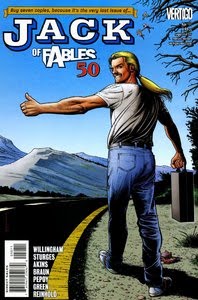
Jack of Fables 46-50 "The end"


FROM THE OUTSIDE LOOKING IN

After prolonged delays, this Wednesday brought the last issue of "Jack of Fables", which doubles not only as the finale of the "Fables"' spin-off, but the ending of it's last story arc as well. Writers Willingham and Sturges have spent five years working on solo adventures of Jack of stories, foreshadowing both the long time in planning "Great Fables crossover", as well as laying the seeds for this final storyline, which sees the ending on their satirical take on the character, at least for the moment.

The majority of the run has been illustrated by Tony Akins, a capable cartoonist who gave the title a distinctively manic look, that much better to differentiate it from the main "Fables" esthetic. Where in Marc Buckingham's hands the parent book sports a urban fantasy look, "Jack of Fables" was made to give off a more lurid atmosphere, mirroring the constant pattern of a never ending dirty joke that the writers strived for. Essentially, for all intents and purposes Jack of Fables had it's own tone, which is paramount for a successful spin-off. Even then, it was always a part of the broader Fables setting, even if purposely working in opposition to the more successful title.

A lot of the main Willingham/Sturges themes were resolved during the crossover, which was the first time the book close to matching the sales of the main title, but the writers were determined to continue for one more year of Jack's adventures. The sales swiftly returned to their previous levels, with the usual trend of continual decline, coming to roughly the half of monthly number of "Fables" copies sold in the Direct market (at least judging from the ICV2's estimates, which can be used to somewhat accurately describe the trends in American comic book publishing). At the time of cancellation, this was still a much higher average than that of a lot of Vertigo's ongoing series, but the creators are reportedly content with the decision, having already told all of the stories they wanted to tell with the character.

THE ULTIMATE JACK OF FABLES STORY

In any event, their last story arc serves as the finale to their work on the book, tying up all of the plot threads that weren't directly resolved during the "Great Fables crossover". Willingham and Sturges slyly start off with the spotlight on the three page sisters, and setting up their current agenda. Basically, the feisty librarians are trying to rebuild the Great library by tracking down the specific books they need to reinstate their Literal status. This is more or less typical Jack of Fables storytelling, serving to slowly reintroduce the reader to the status quo. The first sign of something unorthodox comes with the reintroduction of Jack and Gary, whose current predicament is illustrated in the manner of a Sunday page retro comic strip. And while the jokes told using this rigid layout are refreshingly straight forward, the context behind the change in Tony Akins' style is much more interesting.

Namely, there is a sense of a long time having passed between the story arcs which is finally made apparent by switching to Jack Frost's current whereabouts. Namely, that the de facto usurper of the book's previous two arcs is now relegated to a mere subplot should by itself be notable. Furthermore, seeing Akins' redesign of the character, who has transformed from the slender well-meaning fantasy protagonist to a full blown universe wide hero, further cements his companion, talking owl MacDuff's, 's endless prattling of their noble exploits. To put it bluntly, Jack Frost now looks like "Escape from New York"'s Snake Plissken, and his writers finally have him reconnect with the title's previous continuity. By giving the eye patch wearing, hyper muscled veteran one last mission in which he is to confront his father, now a caricature of a fairy tale dragon, Willingham and Struges are at first glance transparent about their motivations.

But it's only when the story continues, by shifting back to (present day?) Earth, and the rest of the supporting cast stuck working in a diner, that the full scope of their plans become revealed. That is, not only are Raven and his troop of runaway Fables also coming to the foot of Jack the dragon's cave, which is predictably where the Page sisters also find themselves going to, but that almost a decade has passed while the writers stubbornly kept the focus on his heroic son. This is no doubt the effect the creative team was going for, as the number of people finding their path leads them to Canadian countryside starts increasing, from every which way they are coming, all unaware of the company of the others.

Willingham and Struges seem to be saying that all of the characters previously encountered by Jack cannot move forward even after all these years of him going into retirement, and are seeking some kind of a resolution by confronting the reclusive anti-hero. The clever twist is that some of the foretold intruders upon Jack's soil never actually show up, but the sheer number of the ones that do more than dwarf them. Most importantly, Jack Frost, himself on the verge of retirement, rushes to meet the hideous dragon, one last act he needs to prove himself a true hero, even though MacDuff serves to remind the reader that his owner has done just this time after time, and across the whole galaxy. This is important on a metafictional level, as following the "Great Fables crossover", the book has basically jettisoned it's original, heavily flawed protagonist, in order to spotlight his estranged son, who as proven himself a hero without peer in the two story arcs preceding this last one.


Willingham and Struges went purposely so over the top with depicting a scenario that was the anti-thesis of their heavily post-modern parody of typical male, that they predict that the original "Jack of Fables" reader has by now found himself missing the original Jack. Horner's sexist power play and selfishness turned him into no less then a literal dragon, lying on the heap of the riches accumulated by tricking the other characters and thinking only of himself, but seeing his perfect son get all the glory since, it makes sense that two would go head to head for the book to return to it's meandering metafictional exploits.

THE WIDER POINT

Only, this confrontation is designed for the precise purpose of ending the book. The controversial choice actually makes sense on some level. "Fables" was always the more optimistic book, designed to find a place for fairy tale characters in the modern day and validate the struggles of fantasy authors trying to marry the two in literature. On the other hand, "Jack of Fables" from the start took to the negative of just this approach, singling out the various twist and turns the original fairy tales have taken in lesser hands, and trying to breathe some life in seemingly empty husks of Alice of Wonderland and Paul Bunyan, driven bland and lifeless after numerous revisions and adaptations. It was the book written by two people who admit that they have read a lot of bad writing in their decades long love of the genre, and are not afraid to call upon it.

By using this basic principle, Willingham and Sturges have created a very strange and obtuse storyline that kept hinting at it's most interesting parts, before being derailed by one or the other of Jack's completely unsympathetic schemes. Still, where it breaks off from "Fables" and establishes it's own take is that the role of characters in fiction still managed to be a central theme. The parent book launched from this premise and proceeded in world building, with the idea of contrasting the comparative fairy tales and making a coherent setting to place the fantasy adventures of lovable characters in. To it's credit, "Jack of Fables" never had such aspirations. It delighted in contradictions, and while being tangentially related to the overall Fables universe, the creative team insisted in telling a very particular story.

It was an exercise in using the least likable Fables character, and turning him into something even more monstrous, a horrible parody of manhood, while leisurely making their wider point. Meanwhile, the plots that were to further all these ideas were increasingly offbeat and manic, a far cry from the tongue in cheek romanticism of the parent book. Yet, that they were serious about their intentions, and that all of these ideas fed into the overall direction of the brand was clear during the "Great Fables crossover", that drew heavily on "Jack of Fables" plot lines.

Still, it's clear that, as imagined, the solo Jack book was never going to find the praise of the broader audience, and frankly, it's mainly on the strength of the franchise's overall popularity that it managed to survive as long as it did in the market notorious for it's resistance to new and experimental work. Willingham and Sturges actually make all of this a story point, stipulating that it was Jack Horner's sheer notoriety that kept the title from winning over new fans.

THE END

Still, by devoting two whole arcs to little more than a standard genre storytelling in order to subvert the expectations found little echo in industry. The joke seemingly fell flat, and thus a regular reader had every right to look forward to bringing back the rest of the supporting cast (along with the former protagonist), in what seemed the return to tackling the more nuanced stories a little more directly. Yet, the elegiac tone emanating from the surprised looks on the familiar faces, now supposedly several years older, preceded the official confirmation of the #50 being the book's conclusion.

Even then, the final storyline was plagued by delays and art assists (by Russ Braun), as well as the ink assists, that resulted in some of the pages sporting a hurried look, but did little to hinder the excitement of the fandom. Namely, the major comic book websites and it's devoted blogosphere took little note of the title's existence, and where likewise neutral to it's passing. Which is not to say that Jack of Fables#50 isn't an extra sized final issue precisely targeting a certain type of comic book fan.

A fantasy story featuring a battle to the death featuring the mythic hero and his dragon counterpart, told (mostly) using splash pages is certainly a call back to Thor #380, the high point of Walt Simonson's famous run on the character. Willingham being a creator debuting his own fantasy inspired superhero series at roughly the same time, "the Elementals" creator was surely aware of his colleague's work, that is still remembered favorably to this day. In lieu of the Simonson constructed poem that served to caption that 1987 Marvel comic, the "Jack of Fables" creative team reply by substituting it with color commentary, as if the final battle between their two competing leads was a football game. Likewise, without any kind of explanation one of the journalists is Jack Horner, as originally designed, who does not shy away from gives his own particular take on the proceedings.

What transpires certainly is certainly interesting, as the creative team envelops to tie up all of the multiple going concerns of their rich supporting cast in a huge one sided fight. The results are certainly amusing, and actually line up with the title's underpinnings. With the cancellation of "Jack of Fables", Willingham and Sturges are aware that all of their many problematic side Fables have no place to reside in, and once again directly refer to it in the story. This is done by having Raven, Jack Horner's Indian guide and protector, bring the assortment of escapees from the first story arc's Golden Boughs retirement village to Canada, on pretense of leading them to Fabletown. That none of these many quirky characters with impossibly complicated back story (particularly in relation to the their "Jack of Fables" adventures) seem destined to rejoin the main title seems an afterthought.

Thus the writers happily give them all, for their fate to be sealed, as much as any of the Fables can be effectively written off, at the hands of Tony Akins' wonderfully inventive full page showdowns. That the reader is meant to be caught in the unfairness of all of this is par for the course, but as always with this title, the initial shock is quickly replaced by the sense of elation, as Willingham and Sturges continually insist that these are all fictional characters designed to first and foremost to entertain. And considering "Jack of Fables"' trade record, that usually comes out as a deeply ironic black comedy, best illustrated by the revelation of the fate of tortoise that tried to escape Golden Boughs.

The final scenes show the eventual fate of Jack Horner. This is done by brining up a loose end from early on in the series, that nevertheless echoes a popular "Hellblazer" storyline, which might come at the expense of punchline, considering the potential overlap of the Vertigo imprint's audience. In any event, as the cover promises, the long time misadventures of Jack of stories come full circle, only with the character undergoing an obvious change in the process. Whether this means that following his solo outing Jack will still somehow be reintegrated back into the "Fables" main cast is still to be seen. Story wise, what is promised by creators (albeit in the back matter following the story, and not in any kind of formal epilogue) is that the baby introduced in the beginning of "The end", as well as presumably it's father, were slated to reappear in the Fables universe sometime down the line.

FABLES FUTURE FORETOLD

Once again, this ties into the speculation regarding the upcoming "Fables" plot lines. As for the overall strength of the brand, it is important to note that Vertigo is currently publishing the second "Cinderella" mini-series, written by Chris Roberson who penned the canceled title's solo fill-in issue in "Jack of Fables"#35. This not only indicates that DC's imprint is content in producing the material outside of the Fables' creator Bill Willingham's direct involvement, but more importantly, that they might as yet delay in authorizing another ongoing spin-off. This seems to mirror the decision to capitalize on the imprint's other current success, "American vampire", by likewise producing only a related mini-series.

In many ways, such caution is warranted, as the Direct market certainly doesn't seem to be receptive of the new ongoing commitments, even when tied to a more successful existing franchise, which mirrored Willingham and Sturges' experiences in writing the "JSA" and it's "JSA: All stars" spin-off respectively in the main DC Universe. And while the February cancellation of "JSA: All stars" seemingly has little to do with the Sturges co-written "Jack of Fables", it speaks to the same argument - whatever new projects the company plans around it's popular franchises should follow only after a serious rethinking at the company's part. That "Jack of Fables" was as ambitious as it was, and as long lasting, still doesn't guarantee that the potential "Cinderella" ongoing series would have a better chance of winning over the typical "Fables" reader.

At a time when existing comic book readers are already overtaxed with buying too many titles due to sheer loyalty or overblown hype, perhaps the best approach would be to continue with the mini-series until the company is sure exactly what kind of spin-off the majority of their readers are interested in,

Tuesday, February 15, 2011

John Byrne's Iron Man (#257-277)


In 1990, while still at the peak of his greatest commercial success, John ("X-Men", "Superman: Man of steel") Byrne decided to revamp Iron Man with John ("Uncanny X-Men", "Daredevil") Romita Jr. Positioned in a very particular moment of their careers, the "Invincible Iron Man" collaboration resulted in the publication of the ambitiously titled "Armor wars 2" nine-part storyline, following which Byrne continued on as a writer for nearly a year, with the bulk of his scripts illustrated by Paul ("Squadron Supreme") Ryan.

Historically, these Byrne written issues follow on the heels of the highly regarded David Micheline and Bob Layton character defining collaboration. As such, and as was the editorial mandate of the day, the new creative team tried their best to frame their take around the soap operatic effects that preceded them. And while the unnecessary complicated plot line of the public believing original Iron Man dead and replaced with a new, also unknown pilot gets formally acknowledged, Byrne successfully managed to tie his creative overhaul to a part then current status quo.

ARMOR WARS 2

This meant directly referencing Iron Man's recent spinal injury, as a way of setting up his current predicament. All the while, the "Armor wars 2" subtitle worked only as a cheap gimmick - nothing in the story had to do with any kind of follow up to the Micheline/Layton epic about Tony Stark getting back at the villains who appropriated his technology in their weapons. Byrne's broader idea was simply to get Iron Man into the state where the writer he could be at his most archetypal, while still telling a typical Iron Man story in the process.

In effect, the long set up for the forthcoming Mandarin story feels a bit arbitrary at first, given how disconnected the two plots are. Still, it definitely works when the run is taken as a whole, and the parallels to both Stark and his opponent's predicament, heavy handed though they are, speak of a larger plan that was there from the outset.

Design-wise, Romita jr.'s second run on "Invincible Iron Man" succeeds to once again, set up the entirety of Byrne's vision. James Rhodes sports a convincing African American physiognomy (if burdened by the then-current fashions), which is something that some of the previous artists have at times struggled with, the result of which made Rhodey appear as a "blackface" character. Moreover, Romita jr.'s Mandarin sports a very noble look and dignified outfit that is miles away from the misleading, racial caricature look he debuted with, and much more practical than seemingly any of the many clunky armors he was presented wearing previously.

That said, Byrne really opts to utilize most of the artist's abilities as a penciller of action based comics, with panel after panel of Iron Man tearing up bulky equipment and hurling it into his opponents, seemingly slowing down only to focus on the conversations between Stark and his best friend and employee. As such, "Armor wars 2" starts of as a seemingly typical Iron Man tale, teasing at the mystery of the reason behind Titanium man's return, while hinting at the identity of the true villain behind it (a little game that extends to the title of the issue itself). Still, the larger plot is quickly to intrude, as Byrne quickly reveals that his intention isn't in revitalizing the assortment of Iron Man's rogues gallery. As is apparent in the scenes constantly intercutting "Armor wars 2", the writer is very clear as to his decision to first and foremost restructure Stark's nemesis Mandarin into the threat he is supposed to be.

Similarly, the corporate takeover angle that comes to dominate the opening arc's plot line doesn't extend beyond Romita jr.'s departure. It seems like Byrne purposely decided to start his run of with the familiar elements of an Iron Man story, while slowly preparing the reader for the more ambitious Mandarin story. To achieve this slight of hand, John Byrne uses the Marss corporation, the antagonist in "Namor, the Sub-Mariner", his other Marvel ongoing series at the time. The sprawling, nine part saga interestingly features a clear antagonist in the guise of scientist Kearson DeWitt, who continually references a grudge with Iron Man that is never really revealed in the pages of Byrne's run. Suffice it to say, that despite this dangling plot line, Byrne and Romita jr. manage to bring "Armor wars 2" to a satisfying, action packed conclusion.

Simply put, there feels like there's a lot at stake for the title character's industrialist complex, that experiences even a worker's strike during the proceedings. This is done not only in the complicated ways Tony Stark engineers to avoid the Marss company's hostile influence over his life, but in the very scale of the fighting. The creators achieve a palpable level of danger to Iron Man's health and sanity without resorting to the familiar scenes of his armor slowly shutting off due to the energy discharged during the fight.

Unfortunately, despite Byrne's lofty plans for reshaping the character and the core of his mythos, the kind of consistent and entertaining storytelling evidenced in "Armor wars 2" is not really achieved later on in his run, except for late in the "Dragon seed" saga. With Romita jr. leaving to work on the "Cable" mini-series, honing his style to it's current look, a lot of energy seemingly leaves the pages of "Invincible Iron Man". Of course, Byrne continues his stated mission, to rehabilitate Stan Lee and Don Heck's early Marvel character for the 1990s, but for a while the focus seems squarely on the internal side of the development. Leaving the corporate angle for his Namor work, with precisely one scene showing Stark discussing the future prospects of the company ravaged by the assaults and crippled by the protest of the employees. And even then, it's to stave off the problem while focusing on his own personal problems.

This is not to say that John Byrne's version of the character is the typical scoundrel he is sometimes presented as, far from it. Stark is simply shown to be in mortal peril, with a continuing dire threat against his personal health, and even while attempting to survive, he proceeds to provide help on a truly heroic scale. From the opening issue in which he dismantles a nuclear reactor, to the closing ones in which he helps prevent the WW3 salvo of missiles, he is squarely a heroic figure. There is next to nothing of his playboy nature on display, which presents the character in a truly mature light. He repeatedly renounces his previous lifestyle, openly declaring himself as a former alcoholic, but one that has put behind him his dandy-like ways, to focus on the more pressing problems. And truthfully, despite the short assistance of West Coast Avengers at one point in "Armor wars 2", most of the threats that he combats seem far beyond his league.

Particularly, what becomes the main thrust of the book's run, Mandarin's rise to power in China, and the consequences of his alliance with the mentor-like figure of Chen Hsu results in a conflict that seems at least on the level of threats the Avengers try to put a stop to, if not possibly even a basis of a crossover encompassing all of Marvel universe. But Byrne knew better then to dilute his vision of the character in such ways.

As designed by Lee and Heck, Iron Man is a superhero, first and foremost, and as such should be capable of dealing with any threat with the help of his supporting cast. In this iteration, Iron Man chiefly interacts with Rhodey, who is somewhat surprisingly left without any real goals beyond helping Tony as best as he can. But this should come as no surprise, considering how focused Byrne gets, once past "Armor wars 2".

ORIGIN RETOLD

Namely, the writer promptly retells Iron Man's origin in a two-part story framed by the continuing plot involving his health problems. The familiar events are depicted without a direct reference to the Vietnam war, instead taking place in the South-East Asia, where a Stark compound is having trouble in the politically unstable part of the country. Without overt reference to any kind of war, Iron Man's subsequent captivity is handled as a part of an attack by the local crime lord. Wong-Chu's actions are retold as petty and short-sighted, with Byrne revealing that the real megalomaniac behind the capture of professor Yinsen and Tony Stark is the Mandarin, who has kept to the shadows the whole time.

And while certainly nothing in Iron Man's debut contradicts what Paul Ryan is given to pencil, the retcon seems forceful and makes for somewhat of a stilted story. Likewise, Ryan's clear layouts, and competent superhero art seems somewhat perfunctory after Romita jr's pages, that bursted with dynamicism and stylized figures. It is certainly clear that the editorial believes in Byrne's vision enough that they deemed to provide him with a capable artist, but it still makes for a somewhat drab mid section of the run. And while Wong-Chu certainly isn't a villain remembered for anything beyond being the catalyst of Stark's creation of the Iron Man armor, there was no reason to burden the relatively simple coming of age story by additional Mandarin scenes, just to drive home the point that the two were adversaries from the start (especially considering that Mandarin himself is a very early Iron Man villain).

But, nevertheless, Byrne continues on with his story by sending Stark and Rhodey to China, basically beginning the "Dragon seed" saga at least two issues before the official designation. Interestingly, dealing with Iron Man's beginnings has brought the writer to revisiting the character's stance against communism. And while coming to China, Stark certainly displays a paranoid and superior attitude to the conflicting ideology, Byrne doesn't go completely overboard in his attack at the communist state. Certainly his opinion is negative, and he has Stark being fairly open about the government's policies as it pertains to the common men, but he avoids the one sided paranoia of the Marvel Silver age.


To the contrary, Stark strikes a deal with the Chinese government, one that would help him solve his medical problems, if he decided to help with the threat Mandarin poses. As part of the continuing soap opera, Byrne has opted to have "Armor wars 2"'s effects on the protagonists cause him severe complications. It would be easy to point out to the change of editors mid-run as the writer's soon departure from the title as the reason for leaving behind a major story thread unresolved. But, considering the guiding principle that seemingly inspired him, it would probably be a mistake to blame him leaving Tony in such a dire predicament a genre tradition, with the writer openly inviting the new creative team to resolve plot line as they bet see fit, in the continuing saga of the lead character's adventures.

But on a closer examination, there is every reason to believe that Byrne wanted to restore Tony's fragile health and dependency on the armor from his earliest Silver age days. Conversantly, once the writer's did away with his alcohol dependency, it seemed the wisest to restore the grounded aspect of the character by returning to the original set-up. Thus, Stark, a man depending on increasingly complicated ways of using his technology to save his life and protect thousands of others, once again returns to his status as a conflicted Silver Age Marvel character. But Byrne certainly acknowledges the passage of time in his run, by giving Tony a love interest in dr Su Yin, a Chinese scientist, working on his recovery.

Unfortunately, due to the plot-heavy nature of the main four parts of the "Dragon seed" saga, Stark's attempt to seduce her, and his following emotional outbursts seem contrived. The whole ordeal seems slightly out of character for Marvel's womanizing hero, who despite his stated maturity seems slightly out of touch in these scenes. Perhaps Byrne was simply realistic, knowing how hard it is to depict a relationship that feels true in a superhero comic, that is inherently tied into it's protagonist being continually driven away from everything else to continually risk his life against the endless barrage of super villains.

THE DRAGON SEED SAGA

In any event, when approaching the title, the writer was aware how hard it would be to implant any kind of major change in the protagonist, given the popularity of the runs that came before him, as well as the nearly three decades of publishing that has pretty accurately defined the characters for whole generations of readers. Thus, he focused most of his energy on Mandarin, whose character arc is much clearer and precise. Byrne correctly poises that the over the top villain has been somewhat overshadowed by the corporate opponents his predecessors have introduced to the series.

Reestablishing Mandarin, as if he was created at the beginning of the 1990s was a much more difficult predicament than the relatively minor tweak he's given the protagonist, and not only because of the difference in popularity. Perhaps more than any other arch villain, Mandarin is fierce racial caricature, saddled with a megalomaniac ambition that was not so glaring in the comics publishing on the 1960s, but has had to be severely retooled since. Byrne approaches the idea as literally featuring Mandarin as a crime boss of a syndicate fallen on hard times. In the opening of "Armor wars 2", the villain discovers that one of his underlings has actually succeeded in replacing one of his rings of power with a simple copy, and that prompts him to start his long journey towards finally living up to his goals.

As if approaching a hero of the piece, the writer accomplishes this by pairing him with a mentor, who is himself at first seemingly another stereotypical Asian. This time though, the stereotype is intended to hide Chen Hsu's true nature, as the wizened old shop keeper begins training Man's nemesis. The sorcerer forces Mandarin to accept that his previous defeats lie in his brash and impulsive ways, and starts helping him find focus, before revealing his plans for the would-be ruler of China.

Here John Byrne and John Romita jr. reveal their decision to cast Tony's arch rival as Stark's complete opposite, by focusing on the mysticism behind his origins. The decision is further elaborated by bringing in another early Lee/Kirby creation, that of the giant dragon Fin Fang Foom. And while all this set-up preceding Stark's arrival in what feels like something resembling then-contemporary China certainly feels strange and oft putting, the creators treat it with out-most seriousness. It's hard to really be offended by their depiction of the Valley of the Dragons, from which Mandarin starts his conquest of 1/3 of China, in that it is so clearly divorced of the reality, that the reader is forced to simply accept it, as just another of the fictional locations in the Marvel universe.

With the initial attack perpetrated by the now fully trained Mandarin over, the subplot connects back to Tony Stark with the starts of his negotiations with the Chinese government. Interestingly, even then, Byrne decides to put off the direct conflict between the two adversaries until establishing the complete scope of "Dragon seed". This is accomplished by having Jimmy Rhodes take Tony's place as Iron Man, while his employer stays in Beijing to contemplate his health and his chances with Su Yin.

Once again, Byrne lapses into exposition, as he finally retells Mandarin's origin, by tying it into the wider "Dragon seed" saga. The descendant of Genghis Khan's accidental discovery of the alien space ship still feels very contrived, but the writer doesn't concern himself with it, opting to spotlight the role of the mysterious race whose weapons he has appropriated. This is where the reader's suspense of belief is stretched to the limit of what constitutes an Iron Man story, given that Byrne decides to tie in the Jack Kirby designed giant monster Foom into the back story of the space aliens, with a direct link to the sorcerer Chen Hsu.

In a way, the story works because it keeps developing Mandarin's character by revealing that he still doesn't use the full extent of his weapons, which was retconned into Iron Man's origin in the previous storyline. But the very nature of the threat in the "Dragon seed" saga still feels very over the top and out of touch with Iron Man. By opting for an archetypal approach that is a complete opposite from Dennis O'Neill's run on the character, Byrne almost loses sight of his own mandate, before bringing in Tony Stark for the final showdown in #275. It is largely thanks to the success of the dramatic finale that the storyline, and the arc as a whole succeed, but even then, it's easy to see why Byrne's efforts didn't resonate as the work his predecessors did.

The epic (almost fantasy) feeling of "the Dragon seed" is likewise undermined by the efforts of Paul Ryan, that even at his best simply doesn't match the energy Romita jr. has imbued these characters with as he was redesigning them for "Armor wars 2". The scenes of Fin Fang Foom and his cohorts bringing down mountains around Tony, Rhodey and Mandarin all present clear storytelling and strong layouts, but serve to largely focus the reader on the character, and not the stylistic merits achieved during the composition of the pages themselves. For what it's worth, Byrne provides a powerful moment when Tony finally meets up with Mandarin, who having achieved full power due to Hsu's manipulations opts for the only real choice in the resulting crisis.

This is where the real strength of John Byrne's work on the series shines - he has succeeded in transforming the stereotypical villain into a three dimensional character that actually feels responsible for the events that erupted in the Valley of dragons. For one brief moment, Mandarin seems almost an anti-hero, which is perhaps the peak of morality in a typical superhero comic. But tragically, Byrne chooses this same moment to unleash the explosion that actually resolves the plot in a very organi and constructive way. The aftermath sees Stark return to America, but the journey has made an effect on him that once again has nothing directly to do with Mandarin, as seen in the Tony DeZuniga drawn back-up. The short piece is melodramatic but the artist manages to get across at least some of the subtlety in Tony and Su Yin's feelings.

But compared to Tony, it's once again Mandarin that manages to appear more convincing in his own epilogue. Seeing the ultimate price paid in the events for his attempt to rule China, as well as balancing his cruelty with temper leaves the honorable antagonist utterly devastated by his ally's betrayal, both physically and mentally. After such a powerful conclusion, it's hard to accept Tony's unresolved health problems as a long term problem. Departing the series, Byrne was certain to leave the new creative team an Iron Man that can still use his armor, no matter the doctor's predicaments. It's just that the very core of the character is tied into the idea of a man surviving by building an armor to protect himself and then the others. The fact that the other writers stretched the metaphor of Stark bettering himself while continually adapting his armor doesn't change the fact that developing an addiction to alcohol is just as severe a health problem as Tony's original heart defect.

OKTOBER PROJECT

And yet even though his story was by and large told, John Byrne had two more issues with Paul Ryan to complete his run. Interspersed throughout the "Dragon seed" saga, and a couple of issues preceding it were short vignettes featuring Black Widow as she suddenly remembers the threat of a secret KGB project, and the way she goes about contacting her colleagues in the spy community and the new Russian government about what she knows about the ominous Oktober project. Eventually, she decides to approach the Avengers, before finally deciding on Tony Stark being the one to contact considering the possibility of WW3 that could result out of their inability to stop the former KGB's protocols.

In what is mostly an action story, Stark proceeds to once again retell the history of his current health affliction, while the Widow wisely chooses her words. Byrne's portrayal of Natasha as a fierce and independent woman is very convincing, and is largely in line with Ryan's depiction of the Avenger as a physically fit, attractive woman, without much in the way of the usual superhero excesses when it comes to the female form. And while Widow's then-current costume seems a bit generic, it also reinforces the concept of Natasha as a somewhat more realistic character compared to Marvel's typical stars.

In any event, for a character that debuted in the pages of "Iron Man" (back when he was a "Tales of suspense" headliner), to so successfully take over two whole issues of Tony Stark title feels a bit unusual, particularly considering the circumstances. And while Byrne has certainly set up her return to the title in the preceding episodes, Iron Man's role in the Oktober conflict steel feels arbitrary. The closing pages indicate that the story was perhaps cut short, but Byrne still manages to give Tony a lot of space to shine as the hero, once past the contrived way in which the Oktober project is actually set in motion. All in all, a decent two issues featuring Stark that despite his medical problems still manages no less than to save the world, somewhat echoing his actions in Byrne's opener. And following the extensive work he did to bring back the character to his origins, one could say that John Byrne simply used these two issues to spotlight a solid superhero tale that could be done with the current set-up following his run on the title.

Wednesday, February 2, 2011

Blueberry 7 the Iron horse

In early 1970, French premiere comics magazine "Pilote" saw the beginning of the serialization of "the Iron horse", Jean Giraud and Jean Michel Charlier's seventh Blueberry adventure. By this time, the creative duo was so productive that they were basically producing two complete 48 page albums a year, which also impacted the storyline in a major way. Following a brief interlude after the epic Fort Navajo saga, the creative team had decided that their new multiple volume saga should center around railroad.

Following Civil War, two different train companies competed with the idea of building a transcontinental track in the land that was still settled claimed by Indians, which certainly makes for a broad Western concept the likes of which Giraud and Charlier tackled in Fort Navajo. In fact, it's remarkable how much their new 4 volume railroad adventure draws from the story that introduced Blueberry. General Dodge sends for Mike's presence precisely because of his role in the negotiations with Indians, but what follows is remarkably similar to his previous experience. The Natives are once again lied to and manipulated in order to serve a third party interest, and it's Blueberry who gets stuck in the middle.

Where the two epics largely differ is abundantly clear in "the Iron horse", and that's the experience of the creators. With Fort Navajo, Charlier and Giraud were new to the story, working as if from a broad outline that still allowed for a lot of major changes along the way. Their next Blueberry epic feels much more tightly plotted, with creators knowing fully well that they intend to produce four complete albums in the space of two years. Thus, the first part feels much more expository and slow pace, with the authors knowing fully well that they already have an audience that will follow their tale to the end.

In this way, they introduce a completely new supporting cast, consisting of Blueberry's superiors in Union Pacific, as well as their employees, courier Red Neck, and free agent Jethro Steelfingers. Red Neck, a gaunt, quiet man would stick around long after the whole saga, and become Blueberry's other permanent sidekick, contrasting Jimmy McClure's buffoonery with a more sober point of view. In any event, he follows McClure's path of going to Fort Navajo to request Blueberry's assistance, with creators once again using the scene for comedic effect. Once again, Giraud and Charlier stay away from becoming self-referential and basically use these scenes to provide the reader with a knowledge of just what kind of a man Blueberry is, and proceed to follow through with the plot.

Similarly to the original Fort Navajo album, the first half of the story features an extended scene of massacre, designed to provoke the reader's emotions and set out the stakes involved in someone's grand plan. This time it's a herd of stampeding buffalo, who are first presented as a threat, almost a natural disaster, that the heroes must overcome, before they are made witness of the first signs telling that the tragedy was engineered by outside forces. Interestingly, Red Neck is presented as a veteran cowboy, who repeatedly offers sound advice amid as the hostilities with Indians start becoming a reality, but mostly gets ignored by the atypically rash and impulsive Blueberry.

As soon as he arrives to the Union Pacific's camp, Blueberry established a feud with Jethro Steelfingers, which he wants to settle immediately, without any kind of plan. The protagonist's hurried actions seem somewhat mirrored by a plot that devotes too short a time to Blueberry's introduction with his superiors and the beginning of his mission as a negotiator. Before he can even start in the official capacity, the rival Central Pacific forces are already plotting against him, which he makes disturbingly easy due to his single-minded obsession with defeating Steelfingers.

The duel finally takes place during a long scene set in a typical western saloon, where Blueberry confronts Jethro with the aid of Jimmy McClure, who has since been shoehorned into story in a slightly contrived way. Despite it's length, the showdown works to build tension, present a nicely paced standoff between key players, and ends with literally tearing the building down, as the two rivals proceed to settle their differences with their fists. Steelfingers is an interesting foil for Blueberry, in that he is completely different from Fort Navajo's Lone Eagle. And while he certainly possess a rude cunning, Jethro is defined mostly by his strength, which exhibits in his using the prosthetic arm as if possessing superhuman powers. Seeing Steelfingers using what is illustrated almost like a karate chop, seems slightly out of place in the heavily labored semi-realistic atmosphere of Giraud and Charlier's Wild West, but it's nonetheless effective.

The scenes that follow depicting the train ride he's been forced on, present the villain in all of his ruthlessness and further cement his presence as a serious obstacle to Blueberry's plans. Unfortunately, with the saloon scene taking up most of the scenes in the Union Pacific camp, there is no space to set up the mystery of the CU saboteurs. The creators thus opt to reveal their identity from the start, which is likely for the best, considering the story's range far surpasses that of a static guessing game between a myriad new supporting characters. In any event, those that are introduced in "the Iron horse" are all notably more realistic in their outlook than Blueberry, who continually seems out of his element, which makes up for a lot of his bewildered behavior in this album.

As the last segment of the first episode starts unraveling, it becomes apparent that Charlier has tailored the plot to peak with the race between the new lethal enemies. Whether Blueberry will get a chance to finish his negotiations with the leaders of Sioux and Cheyenne tribes depends entirely on Steelfingers' ability to get to the meeting place and set the ambush in time to present the threat to Mike's agenda. The set piece involving the valley is large and complicated, but Giraud's layouts never fail to clearly portray the distance between each of Blueberry's allies, and their part in securing the area. The arrival of Steelfingers' men and the reaction of each side of the conflict is depicted so clearly that the reader can ease up and follow the rapid succession of shots with just enough dread and excitement that the creative team expected them to experience.

Once again, Giraud and Charlier finish on a high note, providing a fast paced train sequence that leaves little time for the characters to reminiscence on the gravity of the events set in motion. And although they avoided ending on a cliffhanger, the creators were content to count on their readers to simply continue reading the Blueberry segment of "Pilote". On it's own, "the Iron horse" feels adequate but still fundamentally incomplete, seeing how most of it's plots continue directly in what was eventually published in album form as "Steelfingers". And while perhaps not as ground breaking as Fort Navajo, the saga of building the continental railroad is by all means a formidable Western comic book, featuring the work of storytellers whose best ideas were still some years away, to be released when they finally stopped thinking in such rigid terms as the story cycles limited to four or five albums united with a clearly defined common theme.