Showing posts with label Bill Willingham. Show all posts

Tuesday, June 19, 2012

Change of direction and the value of the protracted Second Act (PART ONE)

Faced with decades of history of creator-owned genre ongoing series, it's easy to highlight some of the established trends. Following the brief turn in the 1980s where the creator owned titles continued past their originators, making for seldom sequels of Dean Motter's original "Mister X" run, the non-Mike Grell "Sable" follow-up, and perhaps most famously, additional "American Flagg" material with no participation of Howard Chaykin (all of which probably had to do with the contracts drafted with publishers), the advent of self-publishing lead to a different set-up in the next decade. And while some of the 1990s creators opted for a long but ultimately finite story, like Jeff Smith with "Bone", most of the creators were still forced to confirm to the realities of the market and strike a deal with the existing publisher. And while some of the creators were adamant that the publisher respects the envisioned ending of their work, such as Garth Ennis and Steve Dillon's "Preacher", this has still lead to some of their peers deciding to retain a presence in the market with more than the collections of the already published work.

Continuing with the Vertigo example, the publisher's move into 2000s book reflects this philosophy. On the one hand, DC's creator friendly imprint provided for the acclaimed "Y the Last Man", a finite story that would stay in print thanks to the good will of the fans and kind reviews, it's another title that has fully exploited its popularity in precisely the manner which pertains to this post. Bill Willingham's "the Fables", an eminently likable title that still exhibits all of the weaknesses of the major publisher's flagship title, has from the start mapped out a sprawling story geared with a seemingly clear endpoint. It's doubtful that its creator, who himself debuted in the pages of a 1980ies independent title, had a clear idea that it's appeal was going to win over so many fans and cement itself as the imprint's premiere title. Yet, with the advent of a spin-off ongoing, it was clear that the publisher was eager to change its plans to support the demand for more stories in the same general vein.

Yet, coming into 2010s, rare are the fans who wholeheartedly endorse the creative team's decision to continue past of the obvious endpoint of the story. By continuing the subplots, Willingham was certainly able to tide over the fans and have the new direction feel like an organic continuation, but it's difficult not to think that something was lost in the translation. Of course, this turn of events is nothing new when it comes to serial published genre work. Looking over at Dark Horse, it's easy to see Mike Mignola coming to a natural, if unwieldy endpoint for Hellboy in "the Conquerer Worm" mini-series. Faced with a market that was still positively responding to his creation, and the advent of the movie adaptation on the way, the writer/artist was determined to find a way of launching a less ambitious yet quality genre spin-off, while he reworks his signature creation into another direction. Interestingly, due to the strength of the talent involved with "B.P.R.D.", the title formed a separate identity while retaining enough of old Hellboy charm, but "Hellboy" the series continued in a very uncertain direction.

A couple of short, distinctively patchy mini-series followed, testing the resolve of the fans, before Mignola settled for handing over the artistic duties, a major part of the series' charm, to another artist. Following the terminated collaboration with Lee Bermejo, Mignola gave the script to Duncan Fegredo, a considerably accomplished artist in his own right, which finally provided for the continuation of a much teased and very controversial second phase in the life of Hellboy.

Continuing in the direction of the acclaimed short-stories featuring the character leaning in a more mythological direction has meant for some puzzling and very disconcerting events. A vocal majority of Mignola's fans defended the new direction, but it's clear that it's at odds with the initial pulp-inspired roots of the character. Just like "Fables", "Hellboy" had taken a significant overhaul when it comes to it's initial story structure to assure it's continued existance in the second decade of its publishing. Right now, as it enters its third decade in the American direct market, from editorial standpoint the title's never been stronger, but it comes at the expanse of "B.P.R.D." undergoing a major change in the direction, and the main title entering it's third, and supposedly final transformation.

Both the Vertigo and Dark Horse flagships, with their numerous spin-offs, changes in direction, and growing lists of contributors have long since abandoned their initial set-up, but the real question is have they lost some of their appeal with all the reshuffling?

To fully comprehend the answer, one must ironically look back at their superhero predecessors, which is pertinent considering that both Willingham and Mignola made their names in the industry by working on superhero titles.

Friday, April 1, 2011

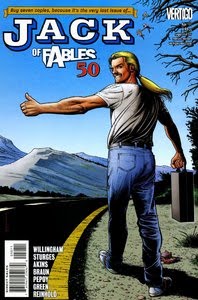
Jack of Fables 46-50 "The end"


FROM THE OUTSIDE LOOKING IN

After prolonged delays, this Wednesday brought the last issue of "Jack of Fables", which doubles not only as the finale of the "Fables"' spin-off, but the ending of it's last story arc as well. Writers Willingham and Sturges have spent five years working on solo adventures of Jack of stories, foreshadowing both the long time in planning "Great Fables crossover", as well as laying the seeds for this final storyline, which sees the ending on their satirical take on the character, at least for the moment.

The majority of the run has been illustrated by Tony Akins, a capable cartoonist who gave the title a distinctively manic look, that much better to differentiate it from the main "Fables" esthetic. Where in Marc Buckingham's hands the parent book sports a urban fantasy look, "Jack of Fables" was made to give off a more lurid atmosphere, mirroring the constant pattern of a never ending dirty joke that the writers strived for. Essentially, for all intents and purposes Jack of Fables had it's own tone, which is paramount for a successful spin-off. Even then, it was always a part of the broader Fables setting, even if purposely working in opposition to the more successful title.

A lot of the main Willingham/Sturges themes were resolved during the crossover, which was the first time the book close to matching the sales of the main title, but the writers were determined to continue for one more year of Jack's adventures. The sales swiftly returned to their previous levels, with the usual trend of continual decline, coming to roughly the half of monthly number of "Fables" copies sold in the Direct market (at least judging from the ICV2's estimates, which can be used to somewhat accurately describe the trends in American comic book publishing). At the time of cancellation, this was still a much higher average than that of a lot of Vertigo's ongoing series, but the creators are reportedly content with the decision, having already told all of the stories they wanted to tell with the character.

THE ULTIMATE JACK OF FABLES STORY

In any event, their last story arc serves as the finale to their work on the book, tying up all of the plot threads that weren't directly resolved during the "Great Fables crossover". Willingham and Sturges slyly start off with the spotlight on the three page sisters, and setting up their current agenda. Basically, the feisty librarians are trying to rebuild the Great library by tracking down the specific books they need to reinstate their Literal status. This is more or less typical Jack of Fables storytelling, serving to slowly reintroduce the reader to the status quo. The first sign of something unorthodox comes with the reintroduction of Jack and Gary, whose current predicament is illustrated in the manner of a Sunday page retro comic strip. And while the jokes told using this rigid layout are refreshingly straight forward, the context behind the change in Tony Akins' style is much more interesting.

Namely, there is a sense of a long time having passed between the story arcs which is finally made apparent by switching to Jack Frost's current whereabouts. Namely, that the de facto usurper of the book's previous two arcs is now relegated to a mere subplot should by itself be notable. Furthermore, seeing Akins' redesign of the character, who has transformed from the slender well-meaning fantasy protagonist to a full blown universe wide hero, further cements his companion, talking owl MacDuff's, 's endless prattling of their noble exploits. To put it bluntly, Jack Frost now looks like "Escape from New York"'s Snake Plissken, and his writers finally have him reconnect with the title's previous continuity. By giving the eye patch wearing, hyper muscled veteran one last mission in which he is to confront his father, now a caricature of a fairy tale dragon, Willingham and Struges are at first glance transparent about their motivations.

But it's only when the story continues, by shifting back to (present day?) Earth, and the rest of the supporting cast stuck working in a diner, that the full scope of their plans become revealed. That is, not only are Raven and his troop of runaway Fables also coming to the foot of Jack the dragon's cave, which is predictably where the Page sisters also find themselves going to, but that almost a decade has passed while the writers stubbornly kept the focus on his heroic son. This is no doubt the effect the creative team was going for, as the number of people finding their path leads them to Canadian countryside starts increasing, from every which way they are coming, all unaware of the company of the others.

Willingham and Struges seem to be saying that all of the characters previously encountered by Jack cannot move forward even after all these years of him going into retirement, and are seeking some kind of a resolution by confronting the reclusive anti-hero. The clever twist is that some of the foretold intruders upon Jack's soil never actually show up, but the sheer number of the ones that do more than dwarf them. Most importantly, Jack Frost, himself on the verge of retirement, rushes to meet the hideous dragon, one last act he needs to prove himself a true hero, even though MacDuff serves to remind the reader that his owner has done just this time after time, and across the whole galaxy. This is important on a metafictional level, as following the "Great Fables crossover", the book has basically jettisoned it's original, heavily flawed protagonist, in order to spotlight his estranged son, who as proven himself a hero without peer in the two story arcs preceding this last one.


Willingham and Struges went purposely so over the top with depicting a scenario that was the anti-thesis of their heavily post-modern parody of typical male, that they predict that the original "Jack of Fables" reader has by now found himself missing the original Jack. Horner's sexist power play and selfishness turned him into no less then a literal dragon, lying on the heap of the riches accumulated by tricking the other characters and thinking only of himself, but seeing his perfect son get all the glory since, it makes sense that two would go head to head for the book to return to it's meandering metafictional exploits.

THE WIDER POINT

Only, this confrontation is designed for the precise purpose of ending the book. The controversial choice actually makes sense on some level. "Fables" was always the more optimistic book, designed to find a place for fairy tale characters in the modern day and validate the struggles of fantasy authors trying to marry the two in literature. On the other hand, "Jack of Fables" from the start took to the negative of just this approach, singling out the various twist and turns the original fairy tales have taken in lesser hands, and trying to breathe some life in seemingly empty husks of Alice of Wonderland and Paul Bunyan, driven bland and lifeless after numerous revisions and adaptations. It was the book written by two people who admit that they have read a lot of bad writing in their decades long love of the genre, and are not afraid to call upon it.

By using this basic principle, Willingham and Sturges have created a very strange and obtuse storyline that kept hinting at it's most interesting parts, before being derailed by one or the other of Jack's completely unsympathetic schemes. Still, where it breaks off from "Fables" and establishes it's own take is that the role of characters in fiction still managed to be a central theme. The parent book launched from this premise and proceeded in world building, with the idea of contrasting the comparative fairy tales and making a coherent setting to place the fantasy adventures of lovable characters in. To it's credit, "Jack of Fables" never had such aspirations. It delighted in contradictions, and while being tangentially related to the overall Fables universe, the creative team insisted in telling a very particular story.

It was an exercise in using the least likable Fables character, and turning him into something even more monstrous, a horrible parody of manhood, while leisurely making their wider point. Meanwhile, the plots that were to further all these ideas were increasingly offbeat and manic, a far cry from the tongue in cheek romanticism of the parent book. Yet, that they were serious about their intentions, and that all of these ideas fed into the overall direction of the brand was clear during the "Great Fables crossover", that drew heavily on "Jack of Fables" plot lines.

Still, it's clear that, as imagined, the solo Jack book was never going to find the praise of the broader audience, and frankly, it's mainly on the strength of the franchise's overall popularity that it managed to survive as long as it did in the market notorious for it's resistance to new and experimental work. Willingham and Sturges actually make all of this a story point, stipulating that it was Jack Horner's sheer notoriety that kept the title from winning over new fans.

THE END

Still, by devoting two whole arcs to little more than a standard genre storytelling in order to subvert the expectations found little echo in industry. The joke seemingly fell flat, and thus a regular reader had every right to look forward to bringing back the rest of the supporting cast (along with the former protagonist), in what seemed the return to tackling the more nuanced stories a little more directly. Yet, the elegiac tone emanating from the surprised looks on the familiar faces, now supposedly several years older, preceded the official confirmation of the #50 being the book's conclusion.

Even then, the final storyline was plagued by delays and art assists (by Russ Braun), as well as the ink assists, that resulted in some of the pages sporting a hurried look, but did little to hinder the excitement of the fandom. Namely, the major comic book websites and it's devoted blogosphere took little note of the title's existence, and where likewise neutral to it's passing. Which is not to say that Jack of Fables#50 isn't an extra sized final issue precisely targeting a certain type of comic book fan.

A fantasy story featuring a battle to the death featuring the mythic hero and his dragon counterpart, told (mostly) using splash pages is certainly a call back to Thor #380, the high point of Walt Simonson's famous run on the character. Willingham being a creator debuting his own fantasy inspired superhero series at roughly the same time, "the Elementals" creator was surely aware of his colleague's work, that is still remembered favorably to this day. In lieu of the Simonson constructed poem that served to caption that 1987 Marvel comic, the "Jack of Fables" creative team reply by substituting it with color commentary, as if the final battle between their two competing leads was a football game. Likewise, without any kind of explanation one of the journalists is Jack Horner, as originally designed, who does not shy away from gives his own particular take on the proceedings.

What transpires certainly is certainly interesting, as the creative team envelops to tie up all of the multiple going concerns of their rich supporting cast in a huge one sided fight. The results are certainly amusing, and actually line up with the title's underpinnings. With the cancellation of "Jack of Fables", Willingham and Sturges are aware that all of their many problematic side Fables have no place to reside in, and once again directly refer to it in the story. This is done by having Raven, Jack Horner's Indian guide and protector, bring the assortment of escapees from the first story arc's Golden Boughs retirement village to Canada, on pretense of leading them to Fabletown. That none of these many quirky characters with impossibly complicated back story (particularly in relation to the their "Jack of Fables" adventures) seem destined to rejoin the main title seems an afterthought.

Thus the writers happily give them all, for their fate to be sealed, as much as any of the Fables can be effectively written off, at the hands of Tony Akins' wonderfully inventive full page showdowns. That the reader is meant to be caught in the unfairness of all of this is par for the course, but as always with this title, the initial shock is quickly replaced by the sense of elation, as Willingham and Sturges continually insist that these are all fictional characters designed to first and foremost to entertain. And considering "Jack of Fables"' trade record, that usually comes out as a deeply ironic black comedy, best illustrated by the revelation of the fate of tortoise that tried to escape Golden Boughs.

The final scenes show the eventual fate of Jack Horner. This is done by brining up a loose end from early on in the series, that nevertheless echoes a popular "Hellblazer" storyline, which might come at the expense of punchline, considering the potential overlap of the Vertigo imprint's audience. In any event, as the cover promises, the long time misadventures of Jack of stories come full circle, only with the character undergoing an obvious change in the process. Whether this means that following his solo outing Jack will still somehow be reintegrated back into the "Fables" main cast is still to be seen. Story wise, what is promised by creators (albeit in the back matter following the story, and not in any kind of formal epilogue) is that the baby introduced in the beginning of "The end", as well as presumably it's father, were slated to reappear in the Fables universe sometime down the line.

FABLES FUTURE FORETOLD

Once again, this ties into the speculation regarding the upcoming "Fables" plot lines. As for the overall strength of the brand, it is important to note that Vertigo is currently publishing the second "Cinderella" mini-series, written by Chris Roberson who penned the canceled title's solo fill-in issue in "Jack of Fables"#35. This not only indicates that DC's imprint is content in producing the material outside of the Fables' creator Bill Willingham's direct involvement, but more importantly, that they might as yet delay in authorizing another ongoing spin-off. This seems to mirror the decision to capitalize on the imprint's other current success, "American vampire", by likewise producing only a related mini-series.

In many ways, such caution is warranted, as the Direct market certainly doesn't seem to be receptive of the new ongoing commitments, even when tied to a more successful existing franchise, which mirrored Willingham and Sturges' experiences in writing the "JSA" and it's "JSA: All stars" spin-off respectively in the main DC Universe. And while the February cancellation of "JSA: All stars" seemingly has little to do with the Sturges co-written "Jack of Fables", it speaks to the same argument - whatever new projects the company plans around it's popular franchises should follow only after a serious rethinking at the company's part. That "Jack of Fables" was as ambitious as it was, and as long lasting, still doesn't guarantee that the potential "Cinderella" ongoing series would have a better chance of winning over the typical "Fables" reader.

At a time when existing comic book readers are already overtaxed with buying too many titles due to sheer loyalty or overblown hype, perhaps the best approach would be to continue with the mini-series until the company is sure exactly what kind of spin-off the majority of their readers are interested in,

Friday, April 30, 2010

Jack of Fables 41-45 "Kings of earth and sky"


That "the Fables"' first spin-off was a controversial project was clear from the start. Putting the unlikable rogue Jack of tales in the lead role was always an ambitious choice, but the truly polarizing aspect of the Vertigo title's second ongoing series was always it's ambiguous co-writing credit. Yet, Bill Willingham and Matthew Sturges' "Jack of Fables" has preserved for years as the supporting title, with sales closely following the parent book. This has given it's creators a chance to freely enjoy their trademark multi layered self-aware storytelling that never tips it's hand to the readers.

Unlike "Fables", it's perennial troubled spin-off has always toyed with the metafictional aspects that fully acknowledge the difficulty of the ideas involved. It was always a title that spun some rather far fetched pulp inspired yarns, yet remained tongue in cheek the whole time, while teasing some rather improbable and unnerving events. Right alongside the black humorous bulk of the narrative involving Jack facing the basic tools of writing fiction, another subplot kept getting alluded to. And in "the Great Fables crossover", that was to wrap up the three years in the making saga, and have the character come full circle with Fables that he has come to stray from, it finally debuted.

Following on the heels of the parent series' new status quo, the mini event saw a new hero take center stage, and hinted at the changes to come for Jack's own series, all in a manner that was as literal as possible. yet, Jack's teenage son still seemed like merely one of the many new characters involved with the proceedings, while admittedly most of the others being even more obnoxious with their roles and titles. Still, following an unfortunately placed fill-in story, the co-writers stayed true to their promise, and started radically altering the series' premise.

The first arc of the new status quo still had to wrap up the loose ends of "Jack of Fables"' previous three years of stories, which in effect meant double billing the page count to host both the logical conclusion of Jack's adventures, and the introduction of his son's first adventure on his own. The shift in direction seemed sudden, but like always with the title, felt planned well in advance. In the new section, the reader was treated with an innocent fantasy episode played ironically typically, but there was still an expectation that the two narratives will collide in the last chapter. Interestingly, Willingham and Sturges had decided to play coy, and have Jack's tale end completely separately, while only soliciting his son's further pulpy adventures as a follow up. The reader, long treated to a purposefully murky storytelling and outright lies by the narrator as part of the standard comedy routine, expected everything but that, particularly considering the "Fables"' history, and the Vertigo's general trend of grown up fantasy storytelling.

And, of course, this is precisely where the co-writers decided to go next with the series. By transporting their hero to yet another new world, they opted for a full on epic fantasy science fiction mash up, with the previous protagonist mentioned only in passing. Thus, they got to graduate his long prepared successor to the title role, and even more importantly style the complete storyline after him. Even the opening text along with the hints at the end of each issue, long infamous for their sarcasm and general uselessness, thus turn into tried and ready hyperbole, hinting at the further adventures of the tragically noble hero.

The self sacrificing lead character is once again shown to be a complete departure from his egoistic father, which is exactly the point. Willingham and Sturges were well aware of how loathsome the never changing scoundrel Jack of tales has become, so following the crossover, they slyly set out to replace him with a much more likable new face. This meant making him the most naive and good-hearted of the protagonists, constantly trying to help those in need, while thankfully finding suitably grand quests lined up in wait for him. In "Kings of earth and sky", young Jack Frost has to try and liberate a whole kingdom from the giant ruler of the planet, while being constantly beset by the people he's trying to save.

On the face of it, it doesn't get more heroic than that, and also more bland. The co-writers have once again purposefully set out their new protagonist on a very generic quest, subtly following the tales that inspired his predecessor, and spiced it with typical subplots. The constant twists come at every turn, as Jack learns not to trust people unequivocally, while risking losing his only friend and mentor, the magical owl MacDuff. Seemingly, the reader is witnessing a slow coming of age story of a young man that could one day become a ruler of a magical kingdom, if he's not beset by sudden death. It's just that such stereotypical storytelling completely opposes the core concept of "Fables", and the entirety of the sinisterly clever "Jack of Fables" run.

The constant presence of Babe the blue ox's page (undergoing a particularly interesting blandification paralleling the main plot) reminds us that there is no chance that such a status quo will remain much longer beyond this introductory arc, meant to stun the readers into once again doubting the whole point of the series. Even the ending blurb hints at the return of Frost's father, by featuring a seemingly generic title of the next arc, that still reveals a clear link to the previous storyline. Willingham and Sturges are once again prepared to shock the readers, but the real question turns out to be how the ambitious idea is mean to work out.

Taking a lot of the readers' loyalty for granted, "the Kings of earth and sky" still doesn't stumbles in delivering it's promises. The execution is flawed on several levels, most apparently on the artistic front. Simply put, Tony Akins the series' regular penciller is called upon do deliver so much detail that he splits the artistic duties of the middle two issues of the arc with Jim ("Crossing midnight") Fern. This problem was sidestepped by having Russ Braun work on the whole of previous storyline, but in "the Kings of earth and sky", there's hardly a unity of style between the two different pencillers. Fern tries his best to continue Akins' initial ten odd pages each issue, but his figurework is completely at odds with the series' standard cartoony work. The jarring shift is very noticable in that the more realistic pages bring forth a completely different look to the "Jack Carter, warlord of Mars"-inspired storyline, immediately clashing with the pages surrounding them.

Thus, Akins' trying to incorporate layouts that echo Mark Buckingham's work on the main "Fables" series simply stop exhibiting the requisite dynamic in the fill in artist's pages, who more or less tells the story without any irony. This leads to Jack Frost's overblown heroics and his female friend's skimpy dressings turn from satire that was called for back into standard adventure story illustrations they were inspired by, before returning back to the norm with the start of every new issue. The colors maintain what little coherence remain, but the rest of the problems lie firmly with the writers.

While they are certainly to be complimented for presenting a well paced page turner, after so many "Jack of Fables" arcs that felt strained and overwritten, the most successful part of the storyline really belongs to their inspirations. And while they certainly find a way to channel the Michael ("Elric", "Jack Cornelius") Moorcock like pulp narratives steeped in the lurid haze of counter culture, Willingham and Sturges end up going too far in a single direction, risking the subversion of their own creative voices for the purposes of pastiche. And this is precisely what happens, as the series' traditional playful postmodernism becomes a distant subtext, easily overcame by ray guns firing through the sweaty psychedelic background.

Moorcock himself was always keen to stretch the form of the pulpy science fiction, but in sticking so close to his template, the co-writers gambled to entertain only the segment of readers familiar with his work, or otherwise generally susceptible to his hugely influential "Saga of the eternal warrior". What's missing is the concrete link to the series the readers have been following up till the beginning of this storyline, a knowing technique employed with potentially troublesome results.

It takes a lot of belief in the "Fables" brand as a whole to see "the Kings of earth and sky" for what it truly is, a middle chapter in the delightfully false new status quo that almost certainly won't last a year, before being tied together with the stylings that preceded it. It's just that read as a story in it's own right it might send a mixed signals message to its readers, who might not be so fond of the radical shift that "Jack of Fables" has undergone.

As an experiment in the continuing storytelling, the current direction of the series is in line with the title's constant ethos of subverting the readers' expectations of what they can expect from a spin off. Yet, as a story on it's own, it's completely dependent on future arcs to determine how the whole of this particular phase of the title measures up. This is certainly a bold decision, made by creators unafraid to follow their own creative impulses, instead of settling in the relative conformity of the tried and true status quo.