Showing posts with label xiii. Show all posts

Saturday, August 11, 2012

XIII 20 - Day of the Mayflower


Following the conclusion of the Vance/Van Hamme's original "XIII" cycle, Dargaud sought to continue the series with new authors. With the help of the original creative team, the venerable French publisher contracted writer Yves Sante (who already succeeded Jean Van Hamme on "Thorgal") and Russian-born Youri Jigounov, the artist of "Alpha" to come up with a new series of "XIII" stories.

The result is the long-awaited "Day of the Mayflower", published in 2011, as the first chapter of a new conspiracy that the titular number 13 gets dragged in. The story is in continuity with the previous albums, but the connections it makes are a bit flimsy and artificial. XIII is dragged out of retirement by a new cadre of enemies with a highly political agenda, on the flimsy basis of his supposed connection to a figure from America's history.

The volume itself features the book's longtime supporting cast, but mostly centers on Jason himself. This works to set up his friends' expanded roles in the sequel, but also to remind the readers that the new creative team wouldn't be taking the series in too much of a new direction. The villains are active throughout the country, working tirelessly to frame Maclane, and bully their way to their objective.

The book feels the strongest and freshest when it depicts Jason's life in Bar Harbor, the place where he washed up in "the Day of the Black Sun", but the creators' ambitious plan simply won't let him be. Meanwhile, XIII is trying a new treatment in order to help with his amnesia, and this is where Sente and Jigounov appear at their boldest. Namely, by giving Maclane flashbacks, they dispense with the ambiguity that has fueled the series. The creative justification is to be found in the closing pages, that tease the link to the real life political activist, which would be deprived of much of their potency if there was still some doubt considering the lead's identity.

Much more contrived is the idea that one of these memories connects him to a character that has compiled information on the very agency that is targeting Maclane in "the Day of the Mayflower". It was a shortcut that makes sense in the narrative, even if it strains the realism the creative team try so hard to maintain. Speaking of the latter, it is much more important to consider the album in context of the series that preceded it, and the many choices Van Hamme and Vance have made.

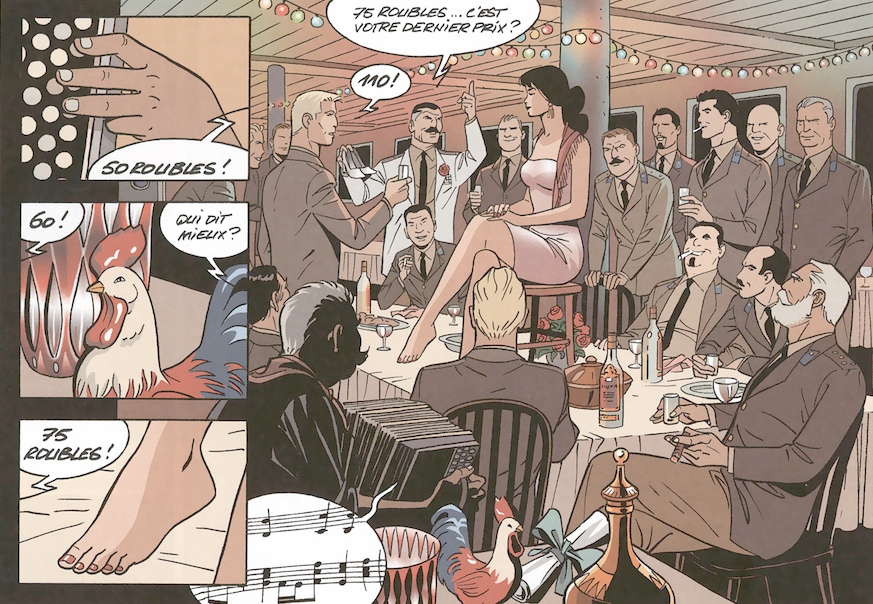
First and foremost, visually, the book is entirely consistent with Vance's celebrated work. There is no doubt that, once the reader opens the pages of "the Day of the Mayflower", that he is reading a "XIII" story. Jigounov has very consciously oriented his already detailed style to resemble Vance, with the results being very peculiar.

Jigounov's line is open and more free flowing, his figures much more kinetic, resulting in the look that is much more modern and current. Yet, there is no mistaking Vance's influence in the way the faces are inked, the way the vehicles and buildings are drawn, and the way the action flows. And while the new artist manages to overcome repeating the same stiff character positions,  the very fact that he has to provide the continuity to a half dozen of Vance designed characters solidifies the feeling that Dargaud wasn't interested in making too many risky decisions regarding the future of the title.

Getting back to the story, it feels a bit too violent even compared to a typical "XIII" volume. The connection to the original XX conspiracy likewise feels strained, as if the creators felt that including Maclane in a completely new story would alienate the existing readers. Otherwise, Sente feels compelled to confront the titular XIII with every possible contrivance, until the protagonist is forced to leave the country, and reunite with a couple of friends in Europe.

The chief hurdle for the reader to get over is that all this is served as the continuation of "XIII". The idea that a single man would survive a series of unlikely events and finally and publicly defeats the conspiracy that has spanned two administrations, and still continue to live in a small fishing village, requires the reader to assume a very strange stance. The creators are clearly telling a new story, their own, but they are doing it as a notional continuation of a very continuity heavy series, and the results are at best a compromise.

Visually and stylistically, it's still a "XIII" story, but in many ways it feels like a restart of the franchise, or even a prequel. On the other hand, if Jigounov was allowed to personalize his style and the scenario was developed independently of the "XIII" brand, it would still have come across as a generic, and pandering to the same demographic.

In other words, "the Day of the Mayflower" is exactly what its marketed to be - a not too ambitious continuation for a popular series that has already had more than its share of contrived plot twists. Where the spin-off "XIII Mystery' tries to make sense of many of the characters and setting alluded to in Van Hamme and Vance's work, the continuation of the main series is reserved precisely for the reader who has allowed the original creators their excesses and missteps, and genuinely wants to continue reading Jason's adventures, no matter how strained and unnecessary they may be, compared to the already bloated series.

As long as the Sente/Jigounov run works as its own story and avoids orientating itself to the full breadth of the scope of the original creative team, it seems that the reader will be getting a solid, if unexceptional modern thriller, professionally realized under the care of the publisher that continues to capitalize on the brand that has stayed strong for three decades.

Tuesday, June 19, 2012

Change of direction and the value of the protracted Second Act (PART THREE)

The creative team set to follow Uderzo on "Asterix" will not seek to undo the appeal of the series with glaring changes in direction. At best, they will be returning some vigor to the long gestating best seller by infusing it with their own talent and energy, but there is no need to artificially change the working formula. Following Goscinny's death in 1977, Uderzo himself has undertaken to preserving the flair of the series' best period, even going so far to sign Goscinny on the albums done decades after his friend's passing.

Without a rigid adherence on continuity these stories work as complete episodes that are fully rounded and accessible, but at a glance might seem slighter than the storytelling model prevalent in American comics. Yet, another regular staple of the "Pilote" magazine illustrates the point much more efficiently.

Charlier and Giraud's "Blueberry" is a comic book series that has endured at least one major change in direction. Starting out as an ensemble piece military western, following the initial story cycle, the creators have started mapping out smaller stories, that complimented each other and basically all fit in the western mold despite the many twists and turns. All told the story of Mike S. Donovan, an roguish character whose travels made for a very engrossing genre adventures. With the writer's death and the main strand of the series finished, Giraud simply shifted the story to Blueberry's final days, determined to tell a Tombstone epic that stood on its own, and hardly qualifies as a change of direction.

Yet, it's clear that the Franco-Belgian premier western title has had its phases and hardly constitutes a single story, except when viewed as the story of Blueberry's life, which is certainly a reading encouraged by its creators, seeing as how Donovan, actually ages through the saga that allowed its creators to create their own spins of most of the typical western scenarios. Precisely this aspect of Blueberry is picked up by Swiss-born Derib, whose "Buddy Longway" presents a much more unified story of a trapper living with his family in frontier, with all of the changes coming naturally, due to the passage of time and his children coming of age.

Of all the popular Franco-Belgian comics, American genre comics most resemble the popular fantasy "Lanfeust of Troy". Derived from singular creative vision of its creators, the genre hybrid mixes lighthearted epic fantasy with the idea of what can be described in the terms of comics as mutant superpowers, the series has progressed to multiple spin offs and direction changes. After Arleston and Tarquin send their sword and sorcery mutant off on a "Star Wars" like science fiction adventure, and spin-off the popular Troll character into its own open ended "Troll of Troll" series of albums, its difficult to talk about the aesthetic unity and creative cohesiveness. "Lanfeust" is another victim of its own success, with the publisher more than happy to flood the market with dozens of spin-offs. Once again, only the most ardent fans will stick with all of the many incarnations, leaving a more typical medium afficianado to pick and choose what constitutes Lanfeust's story for them. It's clear that the tangential stories hurt the brand and dilute the brand, but "Soleil" so far seems perfectly content to forgo the priorities of a well rounded, well told story in lieu of satisfying short-term financial reports.

To pick a less extreme example, Vance and Van Hamme's "XIII" has followed the progression that thankfully inches much closer to Blueberry's part of the spectrum. The initial five album story was so successful that the creators decided to chart a new course for their popular characters, that tried to expand the conspiracy to more of the XX century hot-spots. This proved every bit as diverting and uneven as this implies, but the "Bourne identity"-inspired mystery provided with a canvas broad enough to let the reader gravitate to Vance and Van Hamme's detailed, entertaining stylings when the story details felt forced and stretched too thin.

Along the way, Vance and Van Hamme finished their run, but have arranged with "Dargaud" to have another creative team follow them. As with "Blueberry", the series was spun-off into a companion title spotlighting the past of the characters prior to the dramatic events of the main series. And while it's still early to tell what course will Jigounov and Sente's "XIII" take, in regards to the continuity of the original albums, it's certain that the editorial oversight will sooner or later return the series to its roots, preserving that much suffering
man with the XIII tattooed on his skin will likely continue to exist in the late Cold war world of spies and characters hinting secrets about his past, quickly forgetting about the original creators' lukewarm epilogue.

Again, despite the fact that most of the cast ended up dead during the course of preceding albums, "Dargaud" is not at fault for continuing in the same mold. Despite the pretense of realism, at its core "XIII" is an adventure serial and as such more than welcome to continue to spin its wheels. After all, Vance and Van Hamme were the first to provide the road map for just such continued exploitation.

Taking a different publishing model into account, it's clear that the American genre comic book still has much more in common with traditional superhero industry than it appears at a first glance. In many ways, with its beginnings at DC and the subsequent Top Shelf edition, Alan Moore and Kevin O'Neill's "League of Extraordinary Gentlemen" becomes a unique mirror to look upon the development of the modern genre comic in America.

Monday, December 12, 2011

XIII Mystery #2 - Irina

Following up on the first XIII spin-off volume, Mongoose, Dargaud published "Irina" in the october of 2009. Done as the collaboration between veteran writer Eric ("Song of the Stryges") Corbeyran and artist Philippe ("Pin-up) Berthet, the second episode had a much harder task. Considering that the title character is showed up in the other half of the series, as Mongoose's lover and a trained killer who XIII disfigures, the creative team had a very unenviable task before them.

How does one expand an extremely unsympathetic supporting character's story into something gripping and interesting? As a starting point, Corbeyran takes Irina's relationship with Jessica Martin, another late addition, that ended up being co-star for several of the last XIII volumes. The character's bisexuality seemed somewhat forced when it appeared in the main title, and could arguably have been considered a shortcut to update the series into something edgier and more contemporary, but here it provides a key to understanding the character, along with the Eastern European milieu.

Similar to Mongoose, the follow up XIII Mystery volume takes place during the Cold war, this time from the point of view of KGB. And while tying up the series into concrete dates somewhat complicates the status of the continuation of the regular XIII title (considering that XIII should by now by all accounts be a middle aged man well past his prime), the historical context was always one of the main features of the title, and one can hardly fault Corbeyran for finding the inspiration in USSR wet works. The story is framed around a sequence that precedes Irina's role in the Vance and Van Hamme XIII volumes which is clear from the context. Likewise, the album tells a complete story that is entirely accessible to the new readers, especially considering that Irina herself was hardly developed during the parent series albums.

Similar to "Mongoose", the story covers her formative years, starting out in Belarus, when she was 16, and dating back to the horrible event that scarred her life. An incident in the orphanage involving the death of her best friend permanently impresses itself on the young girl's psyche, causing her to obsess over it to the point of literally subjecting everything in her life to the goal of finding the alleged perpetrator of the crime. Following the girl's escape, KGB agents get on her trail and act out on her ruthlessness by offering her to join the organization.

Corbreyan's script is continually narrated by Irina, which manages to puncture her emotional detachment and reveal the bitter humanity behind the gorgeous features. Berthet is given a task to alter between several designs, given Irina's role as the spy, as well as the changes she undergoes throughout the years. It's difficult to judge the consistency of design given the rapid jumps in the story, especially considering that even her final look differs from William Vance's version, considering that he portrayed a more unbalanced and physically scarred woman, which is difficult to connect with the more typically beautiful and understated Irina of XIII mystery, who only seems to come to life in the action scenes, where the focus shifts from her green eyes to the applying of KGB's brutal training.

On XIII Mystery, Berthet opts for a very paired down and classical style, featuring clear layouts and easily recognizable characters, with pages that are dynamic and easy to follow. Yet, the economy of his figure based style, coupled with Dominique David's use of sharp browns and grays, leaves a strange impression. Despite the traditional nine panel oversized format of a European comic album, Philippe's work almost invites to a smaller and denser presentation, with something like a manga digest perhaps being best suited for his work. His work filtered through David's cold colors even reminds of comics formatted for mobile devices. It is certainly in contrast with Vance's labored and detailed style, but despite the craftsmanship involved, seems very much in tune with Irina's quiet melancholy, leaving the reader with a sense of detachment.

Perhaps it's only fitting that the audience should warm up to the protagonist only so much, considering that despite Corbeyran's elaboration of Irina's motivation, she still chooses the role of a trained assassin to get close to the man whom he blames for her childhood's friend's death. The writer doesn't mince words, and he portrays USSR as a poverty stricken military dictatorship, that proceeds to make a monster out of Irina in order for her to survive and get back at her enemy. Her physicality defines each of her executions, as Corbeyran goes one step further then a typical "Nikita"-like narrative, and depicts her seductions as routinely involving sex, and not just the tease, as is typical with the media that employs such modern day femme fatale tropes.

Irina is equally adept at both seducing and killing men that KGB points her towards, but her heart is only in the steps that lead to the eventual capture of her prey. The brief moments of intimacy usually involve women, and even then largely involve manipulation on some level. Otherwise, she maintains complete control of herself, and basically sleepwalks through her assignments while she makes her play to officer that abused her friend.

The resultant story is as cold and efficient as Irina herself, but it still ends up with plenty of distractions. For all the work done in working on the protagonist's appearance, the resultant body type still seems uneven, as Berthet eventually endows her with a body type that simply seems too buxom, particularly given Vance's original design for the character. Likewise, the object of her search is depicted as on the model handsome officer, with little visible signs of aging, which is certainly not a deliberate creative choice, but a clear oversight on the part of the artist. Despite the presence of wrinkles, the elusive KGB officer looks somewhat close to his age only in the very last scene, where he finally confronts Irina on her own terms.

Most commendably, Corbeyran closes of the volume with a flashback depicting young Julia's death in a way that challenges Irina's motivation, and adds a sense of ambiguity to her single minded pursuit. Otherwise, the subplot involving Jessica feels somewhat slighted and mostly exploits the emotional foundation between the relationship of Irina and her orphan friend, that continues to define the protagonist, leading to a logical extrapolation regarding her sexuality. Otherwise, Corbeyran does little more then set up Jessica's role in the wider XIII story, with most of the pages given the two lovers being ultimately plot oriented.

Mongoose likewise appears late in the story, but he at least impacts directly on it, which cannot be said for Colonel Amos, whose role is little more than an extended cameo that could have been used to bring closure to the other most important relationship in Irina's life, that of her and her KGB husband. Colonel Wladimir Svetlanov is presented as a fairly complex figure, a company man who arranges marriage with Irina in order to further his own interests, which bring her closer to the officer that she blames for Julia's death. The complex dynamic between the two characters is somewhat cut short as Corbeyran arranges the Colonel to help her get to America, where she starts receiving orders from another father figure. That the familiar elements of Van Hamme and Vance's XIII eventually take over the story come as no surprise, as Mystery is primarily designed as a series of prequels by different creative teams, and the volume certainly contains a regular the resolution that climaxes the plot, enabling it to work as a story in its own right, its just that it feels like a misstep not to return to a very interesting dynamic that gave a little color to the otherwise familiar revenge story.

Another missed opportunity can be seen in abandoning the angle of Irina's attraction to her quarry, as some of her narration at one point hints that she finds him attractive. This is an angle that could have made the story of a woman as a spy more unique in itself, but Corbeyran ultimately decides to use it to realize the tension in their final confrontation, providing a definite mix of sex and death to the volume that features copious amounts of both.

It should be noted that "Irina" containts two very brutal torture scenes involving female body that serve to justify the protagonist's hatred toward the KGB officer that robbed her off her friend and her childhood, which might seem logical, but still strike the reader unprepared. As for the sexual content, it feels very subdued, despite being graphic. The creators opt to depict sex as the weakness on the part of the characters, but even then they shy away from using it as fan service. For what it's worth, Corbeyra and Berthet's take on XIII Mystery contains about as much exploitative poses as a typical genre representative (with the exception of a hotel room fight that deliberately goes overboard on cheesecake, and thus stands apart in what can hardly be called a light hearted story). For the most part, the creators maintain an even depiction of sex and violence as basically being tools of trade of a damaged woman, exploited by the intelligence agency. Irina goes through with it as long as it furthers her own agenda, but as soon as her relationship with her superiors changes, she chooses to go her own way, which naturally means taking her place as a XIII supporting character, which is how she first came to the attention of the audience.

Sunday, May 8, 2011

XIII mystery #1 - Mongoose

THE BACKSTORY

With the conclusion of the original creative team of Vance and Van Hamme's take on the "XIII" series of albums, the authors decided to let the publisher continue to exploit the profitable franchise. Thus far this has consisted of "Dargaud" establishing a spin-off series titled "XIII mystery", with the idea of spotlighting some of the characters featured in the original albums. So far, each of the three published albums has included a different creative team, which is also implied to be the case in the details listed for most of the upcoming releases. Meanwhile, the publisher is much more careful with the main "XIII" title, whose new writer and artist's work has yet to be presented before the year is over.

The "XIII mystery" debuted in 2008 with "Mongoose", a collaboration between writer Xavier ("le Troisieme Testament") Dorison, and artist Ralph ("Ian") Meyer. With the eponymous Mongoose being the code-name of the chief assassin in the main "XIII" series, this debut of the new series had a complicated task to perform. Obviously, it had to convince the readers that there is a reason to pick up this continuation of the decades in the making popular series, which came to a stopping point long after the original creators planned to end it. In that regard, any fan that stuck with Vance and Van Hamme had already got accustomed to contrivances enabling the byzantine plot to lurch forward a few extra volumes more, making another return to the series seeming much less artificial than it might appear to the uninitiated.

The real problem was convincing the readers to stick around while accepting that the they will be presented with anthology-style offerings, keeping the franchise in circulation while the publisher puts together the new creative team for the main title. On the face of it, it's very easy to dismiss the whole enterprise as strenuous, with the different creators basically adding superfluous bits of information to the past exploits of the series' regulars, that the original creators obviously didn't intended, and thus had no impact on their behavior in "XIII". Still, with the projected publishing schedule of one album per year, "Dargaud" executives must have felt that a solid enough effort could make the nostalgic reader interested enough not to feel that their time and money would be directly exploited.

THE EUROPEAN COMIC SPIN-OFF

On the whole, the main strengths of Franco-Belgian school of comic book storytelling lie with the idea of letting the series' creators focus on the books, taking enough time to make each entry stand out, while adding up to the effort that in the most successful cases makes for particularly distinctive books. And yet, despite this creator-friendly approach, the major publishing houses still try to extend their profits to the new releases, resulting in a slew of spin-offs, not unlike their American contemporaries.

Yet, with the exception of "Spirou" (whose major creative success came with Franquin, himself the second creator continuing the original strip) and "Lucky Luke", there is usually a very clear distinction between the work of the creators and the talent contracted to continue producing the new stories. The best case scenario is to have the new creative team contribute something that is actually distinctive and stands up as a success in it's own right, such as Tome and Janry's "Young Spirou". Unfortunately, typically the effort is something akin to "Young Blueberry", which is marketed as a generic western supposedly continuing the pre-Fort Navajo adventures of it's star ad infinitum.


DORISON/MEYER

In any event, Xavier Dorison and "Dargaud" have decided to continue "XIII" in a way that sticks very closely to the Vance and Van Hamme original. This is already notable in the idea of framing the story in such a way that it spotlights a crucial part of XIII the character's back-story. Thus, in order to show the reader the life of Mongoose, his would be assassin, Dorison decides to employ the story within a story approach, which provides a direct link to the main series "XIII mystery" is spinning out of.

At first though, the effect is distracting, leading the reader to try and remember at which point exactly does the action takes place, but thankfully the confusion is clear as soon as Mongoose shows up. At the same time, the story shifts from filling in the points of the already implied continuity to his remembering the life that has lead him to that point. But the reader shouldn't take this break for Dorison completely abandoning the "XIII" style of storytelling. In fact, he largely embraces it, albeit indirectly.

By having Ralph Meyer, a somewhat more expressive artist than Jean Van Hamme, draw in a similar reference-heavy style, "Mongoose" basically  feels a lot like a "XIII" album flashback. Once again using the recent past as a stage to conduct the spy thriller, Dorison deliberately sticks to Vance's model, making it clear to the readers that he's taking no creative risks in following up the popular series. This time, the backdrop is East Germany, in which an orphaned child makes his first steps on a road to violence that will eventually bring him high in the criminal conspiracy. And for all of the original "XIII"' flirting with realism in the past, the writer takes the right cues to maintain just enough of the everyday to provide some color to the scripts, but not at the cost of the brutal action scenes that cynically end every attempt to concentrate on the reality beyond the book's designated genre.

Yet, neither is "Mongoose" really a Cold War type story. With the bulk of action taking place in America, where a young killer comes of age with the help of a surrogate father, and a deadly inspiration, it presents more of an emigrant experience. We are given just enough to empathize with the young man as he partakes on a rigorous training that will one day lend him the best paying contracts in the business, but at the same time the decades spanning plot mechanism prevents the creative team on dallying too long on his motivations. After all, despite some of his musings on his methods and the life style, the book never turns into Matz and Jacamon "the Killer". That slow-moving internalization of a mercenary in comic book form is after all, a distinctive property in itself, and not a 50-odd page spin-off that has to cover more than three decades, while seemingly operating as it's own series, working at it's own pace.

This is where "Mongoose" works best, with Dorison paying particular attention on making his story feel organic and motivated, and not rushed off in a halfhearted attempt to quickly churn off an inferior product. Seeing Mongoose as a human being, adapting to a very peculiar life-style, while also acting out of his own personal goals almost has the reader forget the image of Vance and Van Hamme's take on the character as a fully formed antagonist. Thankfully, the writer never forgets to stop before making Mongoose too altruistic, which is why he introduces the character as an orphan and devotes very little space to his assumed name and the East-German home he was adopted into. In a very mature storytelling decision, Dorison progresses the character gradually, distancing him from his purported goal as subtly as Meyer ages him before our eyes.

The first-person narration helps maintain the illusion of the character's original motivation until he finally has his altruism judged beyond the complicated charade of half-truths and principles he's constructed around himself. The character is given no time to deal with this development, as the complicated assignment that has driven him to deal with his personal underpinnings also represents the start of the "XIII" conspiracy. The wider series plot thus actively proceeds to deconstruct even the character's then-present day position of being a contract killer, destroying all of his attachments and positioning him solely in regards to the conspiracy.

As his narration ends, he is once again caught up in the precise moment that proved a turning point for the life of XIII, which is again where a great deal of subtlety helps Dorison. He first shows us the character declining the offer to rededicate himself to work for the conspiracy, but then immediately reverses it, revealing himself as having already become the Mongoose of the "XIII" series.

This final scene was set up as a real test of the writer's work, with the reader either accepting the psychological transformation undertaken by the character as realistic, or rejecting the whole volume as misguided and superficial. Thankfully, by layering his work so densely amid the familiar tropes of a visual crime story, the writer achieves the effect of Mongoose's internal musings on the nature of crime and his role in it actually being instrumental in making him the man he becomes, instead of remaining as just so much tough guy talk.

Bluntly, in his own mind his life is a misguided tragedy, but through Dorison choosing exactly which panels to give Meyer to spotlight, the reader is instructed to look beneath the self-deception, and see the truth that Mongoose glimpses, if only at the moment. That such an elaborate psychological profile was presented in a plot-heavy crime comic tying in with the existing series is as much a testament to the writer's carefully constructed story, as much as the strength of the underlying "XIII" franchise. The script really feels in synch with Vance's work, feeling just as credible, as each of the flashback-related earlier volumes did.

And yet, it's difficult to say that Ralph Meyer's work has quite managed to make such a transition. The series co-creator Van Hamme is a very disciplined artist and a true professional, whose attention to detail seems much more organic than what is presented by the follow up artist. Simply put, Meyer's work is much more expressive, even in quieter scenes, lending the work a subtly different quality. And while the artist dully proceeds to illustrate the furnishings in his establishing shots, most of the follow-up panels usually concentrate mostly on his figures emoting against the sparse backgrounds. In this way, the story feels much more personal and energetic, but the baroque plot keeps constantly challenging the artist to succumb to working from reference material. Meyer's work is certainly credible, his character designs distinctive and figurework realistic, yet there is a distinct impression that he's working in someone else's stylings, which only enables him to reveal his professional best.

Ralph Meyer is an artist whose work is very dynamic and solid, much more modern and instinctive than Van Hamme's classically rendered set pieces, yet when it comes to anatomy and the employing his predecessor's designs, his work suffers in comparison. Meyer's contribution is most apparent in the crucial character of Hans, whose design and body language are particularly well presented, at a glance distinctive from the original "XIII" penciller's body types.

In retrospect, it seems much easier for Dorison to emulate Vance, and not have his contribution being so easily compared, as is the case with the artists in a visual medium, such as comics. Both Vance and Van Hamme have created "XIII" to be a very precise and distinctive mechanism that only seemed over-elaborate when  looked at as a whole, thus their successor's work, limited at all sides by scope and ambition, never really had a hope of being something more distinct than a spin-off portraying a charismatic figure of the mythos.

This is in some ways a good thing, as the work on "XIII mystery" raises the profile of it's creators, and enables them to continue with their own projects. On the other hand, it's difficult to imagine "Dargaud" deciding on accepting a more experimental approach in what was the debut in the series that even now sketches out some ten odd potential albums, each in a varying state of development. Hopefully, all of them will be as competent as this debut, even as their story will likely remain peripheral to the main series. With the fall release of the Jigounov and Sente's new "XIII" album, continuing where Vance and Van Hamme left of with the character, time will tell if there's enough interest in the franchise to support two ongoing projects.

"XIII mystery" could very well establish itself as appealing only to the collectors and hard core fans of the series, but when taking into account the popularity of the title, this should still guarantee it tens of thousands of readers. Whether this will prove enough for "Dargaud" to extend the property beyond the designated albums, remains to be seen. Admittedly, even the success of the main "XIII" title, marketed as the direct continuation of the Vance and Van Hamme's work, could depend only on the quality of their successor's work. The series' originators could be counted to return to these characters over and over again, but it's up to "Dargaud"'s quality control to make certain the franchise keeps resonating with the readers in the years to come.

Tuesday, April 21, 2009

"XIII" volumes 6,7

When "XIII" returned after it completed it's initial story-arc, it was subtle differences. Vance and Van Hamme were under no obligation to prove themselves anymore, thus their new effort proved a two-part story. No longer worrying about the new readers or keeping the story satisfying as an album unto itself, they published the first part as "Dossier Jason Fly".

Yet, despite the changes in the structure, the comic read as an entry point in itself. On the surface, it starred a man reclaiming what could be his forgotten past, in much the same way as "Where the Indian walks". Again, the story was set in an idyllic locale, this time a moutain town of Greenfalls. Finally, the creators seem much more secure with the story possibilities of giving XIII a permanent identity. 

Thus the recurring guessing game gets changed into a matter of pseudonyms, centered around a concrete identity, whom the character still can't remember being. Interestingly, for the first time a dfeinite conclusion seems to come from a blind man, recognising XIII's voice.

The story opens in the mountain town, using flashbacks to explain the vents thave have taken place since "Red alert". At face value, the journalistic angle is continued, brining to light the difference in tone, as this volume features a small local media as the lens for providing the information. The action did not fall by the wayside though, as XIII's pursuers find the way to Greenfalls, slowly circling in on the mystery man.

Vance and Van Hamme have decided not to make the readers wait on the resolution of previously set up character arcs, as a major plot point regarding major Jones gets touched upon in a subtle, yet frightening way. Still, she is the last direct link with the previous cast of characters, as Van Hamme is concerned with bringing the coplicated XIII family history to the foreground. 

For the moment, they are supplemented by locals, captured in all their character by Vance. Despite some of the town's residents acting as familiar series archetypes, the artist manages to act upon the unique nuances and establishes them as personalities in their own right, capable of supporting closer scrunity in the next volume. XIII's pursuers quickly find a way to get in touch with the town's shady power player, whose secrets are set to be revealed as Greenfalls conveniently gets sealed off from the outside world.

It stands to the creator's professionalism, that "Night of August the 3rd" feels as an organic continuation as it does. The character arcs all carry over to their natural conclusions, making the most use of the larger format. Van Hamme touches upon the "Where the Indian walks", in taking forward the racism angle, but this time around pushes it to the forefront.

Bringing the Cold war history of the town to light, the writer ties it masterfully with XIII's search for answers. The xenophobia and the town's hideous crime are woven with their current resolution in a way that overshadows the lingering presence of conspiracy. 

The snowed-in town's hysteria, unleashed by the manhunt, expertly gives way to one of the best conclusions of the entire series, as the sense of local melancholy reaserts itslef again. Van Hamme's strong plotting gives a definite place to XIII's role in the Greenfall's history, and the authors even find room to explain an ironic "red herring". With Vance once again at easte while pencilling the new surroundings, as well as winter wear, they cement the feeling that the reader's trust in the longer form has been rewarded.

Moreover, after the ambitious storyline that preceded the two-parter, "XIII" proved that it has carved a unique space for itself among the best of modern Franco-Belgian comics.

Tuesday, April 14, 2009

"XIII" volumes 1-5

"XIII" is the title of the 25-years in the making Belgian comics series, that has just recently concluded it's first story cycle with  the original creators Jean Van Hamme and William Vance. Despite being adapted as the video game and a TV mini-series, the Dargaud-published property has enjoyed little success in the United States so far, with only a few of it's earliest albums seeing print. In Serbia it remains a cult favorite, with all of it's albums, up to the final chapter, having been printed in some form or another (mostly without the color presented in the Belgian original).

When it comes to Franco-Belgian authors, "XIII" creators have been known to present material almost as diverse as that of Moebius. Van Hamme is chiefly remembered for authoring the fantasy "Thorgal", and Vance for creating both the sea fearing "Bruce J. Hawker" comic, and actually even lending his pencil and ink on the first two volumes of the "Marshal Blueberry" spin-off. 

There exists a long practice of using period pieces as the setting of European comics, evident everywhere from "Asterix" to the Italian "Zagor". Despite this, Van Hamme and Vance opted to avoid the historical context, and create a contemporary action comic. They decided to set their story in America, and the inspiration naturally came by from spy fiction in the vein of "the Bourne identity", along with a healthy dose of crime movies. Thus, in 1984 the creators debuted "the Day of the black sun", their own take on the story of one man finding himself embroiled in the criminal conspiracy, with heavy allusions to the Kennedy assassinations.

The original series outline seemed to cohere at five albums, bringing the mind "Lieutenant Blueberry"'s initial status quo, as defined by the "Fort Navajo" cycle. Starting with a wounded man surfacing on a beach with only the number XIII tattoo as an identification mark, the comic is quick to emerges into what would later solidify as it's most definite characteristics. Due to his lightning-quick reflexes, Van Hamme and Vance's amnesiac protagonist is quick to discover that he possesses some kind of military training. The elderly couple that befriend the mysterious man and nurse him to health are shown treating him as if he was the son they lost in the war.  After a slow start, the authors are more than eager to burden the "tabula rasa" character's search for his identity by placing him in the middle of a multi-faceted game of high stakes. 

Despite being the only one unaware of the role that led to him being listed as the most wanted man, he is given little time to differentiate among the various factions interested in him. One of his pursuers identifies himself as the shooter who caused the wound that lead to the amnesia. Following this, the man known only as "XIII" finds himself being given a clue as to his possible identity, but finds it hard to reconcile the shocking facts presented to him. It was difficult to imagine that these two plot points would end up being only a basis upon which the series built a story as complicated as any presented in the genre. The opening volume ends as befitting a fast-paced thriller, on a cliffhanger, promising more of what the readers just experienced.

Vance's art is by then bound to have established an effect on the reader, as the penciler and inker proves capable of bringing every aspect of the series to life. The bold and realistic artwork is employed to bring the figures in motion amidst the heavily-detailed backgrounds, while never losing the subtlelty in the faces of the characters. All of them are brought to life in distinct body types, carrying the feeling of authenticity to the world in which Van Hamme's cinematic, action-packed story takes place in. The only fault that can be attributed to the artist's stylistic choices is the overuse of the ruler to define the edges of the objects in the background, leading to some of the blockier architecture contrasting with the organic figures of characters. Still, the heavily referenced artwork never confuses the reader, working constantly in the service of the story, particularly in it's high-speed chase sequences.

Van Hamme similarly never stops earning the right to be credited next to such a distinct artistic collaborator. His script shows complete command of the story and the genre in which it's being created, but never fails to remind the reader of the subtleties of the characters entangled in the plot. Indeed, it's in the small moments that his characters are at their most honest and emotive, proving themselves as real people with years of experience before the events being depicted. Yet, despite presenting his readers with a story that works as a complete experience in itself, the writer is clearly working towards the wider story that brings the initial volumes together.

It is to the creators credit then that "Where the Indian walks", the next chapter in the arc, works to both continue the plot threads and to present a stand alone genre tale. This time around, the authors focus on placing their tattooed man in the southern small town, as he adapts to what may have been his real identity. The change of scenery comes with recasting the drama as much more of a character piece, with intrigues that threaten to reveal the long-buried secretes beneath the pleasant rural facade.

By now, XIII starts developing into a more distinctive protagonist, defined not only by his athletic prowess, but one prone to charmingly rash decisions and bursts of temper, especially after his constant inability to ease into a normal life, preferably his own. The added character focus helps also to spotlight some of the key characters in the emerging cast, as the protagonist is introduced to the kinder side of colonel Amos, major Jones, and general Ben Carington. The various players continue to influence his fate, but in a subtler way, compared to the high-octane thrills that characterized the first volume. Also, two of the series' common archetypes emerge in this second volume, as the authors introduce a brutish sadistic underling, alongside a typical femme fatale mistress. Still, the direction really pays off with the secondary characters, as Vance brings all of the members of XIII's possible household their own character, portraying them with individual designs.

This helps set up the eventual conflict really well, as he more than fills in on the lack of space Van Hamme has to devote to fleshing out the nuances in the dysfunctional family's personalities. More importantly, the change of scenery further demonstrates his versatility as an artist, as he seemingly paints the nuances of life in the country with the same grace as the more familiar detective story tropes that characterised the previous volume. 

The album ends with a couple of epilogues, the first of which continues the tradition by saddling XIII with another possibility as to his real history. The second one is much more rushed, as a complicated series of events is presented in a montage designed to speed up the change to the next album's distinctive setting. All things considered, the second volume remains one of the best in the series, managing to realize more potential than hinted in "Where the Indian walks", raising the expectations for the series to a whole new level.

The authors follow with "All the tears of Hell", casting XIII into a new dynamic, that of a prisoner in a maximum security penitentiary. This very memorable setup leads to a particularly effective portrayal of a man trying to escape dismal surroundings and is in many ways a creative peak of the series' introductory volumes. The relatively small cast is realized with minimalistic precision, as if both Van Hamme and Vance are starting to become sure that the series may well end up a powerful demonstration for their talents. 

The feeling of claustrophobia is established very quickly, as XIII is forced to deal with the severe conditions that are sentenced to become his likelihood until the end of his days. What's more, the behavioral treatment he is receiving stands to drive home the point that he must make friends with everyone he can, and survey the whole place in order to even try to escape the nightmare.

The volume is full of Van Hamme's carefully measured characterization, which quite literally explodes in the climax, with the choices of a couple of desperate characters. The reader is coldly left to contemplate their true nature that comes ahead in a series of particularly disturbing twists. Of course, Vance follows every step of the way, but his contribution is perhaps most notable in the portrayal of desperation leaking off the shower scene, which still manages to work as a very important plot point. Similarly, the brutally cruel solitary confinement scene maximizes the impact of the writer's pacing, serving as a prime example of carefully setting up each scene for the most possible effect. Yet, overall atmosphere of the piece, driven home by the rocky terrain fired upon by the scorching heat of the sun, manages to quite literally make the prison setting a character in itself, never taking it's eyes off it's victims.

Still, even in the Nevada desert, XIII cannot escape his past, as the members of the conspiracy, represented by their chief hit man Mongoose, try to get to him despite the protective measures. By now, Major Jones, an African-American aide to general Carington, starts developing a unique relationship with XIII, in itself a rarity in comics. She is depicted as anything but a damsel in distress, and is instrumental in helping XIII free himself. The volume ends on cliffhanger, as he decides to confront the shadowy forces that have manipulated him every step of the way. Throughout the volume, there are several conversations between the secondary characters, that still manage to act largely in service of filling in the back story for the new readers. These kind of sequences grew to become a major problem for the next volume, as the authors decided on giving another possible path of life for the beleaguered protagonist.

"S.P.A.D.S." finds both XIII and Jone with special forces, but the story doesn't shift as much as one would assume it would to accommodate another sort of genre adventure. In fact, starting with a long recap, it truly begins with the investigation of Colonel Amos, leading him to his first personal encounter with his opposite number in the criminal organization. The author's decision leads to a whole parallel plot devoted to the efforts of both the secret service chief, as well as general Carington, that is mostly devoted to a lengthy conversation that recasts the previously known events in a new light. Still, the additional information defines the context of the main plot so much, that the actions of XIII, thousands of miles away in a seemingly separate set of circumstances, might seem less than important. In a way, this completes defines the mystery man as a character at that point, for he is a man of action, that leaves the intelligence gathering to his peers, still uncertain how to deal with the manipulation and distortions of truth that surround him from all sides.

Similarly, in the writer's hands, the pair's relationship gains it's final defining element, as XIII starts establishing a practice of conveniently needing to seduce other women in order to discover the truth about himself. His lover is quick to realize this, but is unable to calm her feelings despite the mystery man promising nothing more than a casual relationship. This kind of anti-romantical self-centered behaviour makes perfect sense, when coupled with the fact that as an amnesic, he is constantly trying out new identities provided to him by the men he considers friends. 

Their manipulation leads him to take upon a role of a soldier, trying to remember if the regular army training was ever a part of his life. The hardships and discipline that XIII has to endure the whole training, are only accentuate by yet another brutish character, that takes instant dislike of him. Vance continues to work on deepening the reader's understanding of the character, with the artist being particularly effective as the scenery changes to accommodate the muddy rain forest. Such a portrayal of the greenery in low light, stands in stark contrast with the relentless heat that marked the previous album's desert canyon location.

For all the hallmarks that the fourth album establishes, it remains little more than a transition, as XIII is still unaware of the new information about his true nature as discovered by Amos and Carington. In any event "S.PA.D.S." begs for a re-read of the entire series up to that point, as the events are cast in the new light, leading up to the big confrontation in what must have been designed as the final volume at some point.

"Red alert" begins by the authors deciding to use the media reports as the framing device, recapping the important events in the series at that point. Despite the cleverly designed action sequence that breaks up the report, the narrative trick serves to further distance the reader from the main characters. With the break between volumes shorter then before, they get to spend half of the album getting back to Washington, where the antagonists are in the middle of the final phase of the c'oup d'etat. Vance and Van Hamme being as careful as always, leaving no page wasted, as even during these sequences devoted to trying to return to America in time,  they set up a couple of very important points regarding the future volumes.

When they eventually reconnect with the political thriller that's taking place around the new president, the countless hours used to set up the saga's finale start to pay off. Finally, the seemingly disconnected parts dealing with the jungle training in "S.P.A.D.S." start tying up with the main narrative in more than characterization. At that point Vance stops alternating between the sterility of the diplomatic headquarters and the gruffness of central American backwaters, opting to deconstruct the former by revealing all the pettiness of the power play. Thus, XIII and his allies put all their strength in to survive the greatest threat to the national security, as the author's use the army base setting to it's most effect. All the while, the book continues foreshadowing the future events, even going so far as to end with the mystery of the leader of the conspiracy unresolved.

Van Hamme's mixing of the two opposing approaches turns up with strange results, as the series most definitely reaches a kind of open-ending that's probably the best, given the circumstances. The reality of the book's success seems to have changed the minds of the publishers and the authors, resulting in a relative finality similar to many genre pieces it draws upon. 

The particular phase in the book's life has still been taken to a certain conclusion, and one can hardly fault the creators for being so optimistic about it's future. Perhaps any kind of ultimate resolution off all the myriad story threads introduced in the series up to that point would have lead to a rushed and unsatisfied ending if the fifth volume ended up serving as the last one in the series. The remaining fourteen volumes certainly work to give the saga the best "sequel" that it's creators, William Vance and Jan Van Hamme could have ever imagined.